Africa’s highest capitals: How altitude shapes life from Addis Ababa to Kampala
From the Ethiopian highlands to the rolling hills of East Africa, elevation is quietly shaping how millions live, work and build their cities.
From the Ethiopian highlands to the rolling hills of East Africa, elevation is quietly shaping how millions live, work and build their cities.
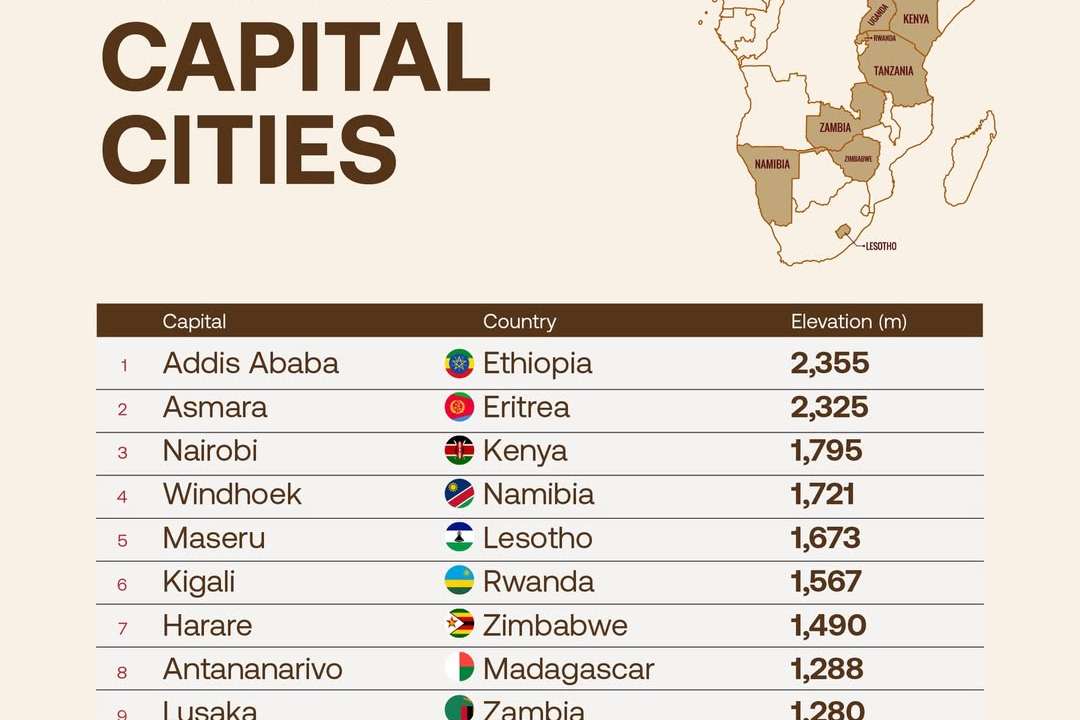
At the top sits Addis Ababa, Ethiopia’s capital, at 2,355 metres above sea level, followed closely by Asmara, Eritrea (2,325 metres). Both cities are located in the Horn of Africa’s highland region, an area defined by elevated plateaus and cooler temperatures compared with the surrounding lowlands.
According to data compiled from World Capitals, the top 10 highest capital cities in Africa are concentrated largely in eastern and southern Africa, where highland geography dominates.
Altitude plays a defining role in shaping these capitals.
RECOMMENDED FOR YOU

France split into three nearly equal populations shows how unevenly the country is settled
Cities such as Nairobi (1,795 metres) and Kigali (1,567 metres) benefit from relatively mild climates despite being near the equator. World Atlas notes that higher elevations often result in cooler temperatures, which can make cities more livable and reduce the spread of certain tropical diseases.
This partly explains why several colonial and post-independence administrations established capitals in elevated regions, a strategic choice for comfort and health.
The ranking is:
- Addis Ababa, Ethiopia — 2,355 m
- Asmara, Eritrea — 2,325 m
- Nairobi, Kenya — 1,795 m
- Kigali, Rwanda — 1,567 m
- Kampala, Uganda — 1,190 m
These cities sit within or near the East African Rift system, where geological activity has created high plateaus and mountainous terrain over millions of years.
Further south, Windhoek, Namibia (1,721 metres) and Maseru, Lesotho (1,673 metres) also feature prominently, reflecting southern Africa’s elevated interior plateau.
Elevation affects more than just weather.
High-altitude cities often face infrastructure challenges, including transport logistics, construction costs and water supply systems. Steep terrain can complicate road networks and urban expansion, particularly in rapidly growing cities like Kigali and Addis Ababa.
At the same time, these locations can offer advantages. Cooler climates can reduce energy demand for cooling, while scenic landscapes can support tourism and investment.
RECOMMENDED FOR YOU
Asia produces the largest share of global GDP
This story is written and edited by the Global South World team, you can contact us here.