Africa’s religious divide: Map reveals a Muslim north, a Christian south and one Hindu-majority state
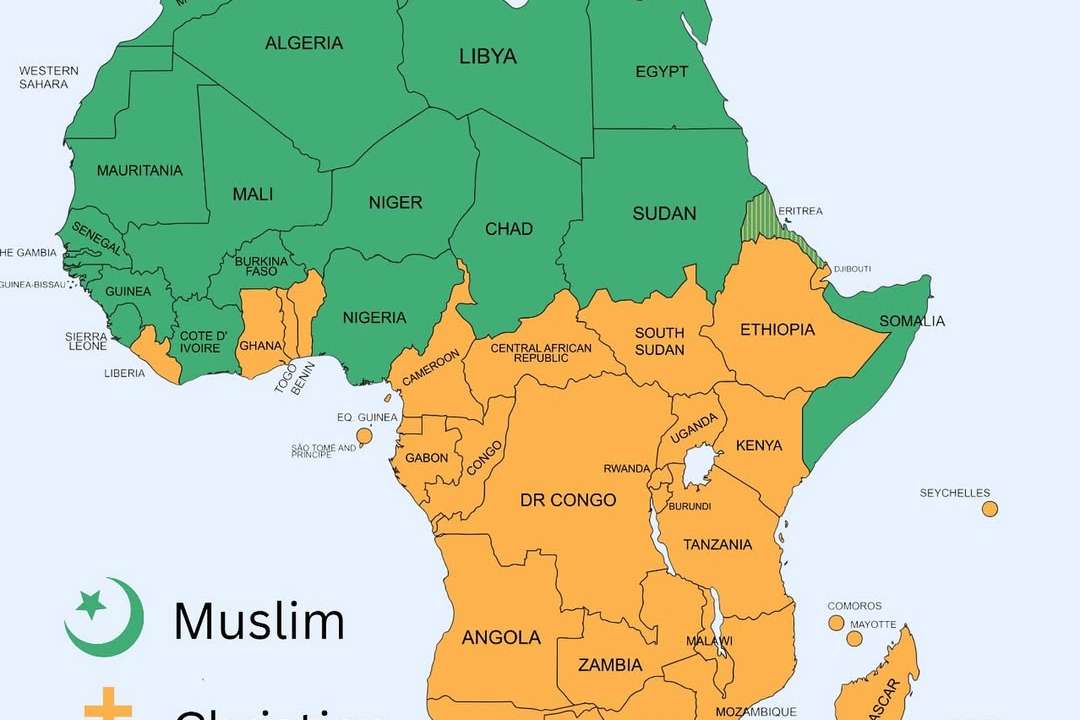
Across North Africa and parts of the Sahel, Islam dominates; most of central and southern Africa is majority Christian; and only Mauritius, an island in the Indian Ocean, is predominantly Hindu.
Islam first reached Africa in the seventh century when the Umayyad and Abbasid caliphates spread the faith across the northern edge of the continent. Over time, Muslim kingdoms and trans-Saharan trade networks entrenched Islam across North and West Africa.
Christianity arrived in parts of northeast Africa within a few centuries of Jesus’s death, but its rapid expansion in sub‑Saharan Africa occurred much later, during European colonial missions in the 15th century. Several countries lying between the two zones, including Nigeria, Cameroon and Sudan, now have large populations of both faiths.
In Nigeria’s case, a roughly 50‑50 split between Muslims and Christians means it hosts about 115 million Muslims – the largest absolute number in any African country. Mauritius stands out because Hindus make up about 47.9 % of its population, a legacy of indentured Indian labourers who were brought to work on sugar plantations during colonial times.
The Pew Research Centre notes that between 2010 and 2020, the population of sub‑Saharan Africa grew by 31 % to 1.1 billion. Christians now account for 62 % of the region’s population, while Muslims make up roughly one‑third; religiously unaffiliated people and followers of traditional African religions each represent about 3%.
In absolute terms, the number of Christians rose to 697 million (up 31 % from 2010) and Muslims to 369 million (up 34 %); Hindus numbered just over a million. Pew emphasises that Muslim‑majority countries cluster in the north, near the Middle East and North Africa, while Christian‑majority countries dominate the south.
This division is so pronounced that it appears within countries: Nigeria’s mostly Muslim northern states and Christian south share a porous frontier, and this north‑south fault line contributed to Sudan’s split into Sudan and South Sudan in 2011. By comparison, the Middle East–North Africa region is overwhelmingly Muslim—94 % of its 440 million people identify as Muslim and only about 3 % as Christian.
Some countries resist neat classification. In Eritrea, estimates of religious composition vary widely: some sources put the Christian share between 47 % and 63 % and the Muslim share between 37 % and 52 %.
A 2010 national health survey found 61.4 % Christian and 38.4 % Muslim, whereas the U.S. Commission on International Religious Freedom’s 2021 report described the population as split roughly in half.
Ethiopia also balances a large Muslim minority with a dominant Orthodox Christian tradition, and in Sudan, the Muslim‑dominated northern provinces separated from the mostly Christian south in 2011. Mozambique saw the region’s largest increase in Christian share over the past decade, while the Muslim share has increased in Benin.
This story is written and edited by the Global South World team, you can contact us here.