After 16 years of Orbán, Hungary votes for change as Magyar vows return to Europe
Hungarian Prime Minister Viktor Orbán has lost power after 16 years following a decisive election defeat, with more than 98% of votes counted in a result expected to have political implications beyond Hungary.
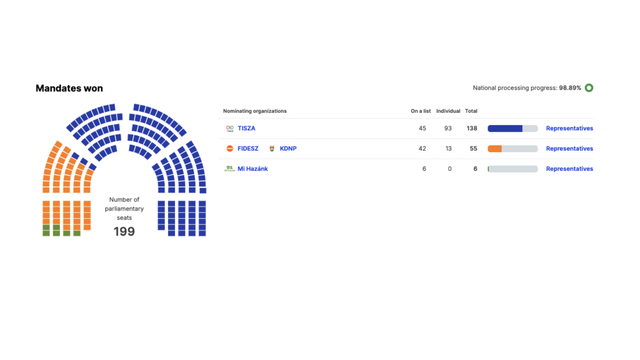
Near-final results from the National Election Office show that Orbán’s ruling Fidesz-KDNP alliance suffered a heavy loss in the 199-seat parliament, while opposition challenger Péter Magyar and his TISZA movement secured a commanding lead.
With 98.89% of the vote counted, TISZA won 138 seats, Fidesz-KDNP secured 55 seats, and Mi Hazánk obtained 6 seats.
The outcome marks a major political shift in Hungary, where Orbán had been one of Europe’s most controversial leaders. He was widely seen as the European Union’s most autocratic leader and maintained close ties with U.S. President Donald Trump and Russian President Vladimir Putin. His removal is expected to ease tensions within the EU, where officials have long accused him of undermining democratic systems and taking advantage of institutional weaknesses.
Orbán also faced criticism over his stance on Ukraine. He was accused of supporting actions that helped block €90 billion in European support to Ukraine, raising concerns among European leaders about Hungary’s role in the bloc.
RECOMMENDED FOR YOU
Six countries account for three-quarters of Europe’s unicorn startups
Despite endorsements from Trump and campaign support that included visits from U.S. Secretary of State Marco Rubio and Vice President JD Vance, the vote appeared to be driven mainly by domestic issues.
Voters were reported to be concerned about Hungary’s economic challenges, as well as allegations of corruption and cronyism linked to Orbán’s administration. The scale of the defeat indicated widespread dissatisfaction, as TISZA was projected to dominate both the national party-list vote and many individual constituencies.
In his speech to supporters, Magyar promised to return Hungary to the main fold of European politics, pledging a pro-European Union and pro-NATO direction for the country.
“My fellow citizens, Hungary will once again be a strong ally in the European Union and NATO. Hungary will once again be a strong ally representing Hungarian interests, because our country's place for a thousand years in Europe was, is, and will be. We will rebuild and strengthen, we will place it on new foundations and expand the cooperation of the Visegrad Four wherever possible,” he said.
The result sparked celebrations in Budapest, where tens of thousands of people took to the streets.

With a projected majority above the threshold required to govern alone, Magyar is expected to form the next government, ending Orbán’s long hold on power and signalling a shift in Hungary’s position within Europe.
This story is written and edited by the Global South World team, you can contact us here.
