Countries feeding the largest share of their population for free
- #US Military Cooperation
- #Campaign Funding
- #Political Reforms
- #Delcy Rodriguez
- #Emmanuel Macron
- #Grammy Awards
- #Viral Videos
- #Law Enforcement
- #El Monstruo
- #Extradition
- #Criminal Responsibility
- #Trump Board of Peace
- #Chagos
- #Economic Development
- #Airlines
- #Public Procurement
- #Italy
- #Mauritania
- #Davos
- #World Economic Forum
- #Visualized
- #World Visualized
- #US Military Cooperation
- #Campaign Funding
- #Political Reforms
- #Delcy Rodriguez
- #Emmanuel Macron
- #Grammy Awards
- #Viral Videos
- #Law Enforcement
- #El Monstruo
- #Extradition
- #Criminal Responsibility
- #Trump Board of Peace
- #Chagos
- #Economic Development
- #Airlines
- #Public Procurement
- #Italy
- #Mauritania
- #Davos
- #World Economic Forum
- #Visualized
- #World Visualized
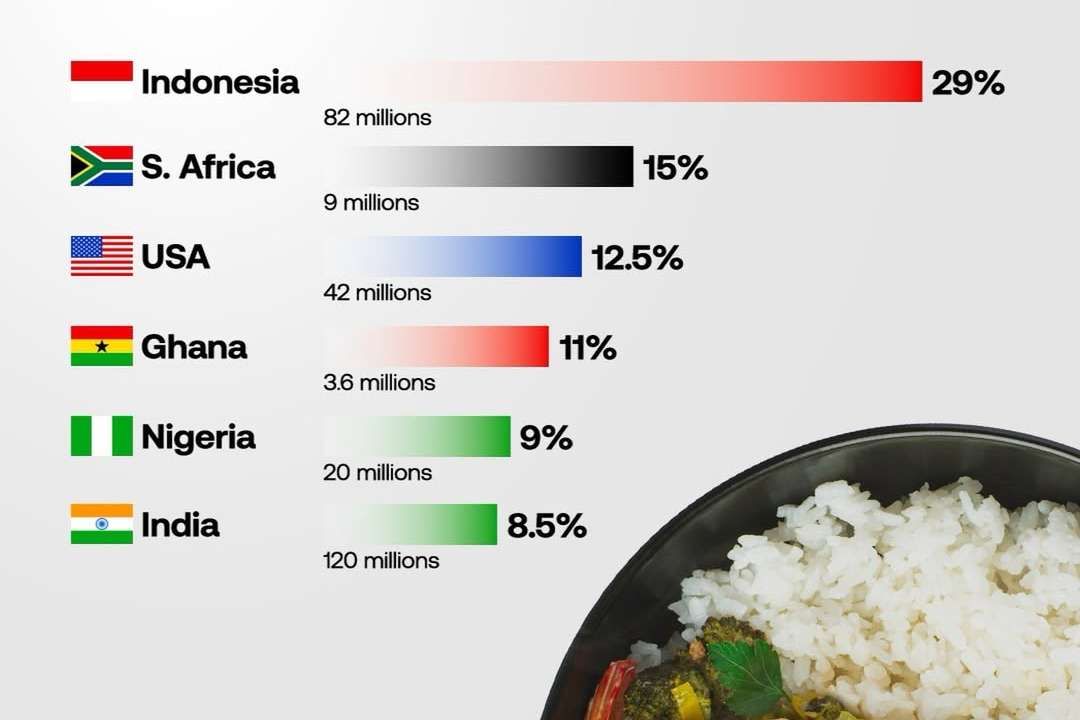
Across the world, millions of people rely on food assistance as a daily necessity beyond viewing it as s a temporary safety net.
Across the world, millions of people rely on food assistance as a daily necessity beyond viewing it as s a temporary safety net.
Countries and figures:
- Indonesia — 29% (82 million people)
- South Africa — 15% (9 million)
- United States — 12.5% (42 million)
- Ghana — 11% (3.6 million)
- Nigeria — 9% (20 million)
- India — 8.5% (120 million)
What this really means is that in some of the world’s most populous nations, a significant portion of citizens cannot consistently afford basic meals without external support.
The rise in free food programmes is being driven by a combination of inflation, unemployment, conflict, and widening inequality.
According to Pew Research, economic hardship has become a growing concern globally, with more people reporting difficulty meeting basic living costs, including food. Pew’s surveys repeatedly show that affordability and economic insecurity are shaping everyday life in both developing and wealthy nations.
Indonesia: The largest beneficiaries
Indonesia tops the list, with nearly one-third of its population reportedly receiving food support.
The country has expanded large-scale food subsidy and school feeding initiatives to reduce poverty and protect vulnerable households from rising prices.
Newsweek has reported that countries across Asia are increasingly relying on mass food distribution systems as governments try to prevent hunger from escalating into political instability.
Nigeria
Nigeria’s position on the list is deeply linked to its worsening food insecurity. Tribune Online Nigeria has published repeated reports on the country’s hunger emergency, pointing to soaring food prices, insecurity in farming communities, and the increasing number of households skipping meals.
The paper has highlighted how food relief and community feeding programmes are now essential in many regions.
With an estimated 20 million Nigerians benefiting from free food support, the country is facing one of the most serious cost-of-living crises in its recent history.
This story is written and edited by the Global South World team, you can contact us here.