Countries with the highest percentages of Christians and Muslims
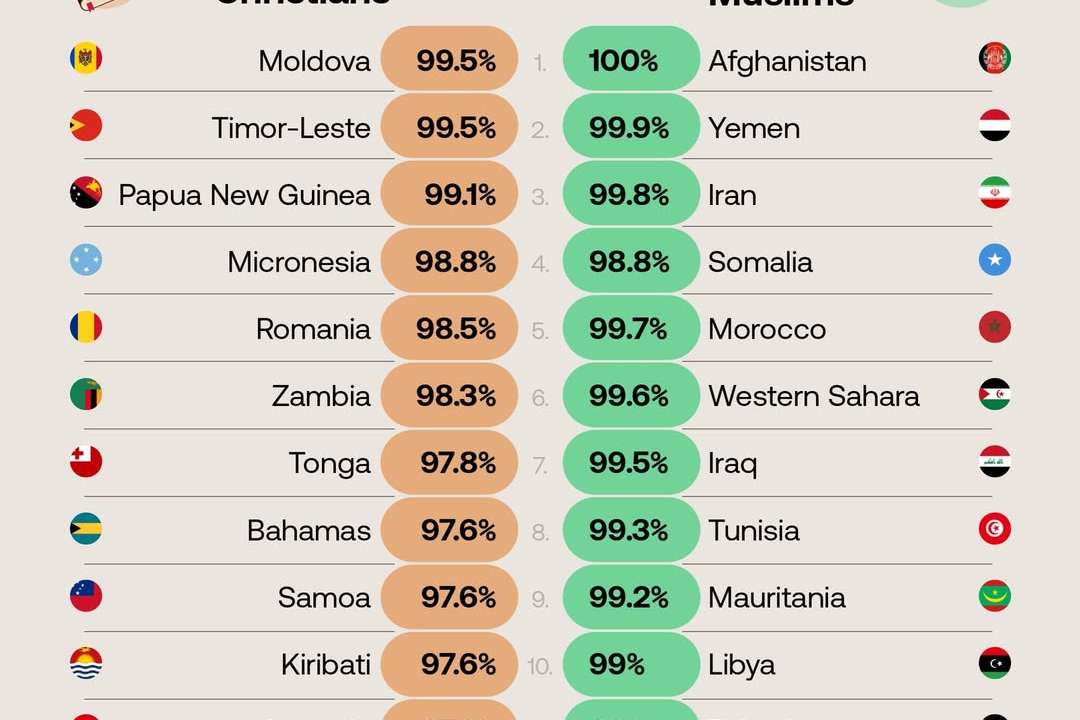
New demographic data highlights just how concentrated religious identity is in some parts of the world. According to figures compiled by World Population Review and the Pew Research Centre, a small number of countries have populations that are overwhelmingly Christian or Muslim, often exceeding 97–99% adherence to a single faith.
New demographic data highlights just how concentrated religious identity is in some parts of the world. According to figures compiled by World Population Review and the Pew Research Centre, a small number of countries have populations that are overwhelmingly Christian or Muslim, often exceeding 97–99% adherence to a single faith.
The world’s most Christian-majority countries
Several countries top the list for having the highest percentage of Christians. Moldova and Timor-Leste lead with around 99.5% of their populations identifying as Christian. In Moldova, Eastern Orthodox Christianity is closely tied to national identity, while Timor-Leste’s Catholic majority reflects Portuguese colonial history and the role of the Church during the country’s independence struggle.
Other countries with extremely high Christian populations include Papua New Guinea, Micronesia, Romania, Zambia, Tonga, the Bahamas, Samoa, Kiribati, Armenia, and Lesotho, all above 97%.
Pew Research notes that many Pacific island nations became predominantly Christian through missionary activity in the 19th and early 20th centuries, while countries such as Armenia and Romania have deep historical Christian roots dating back more than a millennium.
The most Muslim-majority countries
On the Muslim side, Afghanistan stands out with a population that is effectively 100% Muslim, according to World Population Review estimates. Close behind are Yemen, Iran, Somalia, Morocco, Iraq, Tunisia, Mauritania, Libya, Palestine, and Sudan, all with Muslim populations between 98.9% and 99.9%.
Pew Research explains that in many of these countries, Islam has been the dominant religion for centuries, reinforced by shared language, culture, and legal systems. In some cases, such as Iran and Afghanistan, religious identity is also closely tied to governance and national law, contributing to the very high level of religious uniformity.
While Christianity and Islam remain the world’s two largest religions globally, these rankings show that their influence is not evenly spread. Instead, it is highly concentrated in specific regions, and that is Christianity in parts of Europe, Africa, and the Pacific, and Islam across North Africa, the Middle East, and parts of Central and South Asia.
This story is written and edited by the Global South World team, you can contact us here.