Countries with the largest Buddhist populations in 2025
The world has slowly grown to pay attention to only two religions: Christianity and Islam. These two religions have 2.3 billion and 1.9 billion followers, respectively, globally.
Yet, the Buddhist population seems to be catching up quickly. The religion boasts a global population of about 500 million followers and it's the fourth largest religion in the world.
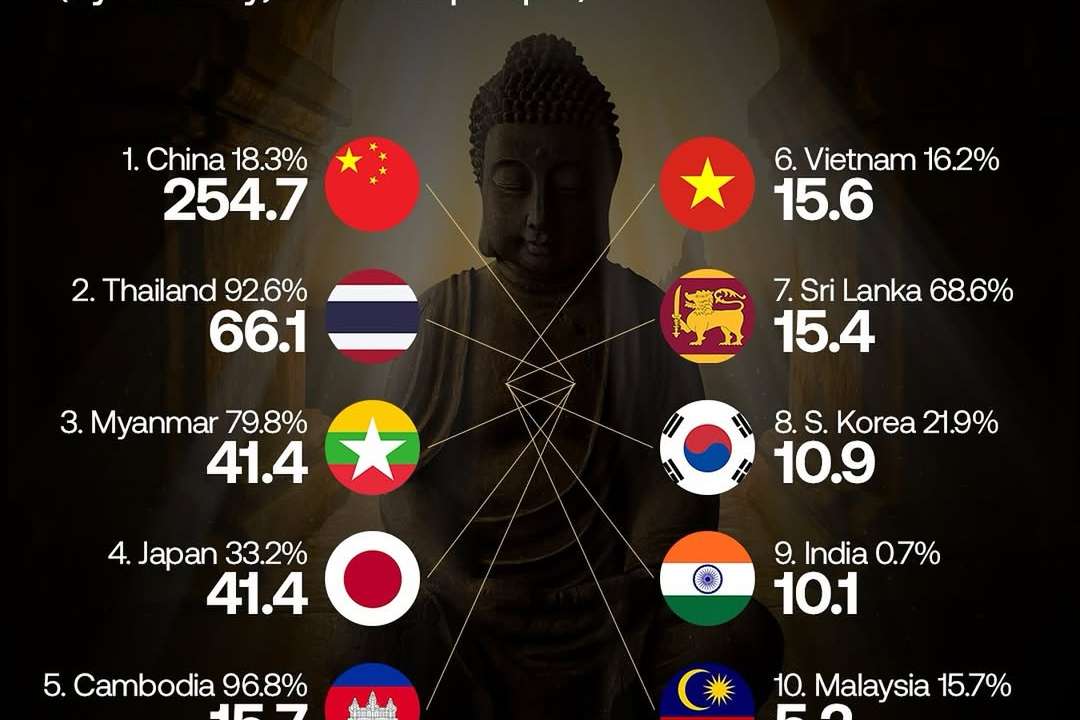
China ranks number 1 in total number of Buddhists — over 254 million — which represents only 18.3% of its population. This is due to China’s vast population base and the presence of many other religious and philosophical traditions, including Taoism, Confucianism, Christianity, and Islam.
Nonetheless, China is home to a rich history of Mahayana Buddhism, which deeply influences its temples, art, and monastic practices.
In contrast, Thailand (66.1 million, 92.6%) and Cambodia (15.7 million, 96.8%) rank as the most intensely Buddhist societies in the world by proportion.
In these nations, Theravāda Buddhism is not just a religion — it's a central part of national identity, education, and daily life. Monastic life remains highly respected, and many young men enter monasteries temporarily as a rite of passage.
Japan (41.4 million Buddhists) and South Korea (10.9 million) reflect a more syncretic approach. In both countries, Buddhism coexists with Shintoism (in Japan) and Christianity (in Korea). Many individuals participate in Buddhist rituals while identifying culturally rather than exclusively religiously.
Though Buddhism originated in India in the 6th century BCE, it now accounts for just 0.7% of India’s population. Still, India remains spiritually significant, home to sacred pilgrimage sites such as Bodh Gaya, Sarnath, and Kushinagar. The modern resurgence of Buddhism in India has been driven in part by the Dalit Buddhist movement, influenced by Dr. B.R. Ambedkar.
This story is written and edited by the Global South World team, you can contact us here.