Djibouti votes, but power doesn’t shift: What’s really at stake in the 2026 election?
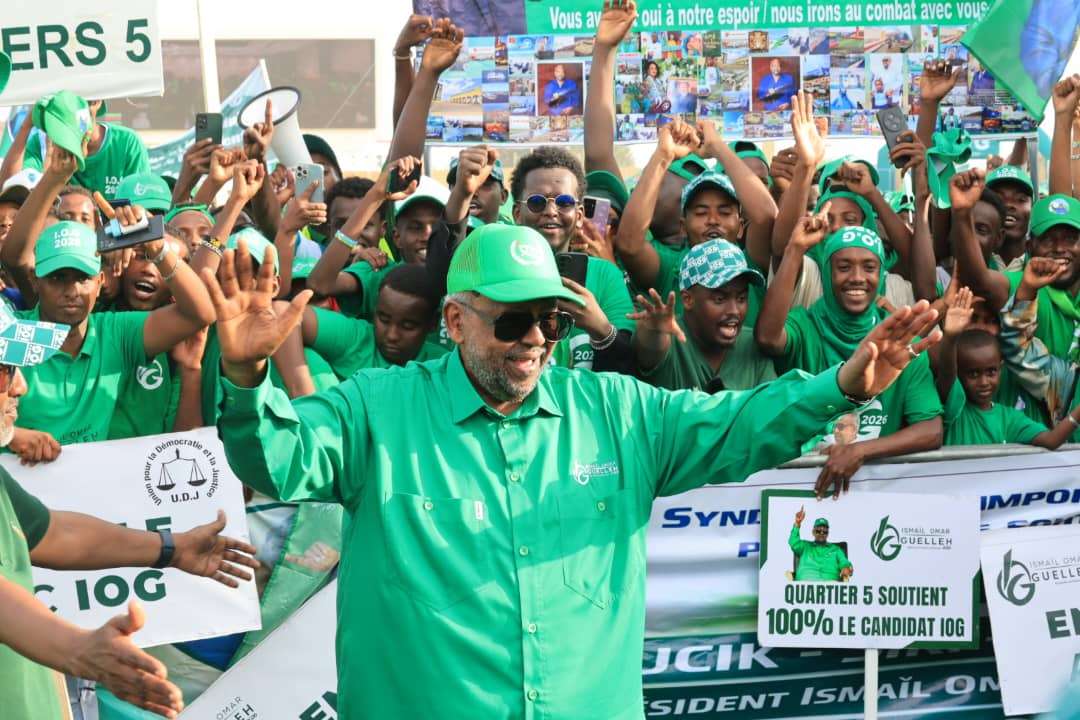
Djibouti heads to the polls on Friday, April 10, 2026, but few observers expect surprises.
At the centre is President Ismaïl Omar Guelleh, widely known as “IOG”, who has ruled Djibouti since 1999 after succeeding his uncle, Hassan Gouled Aptidon, the country’s first president. If re-elected, Guelleh would extend his tenure to nearly three decades in power.
His dominance is backed by the ruling party, the People’s Rally for Progress (RPP), which leads the broader governing coalition, the Union for the Presidential Majority (UMP).
A 2010 constitutional amendment removed presidential term limits, allowing Guelleh to run indefinitely. More recently, in 2025, Djibouti’s parliament eliminated the 75-year age cap for presidential candidates, a move widely interpreted as designed to ensure Guelleh, now 78, could stand again.
The electoral field itself underscores the imbalance. In previous elections, Guelleh has secured overwhelming victories, including 87% of the vote in 2016 and over 97% in 2021, figures that international observers and opposition groups have questioned.
RECOMMENDED FOR YOU
Six countries account for three-quarters of Europe’s unicorn startups
Who is contesting IOG?
Mohamed Farah Samatar stands as the sole challenger to President Guelleh, though his candidacy carries its own complexities. A former insider of the ruling establishment, he is now contesting the presidency under the banner of the Unified Democratic Centre (CDU).
During the lead-up to the votes, Samatar took his campaign to the Tadjourah and Obock regions, where he addressed supporters and attempted to project an alternative vision for the country, insisting that “another Djibouti is possible”.
Even so, analysts remain sceptical about the broader significance of the race. Sonia Le Gouriellec, a specialist on the Horn of Africa at Lille Catholic University, told AFP: “There’s not much at stake. It’s just a token competition.”
Criticism has been sharper from civil society. Omar Ali Ewado, who leads the Djibouti League of Human Rights (LDDH), dismissed the process outright, describing the vote as a “masquerade” and a “foregone conclusion”.
This context shapes the core issue about how the election is unlikely to produce political change, but it may intensify uncertainty about what comes next.
Who can vote?
Roughly 243,000 voters are registered for Djibouti’s 2026 presidential election, according to data from the International Foundation for Electoral Systems, out of a national population estimated at just over one million.
RECOMMENDED FOR YOU
Malaria surge in Sudan’s Khartoum as millions return home
That marks a modest increase from the around 215,000 registered voters in 2021, pointing to a gradual expansion in the electoral roll, though still representing only about a quarter of the population.
Historically, turnout has been relatively strong on paper, averaging close to 67%, though critics argue these figures should be viewed in the context of limited political competition.
Polling stations are expected to open in the morning and close later in the day, after which counting is expected to begin.
Despite being labelled an “electoral autocracy” by international monitors, Djibouti is hosting a regional observer mission from the Intergovernmental Authority on Development (IGAD), with 17 observers from Ethiopia, Kenya, Somalia, South Sudan and Uganda deployed nationwide.
The bloc is expected to release its initial assessment after the vote, followed by a formal statement on 12 April.
What is at stake?
Djibouti’s location along the Bab el-Mandeb Strait places it at the crossroads of global commerce. Estimates suggest that around 12–15% of global trade and a significant share of oil shipments pass through this narrow waterway connecting the Red Sea to the Gulf of Aden. The country has leveraged this position to build an economy centred on logistics, ports, and foreign military partnerships.
The Port of Doraleh, one of the most important infrastructure assets in the region, serves as a critical hub for shipping and for landlocked Ethiopia, which relies on Djibouti for roughly 90–95% of its imports and exports. Revenues from port operations, logistics services, and foreign base leases form a substantial part of Djibouti’s national income.
RECOMMENDED FOR YOU
Norway has Europe’s highest petrol prices, Russia and Belarus remain cheapest
This strategic value has attracted a concentration of global military presence rarely seen in such a small state.
Djibouti hosts:
- The United States’ Camp Lemonnier, its only permanent military base in Africa, with around 4,000 personnel
- China’s first overseas military base, established in 2017
- Long-standing French military installations
- Additional facilities used by Japan and Italy
Additionally, although Djibouti has invested heavily in infrastructure, including rail links and port expansion projects often financed through external borrowing, concerns persist about public debt levels, which have at times exceeded 70% of GDP, much of it linked to Chinese-funded projects.
Youth unemployment remains high, and the benefits of growth have not been evenly distributed, contributing to underlying social discontent.
This story is written and edited by the Global South World team, you can contact us here.