Duterte’s drug war targeted the poor in the Philippines, ICC told
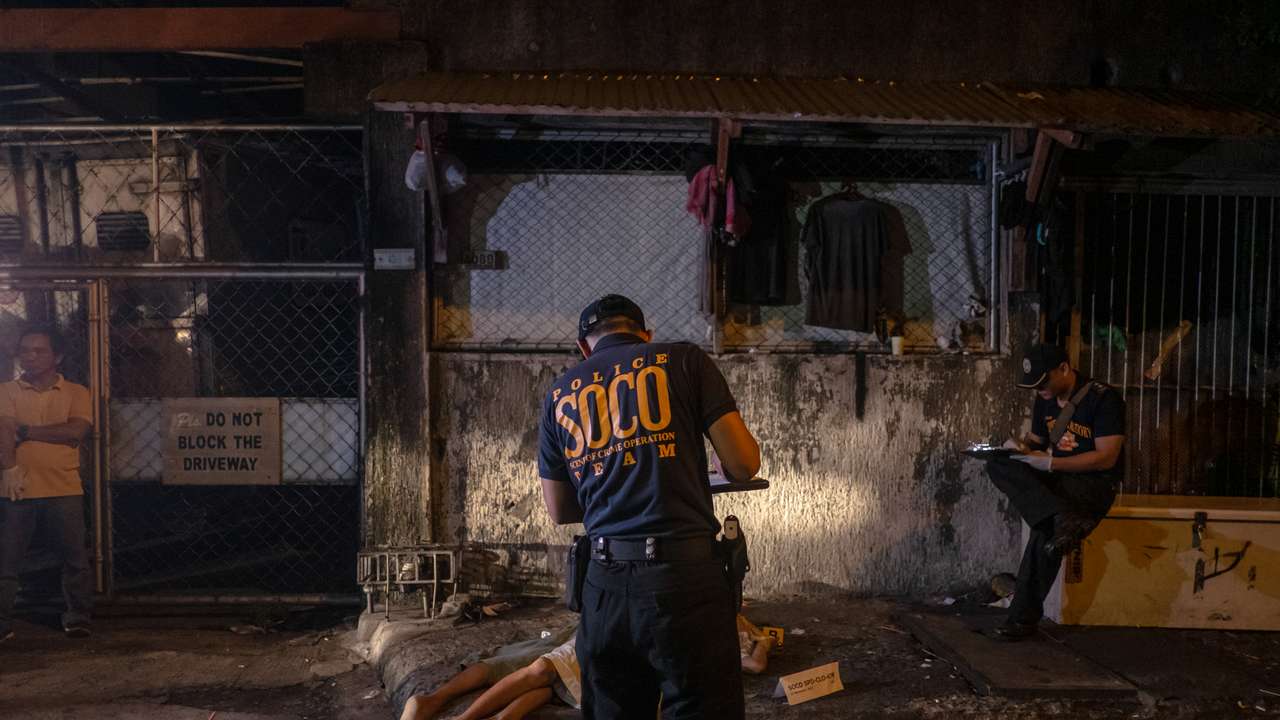
“It’s an illegal war on drugs. It’s an illegal war on the poor.”
This message greets customers at a coffee shop in Metro Manila, the Philippines’ capital region, which for six years until 2022 bore the brunt of a deadly anti-drug campaign launched by then-president Rodrigo Duterte, who now faces allegations of crimes against humanity before the International Criminal Court (ICC).
This assessment was echoed on Tuesday in The Hague, where an ICC official described the campaign as disproportionately targeting society’s most marginalised.
“Duterte’s response was a selective, violent crackdown on the most vulnerable,” said Paolina Massidda, principal counsel at the ICC Office of Public Counsel for Victims.
“Rather than addressing the root causes of drug addiction, such as poverty, lack of education, unemployment, and inequality, the Duterte administration framed the issue as a criminal one, focusing on punitive over social responses,” Massidda added.
RECOMMENDED FOR YOU
‘Brazil is nobody’s backyard’ - Lula challenges US influence at UN
Human rights organisations estimate that more than 30,000 people may have been killed during the drug war — far higher than official police figures of more than 7,000 deaths.
Victims were overwhelmingly men from poor urban communities, many of whom were unemployed or reliant on informal work.
Among those left behind is Cheryl (not her real name), whose live-in partner was killed during a police anti-drug operation in Payatas, Quezon City, in 2017. His death abruptly left her family without its main source of income.
Cheryl said that while grief was overwhelming, economic necessity quickly took precedence.
“Unang tanong ko noon, ‘Paano na kami?’ Siya ‘yung source of income. May anak kaming nagsisimula pa lang mag-aral,” Cheryl said.
(My first question then was, ‘What will happen to us?’ He was our source of income. Our child was just starting school.)
She now works as a barista at Silingan Coffee, a café in Metro Manila that employs relatives of drug war victims and provides a space for them to share their experiences with the public.
Another employee, Sharon Angeles, lost her brother during the early years of the campaign. He was 20 years old.
RECOMMENDED FOR YOU
Gold mining resumes near Central African Republic border after deadly landslide
“Wala talaga siyang kinalaman sa droga,” Sharon said, citing an autopsy that found no evidence of drug use. “Nag-iisa pa naming lalaki ‘yon.”
(He really had nothing to do with drugs. He was our family’s only son.)
Despite the scale of the killings, only a small number of cases have resulted in convictions, most involving low-ranking police officers. Families of victims have long criticised domestic investigations as inadequate and biased in favour of security forces.
“Habang may buhay, may pag-asa. [Pero] ‘yung sasabihin nilang may hustisya? Sa aming mahihirap? Walang hustisya – sa mayayaman lang ‘yun,” Sharon said.
(As long as there is life, there is hope. But when they talk about justice—for us poor people? There is no justice. That is only for the rich.)
At the ICC, prosecutors have repeatedly cited Duterte’s public statements encouraging police to kill suspected drug users and dealers as potential evidence of responsibility at the highest level of government.
Although Duterte withdrew the Philippines from the ICC during his term, the court maintains jurisdiction over alleged crimes committed while the country was still a member.
Duterte has denied any wrongdoing and has maintained that the ICC has no jurisdiction over him.
RECOMMENDED FOR YOU
Goita pledges stronger military and domestic-led growth as Mali marks independence
But for families like Cheryl’s and Sharon’s, the ICC investigation represents a rare opportunity for accountability beyond the Philippine institutions they say have failed them.
“Sa bibig niya mismo nanggaling na magpupursigi talaga siya dyan sa war on drugs,” Cheryl said. “Ebidensya na ‘yon.”
(It came directly from his own mouth that he would persist with the war on drugs. That is already evidence.)
NOTE: Quotes in the story were originally reported through an interview conducted in 2023 with family members of drug war victims in the Philippines. They have been edited for clarity, length, and timeliness as the ICC conducts the confirmation of charges hearing for Duterte.
This story is written and edited by the Global South World team, you can contact us here.