Former Latin American presidents in jail
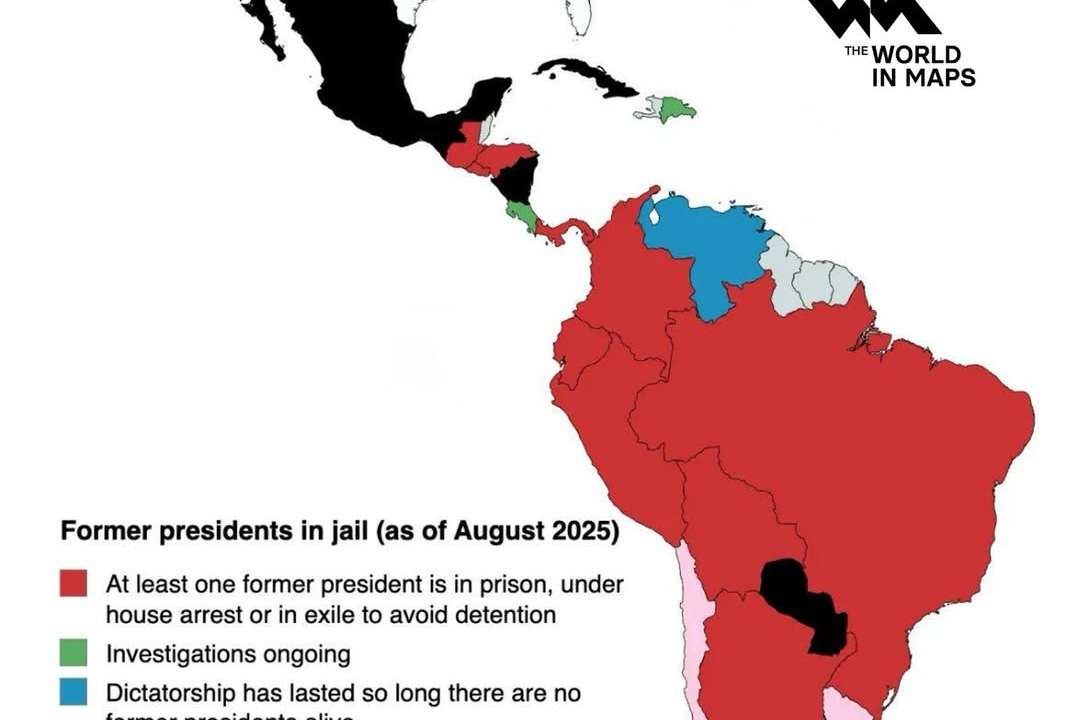
A striking map published by The World in Maps paints a sobering picture of Latin America’s political landscape. As of August 2025, many countries across the region have at least one former president behind bars, under house arrest or living in exile to avoid detention.
The pattern, which inspired the map, underscores how corruption and abuse of power have become endemic at the highest levels of government – and how judicial systems and foreign courts are now holding former leaders to account.
Peru: a parade of former leaders in prison
No country illustrates this trend better than Peru. In August 2025, the Peruvian judiciary ordered preventive detention for former president Martín Vizcarra, making Peru the only country where all living former presidents faced detention or legal restrictions simultaneously. Vizcarra was sent to Lima’s Barbadillo prison to await trial on corruption charges connected to his time as a regional governor.
He joined a roster of predecessors: Pedro Castillo (accused of corruption and attempting a coup), Alejandro Toledo (serving a 20‑year sentence for collusion and money‑laundering tied to Brazilian conglomerate Odebrecht), Ollanta Humala (jailed for illicit campaign contributions) and the now‑deceased Alberto Fujimori, who had served more than 15 years of a 25‑year sentence for human‑rights abuses before being freed on humanitarian grounds.
Another ex‑president, Pedro Pablo Kuczynski, was placed under house arrest for money laundering but remains barred from leaving the country. The case of Alan García – who shot himself in 2019 as police arrived to arrest him – illustrates the stakes of Peru’s anti‑corruption drive.
Brazil and Bolivia: corruption verdicts reach the top
In Brazil, the Supreme Court has shown that even a long‑retired leader can face prison. In April 2025, police arrested former president Fernando Collor de Mello after Justice Alexandre de Moraes ordered him to begin serving an eight‑year and 10‑month sentence for corruption and money laundering.
Collor – Brazil’s first directly elected president after the 1964–85 dictatorship – was convicted of taking roughly 20 million reais (US$5.3 million) in bribes from a Petrobras subsidiary. His case underscores the depth of Brazil’s Car Wash scandal and makes him one of four of Brazil’s seven post‑dictatorship presidents to be convicted, jailed or impeached.
Bolivia has taken a similar stance. Former interim president Jeanine Áñez, who seized power after the 2019 crisis that forced Evo Morales to resign, was found guilty of making “decisions contrary to the constitution” and sentenced in June 2022 to ten years in prison.
She has been detained since March 2021 and followed the proceedings from her cell. The verdict, which also jailed former military commanders, remains controversial but signals Bolivia’s willingness to prosecute leaders who violate constitutional order.
Central America: fraud, drug trafficking and exile
In Guatemala, former president Otto Pérez Molina and former vice president Roxana Baldetti were convicted in December 2022 of racketeering and fraud for running a customs bribery network known as “La Línea”.
A court sentenced both to 16 years in prison, and they remain under investigation in other corruption cases. Their convictions were hailed as a high point for the now‑dismantled UN‑backed anti‑corruption commission.
Honduras made headlines in June 2024 when a US federal judge sentenced former president Juan Orlando Hernández to 45 years in prison for enabling drug traffickers to use Honduran security forces to ship cocaine to the United States.
Hernández, who served two terms and was once a close US ally, was extradited shortly after leaving office in 2022; his conviction marked the first time since Panama’s Manuel Noriega that a former head of state was convicted of drug trafficking in the US.