From fire Temples to Mosques: Iran’s religious transformation
Key Takeaways
Iran’s transition from Zoroastrianism to Islam began in the seventh century following the Arab Muslim conquest of the Sassanian Empire. Over centuries, political change, economic incentives and cultural adaptation reshaped the country’s religious identity. The later rise of Shia Islam under the Safavid dynasty further defined modern Iran’s religious and political structure.
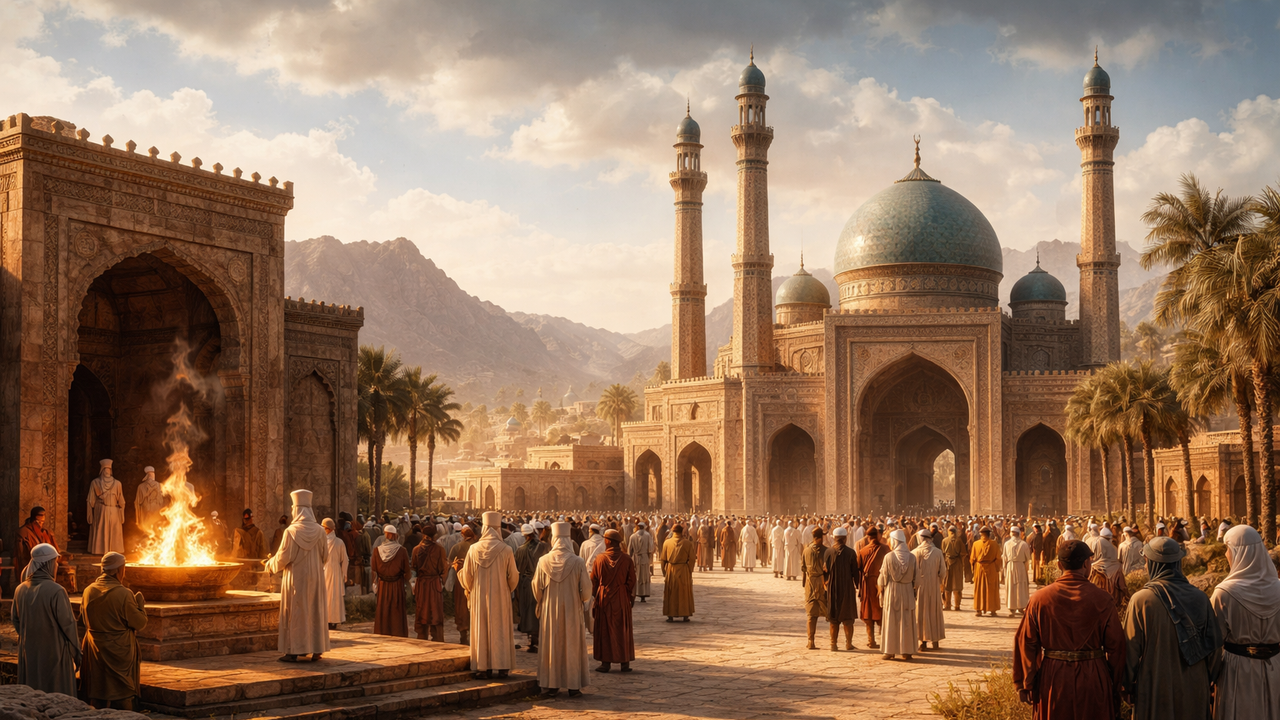
How the Arab conquest and later dynasties reshaped belief, politics and identity in Iran
Iran’s shift from Zoroastrianism to Islam was a long historical process shaped by conquest, governance and social change. This transformation began in the seventh century and continued for centuries as religious institutions and political power realigned.
Zoroastrianism under the Sassanian Empire
Before Islam, Zoroastrianism was the main religion of Persia, especially under the Sassanian Empire (224–651 CE). This belief system, founded by the prophet Zoroaster (popularly known as Zarathustra), focused on the worship of Ahura Mazda and the moral struggle between truth and falsehood. Zoroastrian clergy had significant influence in state affairs, and fire temples served as central places of worship. Other religious communities, including Christians and Jews, lived within the empire.
The Arab Muslim Conquest
The decisive change came in the seventh century, when Arab Muslim forces expanded out of the Arabian Peninsula. According to World History Edu, between 633 and 651 CE, these armies defeated the Sassanian Empire in key battles and brought Persia under the control of the early Islamic Caliphate. The last Sassanian ruler, Yazdegerd III, was killed in 651 CE, ending imperial control. After the conquest, Persia became part of the Islamic world and Zoroastrians were classified as People of the Book, permitted to practise their religion in exchange for paying the jizya tax.
Gradual Conversion to Islam
Conversion to Islam took place over many centuries. It was influenced by social, economic and administrative factors. Muslims did not pay the jizya tax, which acted as an incentive for some to adopt the new faith. Arabic became the language of governance under the Umayyad and Abbasid caliphates, and participation in political and administrative structures often required integration into Islamic society. Over time, intermarriage, trade and education helped spread Islam widely. Persian scholars made significant contributions to Islamic science, philosophy and literature. At the same time, Persian language and cultural traditions continued, with Persian increasingly used in written form using the Arabic script.
RECOMMENDED FOR YOU
Where American forces are stationed in 2026
The Establishment of Shia Islam
Although early Islam in Iran was largely Sunni, a major religious shift occurred in the sixteenth century. The Safavid dynasty, which came to power in 1501, made Twelver Shia Islam the official religion of the state. The Safavids promoted Shia institutions and scholarship and, over three centuries, transformed Iran into a predominantly Shia nation. This marked a significant distinction from many neighbouring regions where Sunni Islam remained dominant.
Cultural Continuity and Change
Despite the religious shift, many elements of pre-Islamic Persian culture endured. Traditions such as Nowruz continued under Islamic rule, reflecting continuity in cultural practices. Persian literature, art and administrative systems adapted to the context of Islamic governance, preserving aspects of earlier heritage within the broader Islamic framework.
The Name Persia and the Emergence of Iran
The region now known as Iran was called Persia by outsiders for centuries. Internally, the people referred to their land with names related to Iran, meaning “Land of the Aryans,” a term used since at least the Sassanian period. The name Persia came from the Greek term for the region of Parsa, but the people of the land used variants of Iran in their own languages. In 1935, under Reza Shah Pahlavi, the government formally requested that foreign nations use the name Iran in official correspondence. This reflected the country’s historical identity and internal preference for the name.
Modern Identity
Today, Iran’s religious identity is shaped by centuries of history. The Islamic Republic, established in 1979, institutionalises Shia Islam in the state structure. This religious foundation interacts with cultural recall of pre-Islamic heritage, illustrating the complex evolution of belief and identity in the country formerly known as Persia.
This story is written and edited by the Global South World team, you can contact us here.