G20 Growth Outlook for 2026: Emerging economies set to outpace the West, IMF forecast shows
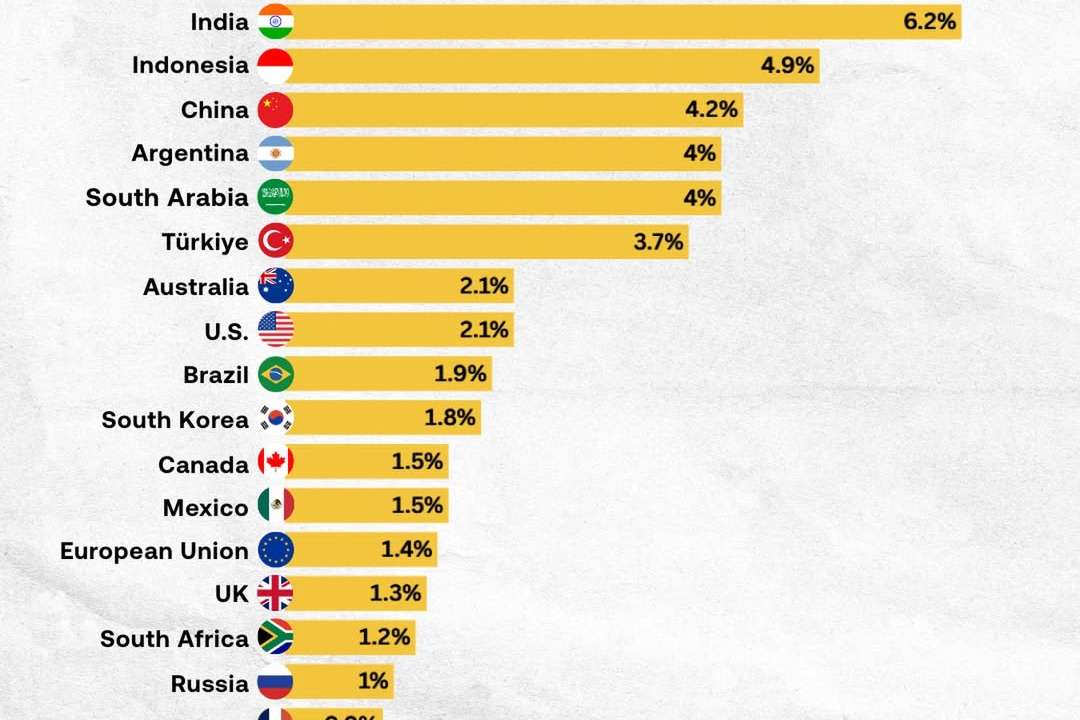
The global economic recovery is set to remain uneven in 2026, with emerging economies driving growth while much of the developed world continues to slow.
The global economic recovery is set to remain uneven in 2026, with emerging economies driving growth while much of the developed world continues to slow.
That is the central message from the International Monetary Fund’s latest World Economic Outlook, which projects wide disparities in GDP growth across G20 economies this year.
A visual ranking of projected annual real GDP growth rates places India firmly at the top, followed by Indonesia and China, while major advanced economies such as Japan, Germany, and Italy sit at the bottom of the table.
India Leads the G20 Growth Rankings
India is forecast to grow by 6.2% in 2026, making it the fastest-growing economy in the G20. The IMF attributes this momentum to strong domestic demand, sustained public investment, and the country’s expanding manufacturing and services sectors.
RECOMMENDED FOR YOU
Six countries account for three-quarters of Europe’s unicorn startups
Indonesia follows with a projected growth of 4.9%, reinforcing Southeast Asia’s role as a key engine of global expansion. China, despite ongoing structural challenges and a cooling property sector, is still expected to post a solid 4.2% growth rate, keeping it among the top performers.
Argentina and Saudi Arabia are both projected to grow by 4%, reflecting commodity-linked recoveries and policy adjustments aimed at stabilising their economies.
Middle performers: Growth, but at a slower pace
Türkiye is forecast to grow by 3.7%, supported by consumption and post-election economic recalibration. Australia and the United States are both expected to expand by 2.1%, signalling resilience but also highlighting the limits imposed by tight monetary policy and cooling labour markets.
Brazil’s growth is projected at 1.9%, while South Korea is expected to record 1.8%. Canada and Mexico are both forecast at 1.5%, closely tied to trends in US demand and trade conditions.
Europe and Japan lag behind
The outlook is notably weaker for much of Europe. The European Union as a bloc is projected to grow by just 1.4%, with the UK slightly lower at 1.3%. France and Germany are both forecast at 0.9%, while Italy trails at 0.8%.
Japan sits at the bottom of the G20 rankings, with growth projected at just 0.6%. Ageing demographics, weak productivity growth, and persistent inflationary pressures continue to weigh on the country’s economic prospects.
Russia is projected to grow by 1%, reflecting ongoing geopolitical pressures and structural constraints.
RECOMMENDED FOR YOU

Olympic flame arrives on African soil for first time as Senegal begins Dakar 2026 countdown