Global dairy titans: Who tops the billion dollar league in 2025?
The global dairy industry is entering a defining moment. According to the latest Rabobank Global Dairy Top 20 report, growth across the world’s largest dairy producers has slowed to a near standstill, reflecting the combined pressure of lower milk prices, shifting consumer habits, and rising environmental demands.
Yet amid these challenges, one truth remains unchanged: Lactalis still reigns as the world’s largest dairy company.
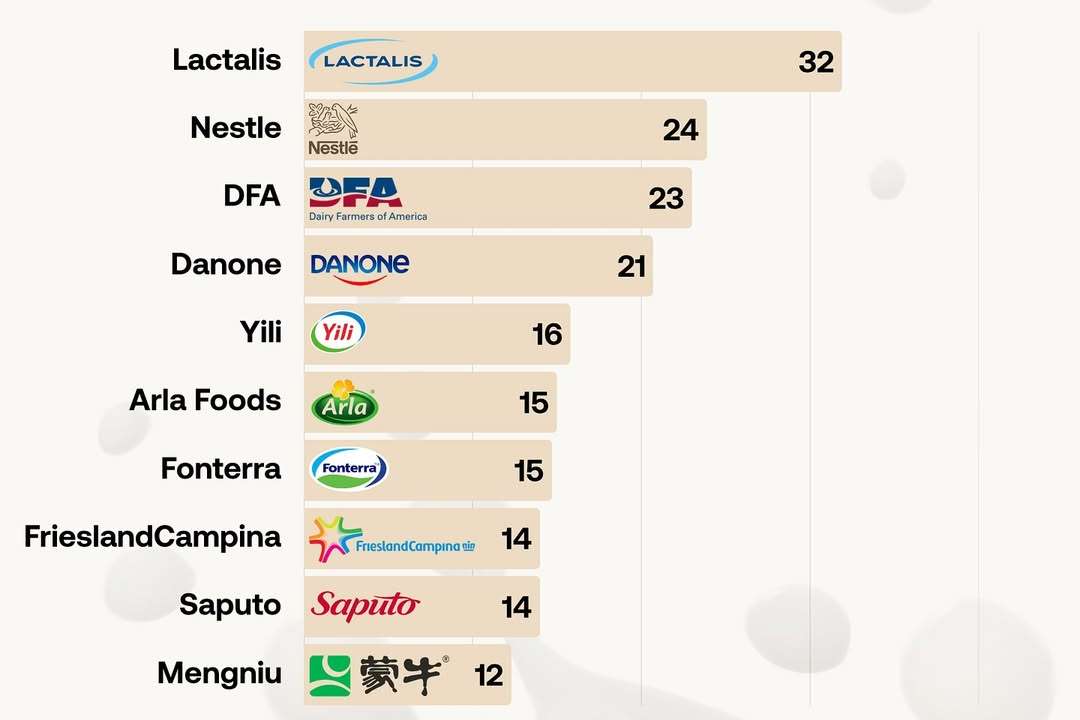
With estimated dairy revenues of $32 billion, the French-based Lactalis group leads the global pack, followed by Nestlé at $24 billion, Dairy Farmers of America (DFA) at $23 billion, and Danone with $21 billion.
Rounding out the top ten are Yili, Arla Foods, Fonterra, FrieslandCampina, Saputo, and Mengniu, whose revenues range between $12 billion and $16 billion. The ranking, visualised in the World Visualized chart, highlights the immense scale of these dairy powerhouses, but also reveals an industry facing a new era of strategic and structural change.
Rabobank’s analysts note that in 2024, the combined turnover of the Top 20 dairy firms rose by only 0.3% in U.S. dollar terms, compared with an 8.1% increase the year before. The slowdown stems largely from weaker commodity milk prices and volatile currency movements, especially between the euro and the U.S. dollar, which have eroded European revenue figures. Rabobank’s full analysis predicts only modest growth through 2025, unless a wave of mergers and acquisitions reshapes the competitive field.
That reshuffling may be closer than it appears. Rabobank’s forward outlook suggests “subtle shifts” in 2025, but a potential shake-up in 2026. Consolidation pressures are mounting as companies seek to achieve scale and resilience in the face of rising costs and sustainability obligations.
Lactalis, for instance, recently signed a landmark deal to acquire many of Fonterra’s consumer brands — including Anchor, Mainland, and Fernleaf — along with several processing sites in Oceania, Asia, and the Middle East. The move not only strengthens Lactalis’s southern hemisphere reach but also marks a strategic pivot for Fonterra, which is turning its focus toward B2B ingredients and nutrition.
Meanwhile, Rabobank hints at possible future combinations, such as FrieslandCampina merging with Milcobel, or Arla Foods joining forces with DMK in Germany. Even legacy players like Unilever may exit the ranking altogether, as it considers divesting its ice cream business —a move that could open space for newer dairy-focused entrants, such as Emmi or Magnum.
Beyond corporate manoeuvring, the industry’s fundamentals are being tested by a mix of climate, policy, and consumer trends. The Rabobank Global Dairy Quarterly (Q3 2025) report highlights rising milk production in key export regions, which could push global prices down later this year. Farmgate milk prices have surged, up 27% in New Zealand and 18% in Europe, but supply growth is expected to peak in the second half of 2025 before easing in 2026.
At the same time, sustainability pressures are reshaping corporate behaviour. Nestlé recently made headlines by withdrawing from the Dairy Methane Action Alliance, citing a shift in strategy while reaffirming its long-term net-zero goals. Climate-related disruptions are also taking their toll.
A Guardian investigation revealed that even a single hour of extreme heat above 26 °C can reduce a cow’s milk output by half a percent per day, with compounding effects in prolonged heatwaves, a pattern that could cut global dairy supply by 4% by mid-century.
This story is written and edited by the Global South World team, you can contact us here.