Global forest crisis: Laos leads in tree-cover loss
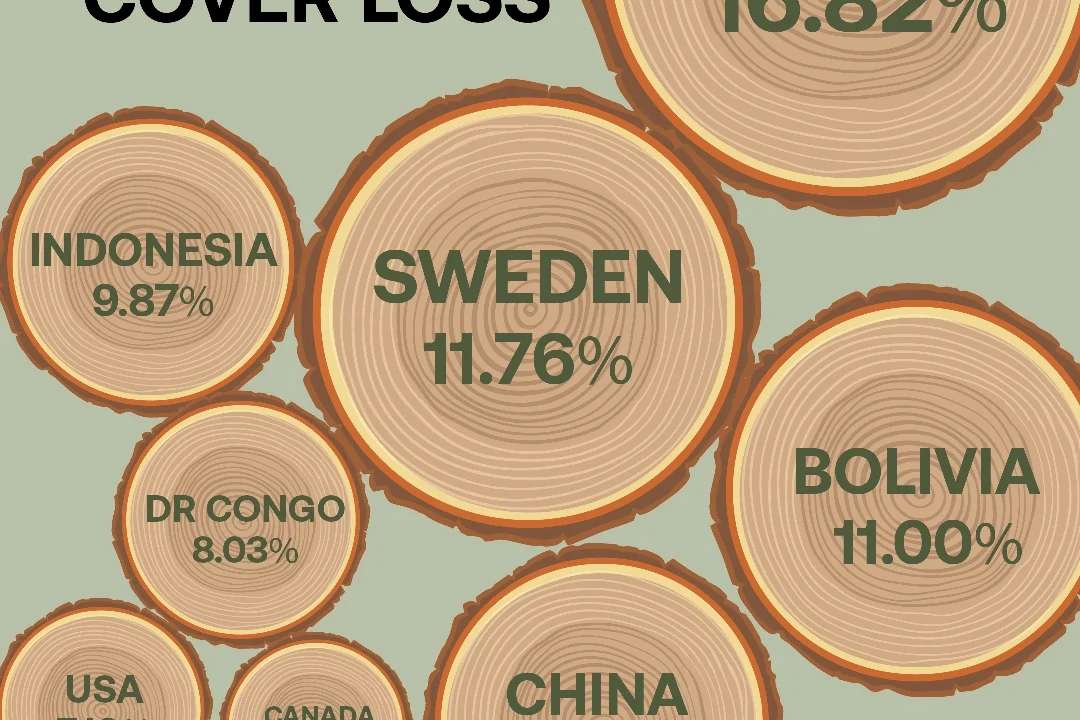
The world is losing its forests at an alarming rate, and a striking new visualisation shows just how severe the problem has become. Laos now leads the globe in tree-cover loss, with 16.82% of its forests disappearing, followed by Sweden (11.76%) and Bolivia (11.00%).
The world is losing its forests at an alarming rate, and a striking new visualisation shows just how severe the problem has become. Laos now leads the globe in tree-cover loss, with 16.82% of its forests disappearing, followed by Sweden (11.76%) and Bolivia (11.00%).
Other major contributors include Indonesia, DR Congo, Brazil, the USA, Canada, Russia, and China. Together, these countries represent a substantial share of global deforestation, and the impact reaches far beyond their borders.
According to Market vs Media, Russia lost more than 4.2 million hectares of tree cover, and Brazil lost more than 3.3 million hectares. However, not all losses are permanent; some result from seasonal logging and wildfires. EARTH ORG estimates that the world loses 10 million hectares of forest each year, with 96% of this destruction concentrated in tropical regions, where biodiversity is richest and carbon storage is most vital.
The global trend is worrying: tree-cover loss has nearly doubled since the early 2000s, rising from 13.4 million hectares in 2001 to 29.6 million hectares in 2024. In total, the world has lost over 517 million hectares of tree cover, about 13% of what existed at the turn of the millennium.
RECOMMENDED FOR YOU
Six countries account for three-quarters of Europe’s unicorn startups
This includes 3.7 million hectares of tropical primary forests lost in 2023, equivalent to ten soccer fields every minute. Fires alone accounted for 6.7 million hectares of loss in 2024, almost double the figure from the previous year.
These numbers reveal stark regional contrasts. Laos’s steep loss reflects rapid agricultural expansion and mining, while Sweden’s high percentage comes mainly from industrial logging, much of which will regrow, but still represents a major disruption to carbon cycles.
Bolivia’s situation is particularly concerning: while Brazil has reduced Amazon deforestation by 36% through stricter enforcement, Bolivia is seeing deforestation rise due to soy expansion and wildfires.
The economic consequences of deforestation are also becoming clearer. Tree loss threatens commodity markets tied to palm oil, beef, and soy, while increasing scrutiny from investors who are pivoting toward ESG-aligned funds.
Carbon markets are gaining traction, but without stronger incentives for forest-rich countries like DR Congo and Laos, permanent loss could accelerate, putting global climate targets at risk.