Global nuclear arsenal in February 2026: World faces a turning point as key arms treaties near expiry
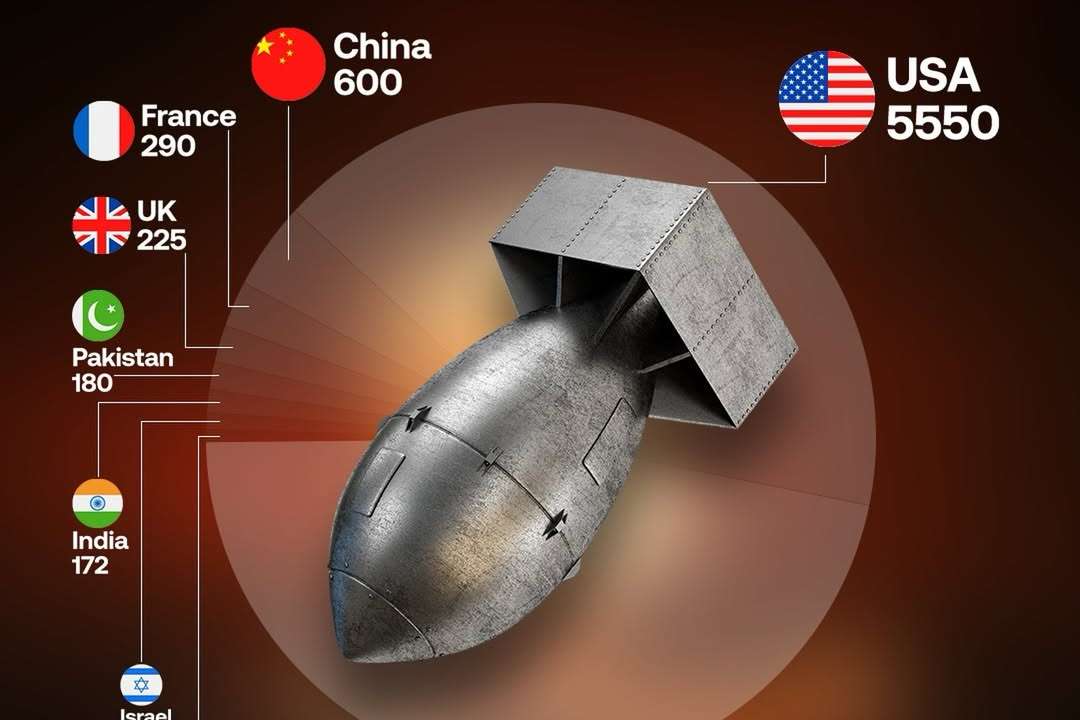
As of February 2026, the global nuclear balance stands at a critical juncture, with the world’s largest nuclear powers holding thousands of warheads just as cornerstone arms-control agreements move towards expiration.
Data from the Federation of American Scientists (FAS) show that the global nuclear arsenal remains dominated by the United States and Russia, with steady expansion elsewhere.
Russia remains the world’s largest nuclear power, with an estimated 6,200 to 6,300 nuclear warheads, according to FAS. The United States follows closely with roughly 5,500 warheads.
With New START set to expire in 2026, Moscow warns that the absence of a replacement treaty could remove the last formal limits on US and Russian strategic nuclear forces, increasing the risk of renewed arms racing and reduced transparency. This warning comes after Russia called for the agreement to be extended by a year, with no response.
"In just a few days, the world will be in a more dangerous position than it has ever been before," spokesman Dmitry Peskov told journalists on Tuesday, February 3.
China also emerges as the fastest-growing nuclear power. According to SIPRI and FAS, Beijing’s arsenal reached approximately 600 warheads by early 2026, up from just a few hundred a decade earlier. Satellite imagery analysed by independent researchers and cited by Reuters showed the construction of hundreds of new missile silos, signalling a shift away from China’s historically minimal deterrence posture.
Arms control experts cautioned that China’s expansion, combined with the potential collapse of US-Russia limits, could push the global system toward a three-way nuclear competition for the first time.
Beyond the major powers, several countries maintained smaller but strategically significant nuclear forces. France held about 290 warheads, while the United Kingdom possessed roughly 225, according to SIPRI. In South Asia, Pakistan (around 180 warheads) and India (about 170) continued gradual expansion amid ongoing regional tensions.
Israel, which does not officially acknowledge its nuclear arsenal, was estimated by FAS to have around 90 warheads, while North Korea was believed to possess roughly 50, with continued missile and warhead development reported by Reuters.
Though smaller in number, these arsenals carry outsized risk due to regional rivalries, limited communication channels, and shorter missile flight times.
What is the New START agreement?
New START (the New Strategic Arms Reduction Treaty) is a nuclear arms control agreement between the United States and Russia. It was signed in 2010 by then-presidents Barack Obama and Dmitry Medvedev and entered into force in 2011.
Its purpose is to limit and monitor the world’s two largest nuclear arsenals.
Under New START, both countries agreed to caps on:
- 1,550 deployed strategic nuclear warheads
- 700 deployed delivery systems (intercontinental ballistic missiles, submarine-launched missiles, and heavy bombers)
- 800 total launchers (deployed and non-deployed)
The treaty also includes on-site inspections, data exchanges, and verification measures, which allow both sides to check that the other is complying. This transparency is widely seen by arms-control experts as one of the treaty’s most important features.
However, New START expires on February 5, 2026. It was originally set to last 10 years, with the option of a single five-year extension. That extension was agreed in 2021, making 2026 the final expiration date. The treaty cannot be extended again under its current terms.
If New START expires without a replacement:
- There will be no legally binding limits on US and Russian strategic nuclear forces for the first time since the Cold War.
- On-site inspections and data sharing will end, reducing transparency.
- The risk of miscalculation, arms racing, and mistrust increases.
This story is written and edited by the Global South World team, you can contact us here.