Gun ownership laws around the world
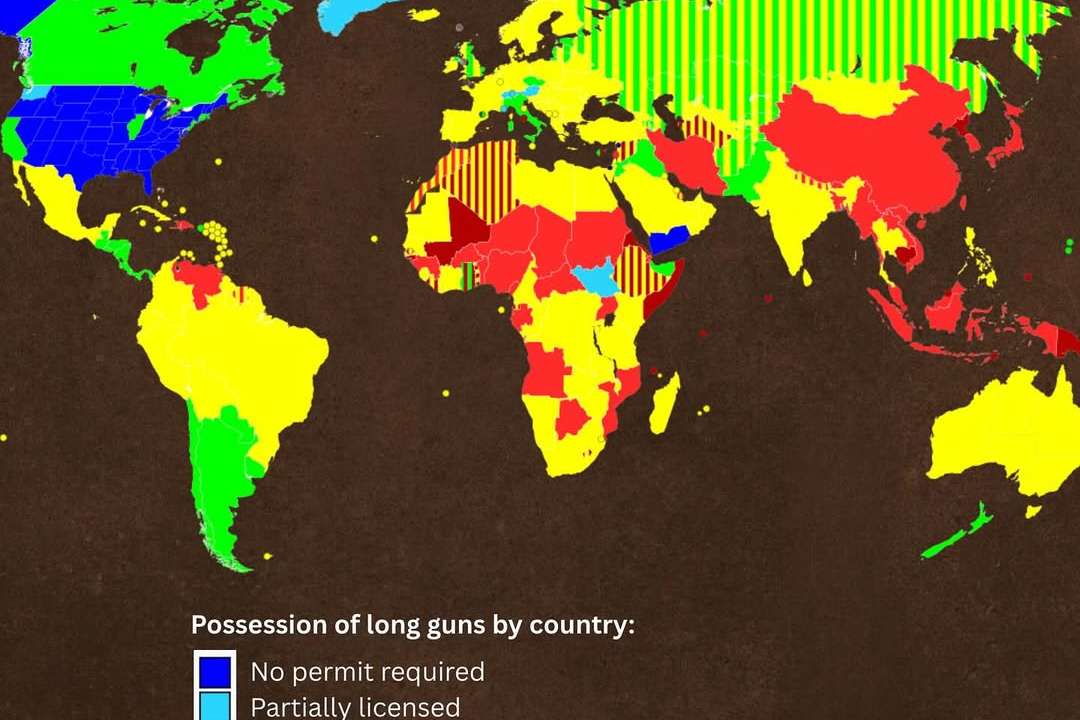
Gun laws vary dramatically across the globe, and a new world map lays bare those differences with striking clarity.
In some countries, citizens can own long guns such as rifles and shotguns without a permit. In others, strict licensing regimes demand not only background checks but also a “good reason” for ownership, such as hunting or sport. And in a significant number of nations, private ownership is prohibited outright.
According to Wikipedia’s overview of gun laws by nation, the world can be roughly divided into a handful of legal regimes. At one end of the spectrum are countries like the United States, where no permit is required in many states to own a rifle or shotgun.
At the other end are nations such as China and Singapore, where civilian gun ownership is broadly prohibited, with only narrow exceptions. In between lie most European and Commonwealth nations, which generally allow gun ownership under license but require applicants to demonstrate a legitimate reason, from hunting to sport shooting, and often impose limits on how firearms can be stored and used.
These rules have real-world implications. Research from World Population Review shows that countries with tighter regulations tend to report lower levels of gun violence, though enforcement and cultural attitudes also play a role. For example, Poland requires license applicants to provide a concrete justification and pass medical and psychological evaluations, while Ukraine allows licensed long-gun ownership but keeps handguns under strict control.
These differences have taken on new urgency in recent years. After a mass shooting in Montenegro left 12 people dead, the government moved to tighten its laws, introducing mandatory psychological checks and a grace period for surrendering unregistered firearms.
In the United States, the Supreme Court recently upheld federal regulation of “ghost guns”, untraceable, self-assembled firearms, affirming they fall under the 1968 Gun Control Act.
Even Australia, famous for its strict post-1996 gun laws, now faces challenges from illicit 3D-printed weapons, forcing lawmakers to consider tougher penalties and improved detection.
This story is written and edited by the Global South World team, you can contact us here.