How crucial will Africa be in sending humans back to the Moon?
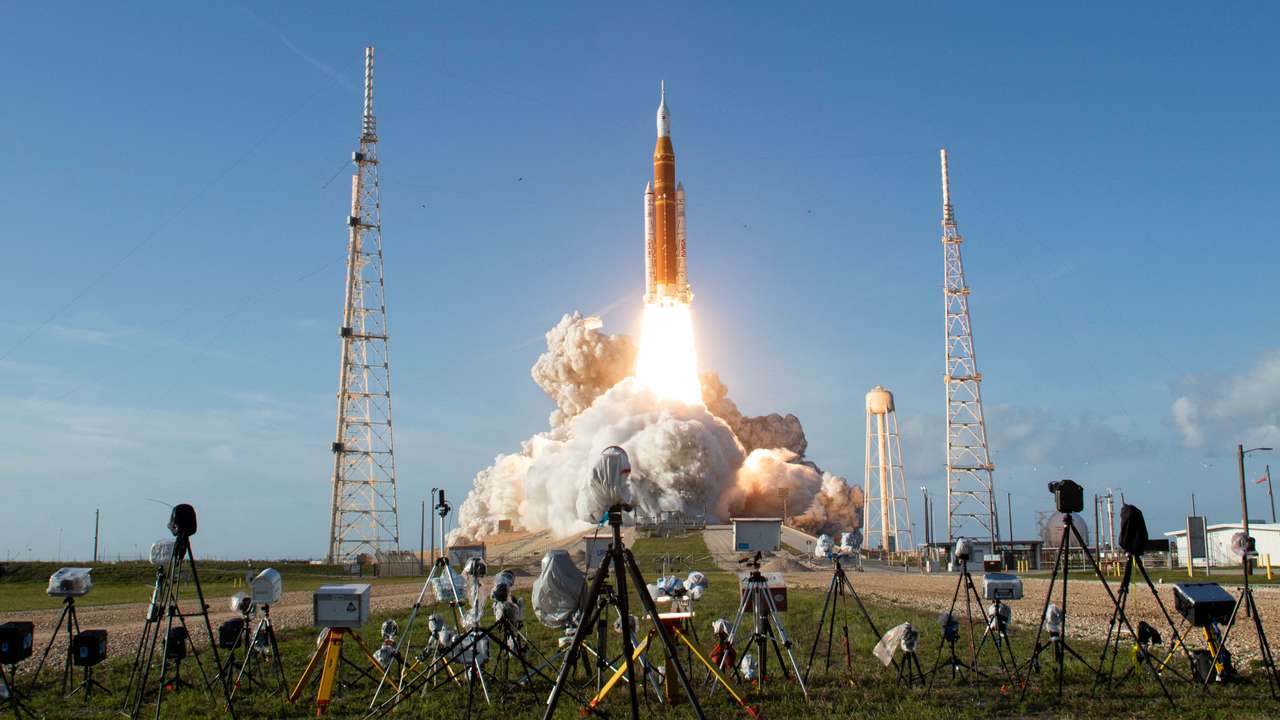
Artemis II’s launch on Wednesday sent humans back to the Moon’s vicinity for the first time in more than 50 years. While the crew will not land, the mission nonetheless marks — in Neil Armstrong’s words — “one small step for man, one giant leap for mankind.”
As NASA pushes ahead with its Artemis programme to return humans to the Moon, Africa is set to play a technically critical role — one rooted less in symbolism than in the hard requirements of global communications, tracking, and mission continuity.From Apollo-era relay stations to new-generation deep space infrastructure, the continent’s contribution centres on one key function: ensuring spacecraft remain in constant contact with Earth.
Africa’s role in the first Moon landing
Africa was embedded in the operational backbone of the Apollo missions that culminated in the 1969 Moon landing.
NASA’s early space programme relied on a globally distributed tracking network to maintain communications as spacecraft moved beyond the line of sight of any single ground station. Facilities in Kano, Nigeria and Tunguu, Zanzibar, alongside a major installation at Hartebeesthoek near Johannesburg, were part of that system.
These stations handled telemetry, tracking, and voice communications, relaying data between spacecraft and mission control. The Hartebeesthoek site also supported earlier missions, including receiving data from the Mariner 4 probe that produced the first images of Mars.
RECOMMENDED FOR YOU

Six countries account for three-quarters of Europe’s unicorn startups
At least part of Apollo 11’s journey to the Moon was tracked through this network, illustrating how missions depended on continuous coverage across multiple continents rather than any single country’s infrastructure.
South Africa’s current role in Artemis
That same requirement for uninterrupted communication is driving Africa’s inclusion in the Artemis architecture.
NASA and South Africa’s Department of Science and Innovation have formalised cooperation to build a new ground station in Matjiesfontein, in the Karoo region. The site will be one of three Lunar Exploration Ground Sites globally, alongside facilities in the United States and Australia.
The installation will include large communications antennas — between 18 and 24 metres — designed to maintain near-continuous links with spacecraft operating in lunar orbit and on the Moon’s surface.
Badri Younes, deputy associate administrator for NASA’s Space Communications and Navigation programme, said the site would support “communication with all of our astronauts in and around the moon” and form part of a broader Moon-to-Mars mission network.
South Africa’s government has allocated at least 70 million rand ($3.93 million) to support infrastructure and communications systems at the site, which will be operated by the South African National Space Agency (SANSA).
Why Africa’s position matters
The inclusion of an African ground station is driven by orbital mechanics rather than diplomacy.
As the Earth rotates, spacecraft move in and out of view of individual ground stations. A network spanning North America, Africa and Australia allows continuous tracking, ensuring that the Moon remains within line of sight of at least one station at any given time.
RECOMMENDED FOR YOU

Burkina Faso to stop importing armoured vehicles, Traore says
This configuration enables real-time transmission of navigation data, system diagnostics, and crew communications. These functions become increasingly critical as missions extend further from Earth and involve sustained human presence.
Expanding role in future missions
South Africa is positioning itself to support a broader pipeline of deep-space activity.
The Matjiesfontein station will also help meet rising demand on NASA’s existing Deep Space Network and support future missions beyond Artemis, including those linked to Mars exploration.
SANSA, for its part, is targeting involvement in dozens of upcoming missions over the next decade, reflecting a shift from historical participation in tracking to a more sustained role in space infrastructure and services.
Africa’s importance in returning humans to the Moon lies in function rather than visibility.
Apollo demonstrated that lunar missions require a globally distributed support system. Artemis builds on the same principle, with Africa once again providing a critical segment of that network.
This story is written and edited by the Global South World team, you can contact us here.