How the world’s top smartphone makers shifted in 15 years
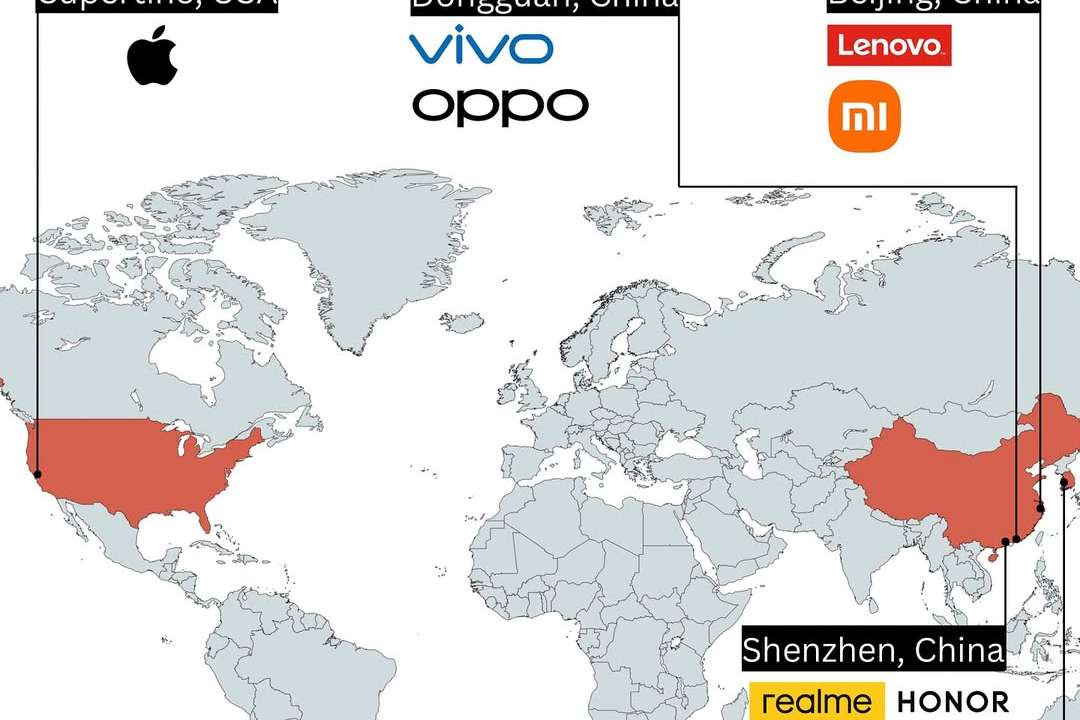
Once led by brands in the US, Europe, and Canada, the phone manufacturing industry has become largely consolidated in China and South Korea, reflecting broader shifts in technological innovation, supply chain integration, and consumer preferences.
In 2010, the smartphone industry was a tapestry of innovation hubs:
- North America boasted powerhouses like Apple in Cupertino, Motorola in Chicago, and BlackBerry in Waterloo, Canada.
- Europe featured icons like Nokia in Espoo, Finland, and Sony Ericsson in Lund, Sweden.
- Asia was home to South Korea’s Samsung and LG, as well as Taiwan’s HTC.
At the time, Nokia was the undisputed leader, commanding over a third of global smartphone sales, while BlackBerry dominated business users.
Fast forward to 2025, and China is now home to seven of the world’s top 10 smartphone makers, including Shenzhen's Huawei, Honor, Realme, Transsion, Dongguan's Oppo and Vivo and Beijing's Xiaomi and Lenovo.
This reflects China’s ascendance as both a manufacturing powerhouse and an innovation hub, supported by robust supply chains, government investment, and a vast domestic market.
Amidst China’s rise, South Korea’s Samsung remains a global leader, headquartered in Suwon. While LG exited the smartphone market in 2021, Samsung’s Galaxy line continues to dominate flagship sales worldwide.
In sharp contrast to the dynamic 2010 map, by 2025, only Apple in Cupertino represents the US on the global smartphone stage. The decline of BlackBerry, Motorola, and other American brands highlights a shift in the global tech power balance.
Experts point to several key factors:
- Supply Chain Integration: China’s vertical supply chains allow rapid production at scale.
- Investment in R&D: Chinese companies have invested heavily in 5G, AI, and camera technologies.
- Government Support: Strategic policies and subsidies have nurtured local champions like Huawei and Xiaomi.
- Changing Consumer Preferences: Chinese brands deliver feature-rich devices at competitive prices, especially in emerging markets.
Meanwhile, European and North American brands struggled with slower innovation cycles, higher labour costs, and in some cases, failed pivots to new technologies.