Hugo Chávez’s 2006 ‘devil’ speech at the UN still echoes through today’s geopolitical confrontations
On September 20, 2006, former Venezuelan President Hugo Chávez stood before the United Nations General Assembly in New York and delivered a speech that would become one of the most widely remembered moments in the history of the assembly.
Chávez spoke just a day after the then United States President George W. Bush had addressed world leaders from the same podium. From the start, Chávez made it clear that his speech would directly respond to Bush and to what he described as US attempts to dominate global politics.
Standing at the lectern, Chávez pointed to the podium and said:
“Yesterday, the devil came here. Yesterday, the devil was right here. In this very spot. It still smells like sulphur... Ladies and gentlemen, from this very podium, the President of the United States, whom I call the devil, came here speaking as if he owned the world.”
During his nearly six-minute speech, Chávez used the platform to criticise what he described as Washington’s efforts to impose its political and economic model on other countries, often through military force. According to Chávez, the United States was attempting to shape the world in its own image while dismissing critics as extremists.
RECOMMENDED FOR YOU

Six countries account for three-quarters of Europe’s unicorn startups
He also challenged Bush’s claim that the United States wanted peace, arguing that the actions of the US government told a different story.
“The United States does not want peace; it wants to impose its model of exploitation and looting and its hegemony at the point of a gun.”
The former Venezuelan leader also condemned military actions in the Middle East and accused what he described as imperialist powers of targeting civilians.
“Imperialist fire. Fascist fire. Murderous fire and genocidal fire. That of the Empire and Israel against the innocent people of Palestine and the people of Lebanon.”
Nearly two decades later, the issues Chávez raised during that speech are once again being debated amid rising tensions in the Middle East.
On February 28, 2026, the United States and Israel launched a large-scale offensive against Iran after weeks of military buildup and threats from US President Donald Trump. Later, it was confirmed that the strikes on Tehran killed Iranian Supreme Leader Ayatollah Ali Khamenei.
Iran quickly retaliated by firing ballistic missiles at Israel and US facilities across the Middle East, including in Bahrain, Kuwait, Qatar, and the United Arab Emirates.
In a Truth Social post, Trump said the goal of the operation was to prevent Iran from obtaining a nuclear weapon and “to defend the American people by eliminating imminent threats from the Iranian regime", urging the people of Iran to capitalise on the attack as what he described as the “only chance for generations” to take over their government.
RECOMMENDED FOR YOU
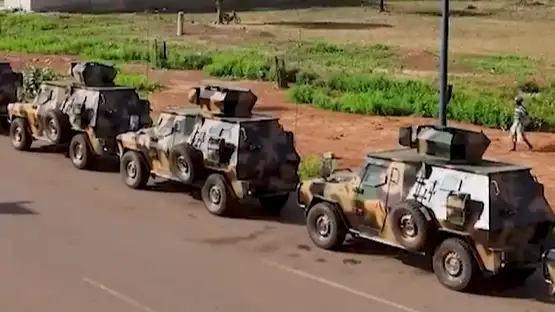
Burkina Faso to stop importing armoured vehicles, Traore says
Before the Iran attack, Chávez’s own successor, Nicolás Maduro, was removed from power after US special forces carried out a direct military operation in Venezuela on January 3. Maduro and his wife, Cilia Flores, were captured and flown out of the country to face drug trafficking and narco-terrorism charges in the US.
The operation included coordinated airstrikes in Caracas and naval deployments along the Venezuelan coast. Trump later described it as a “flawless” mission and said there were no American casualties.
This story is written and edited by the Global South World team, you can contact us here.
