More than half of humanity lives in just seven countries
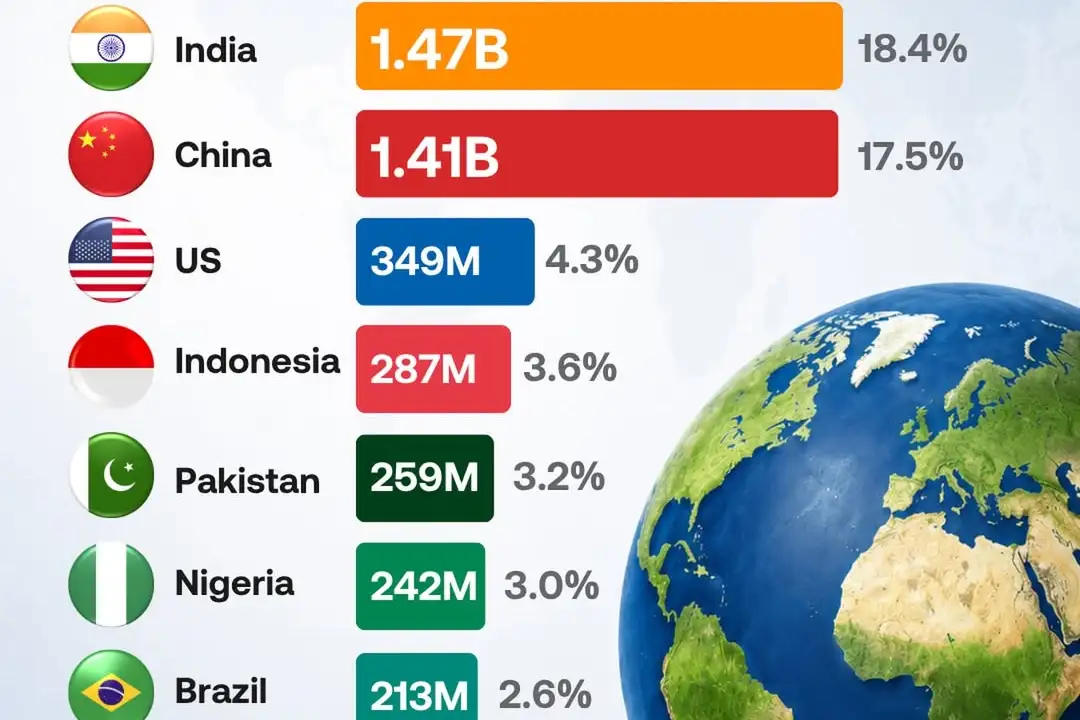
More than half of the world's population is concentrated in just seven countries, highlighting the extraordinary demographic weight carried by a handful of nations that increasingly shape the global economy, labour markets, food demand and geopolitical trends.
Main Points
- India and China alone account for nearly 36% of the world's population, with India remaining the largest nation by population.
- Seven countries are home to 52.6% of humanity, representing more than 4.2 billion people worldwide.
- Future population growth is expected to be driven largely by South Asia and Africa, particularly India, Pakistan and Nigeria.
More than half of the world's population is concentrated in just seven countries, highlighting the extraordinary demographic weight carried by a handful of nations that increasingly shape the global economy, labour markets, food demand and geopolitical trends.
According to the United Nations World Population Prospects 2024 Revision, the seven most populous countries, India, China, the United States, Indonesia, Pakistan, Nigeria and Brazil, are home to approximately 52.6% of the global population, despite representing fewer than 4% of the world's sovereign states.
India remains the world's largest country by population, with roughly 1.47 billion people, accounting for about 18.4% of humanity. China follows closely with approximately 1.41 billion residents, representing around 17.5% of the global population.
The demographic milestone reflects a historic shift that began in 2023 when India overtook China as the world's most populous nation. While India's population is projected to continue growing for several decades, China's population has entered a period of long-term decline due to lower birth rates and an ageing population.
Together, the two Asian giants account for nearly 36% of all people on Earth, meaning more than one in every three people globally lives in either India or China.
After India and China, the United States ranks third with around 349 million people, followed by Indonesia with 287 million, Pakistan with 259 million, Nigeria with 242 million, and Brazil with 213 million.
These countries span four continents and represent a diverse mix of economic and demographic realities. The United States remains the world's largest developed-country population, while Indonesia is Southeast Asia's demographic powerhouse. Pakistan and Nigeria continue to experience rapid population growth, and Brazil remains Latin America's most populous nation.
Collectively, the seven nations are home to more than 4.2 billion people, out of a global population estimated at roughly 8.2 billion in 2024.
The United Nations projects that global population growth will continue, although at a slower pace than in previous decades. Much of the future increase is expected to come from countries in Africa and South Asia, particularly Nigeria, Pakistan and India.
At the same time, several countries, including China, Japan and many European nations, are facing ageing populations and declining birth rates, creating new economic and social challenges.
As governments grapple with issues ranging from food security and climate adaptation to employment and migration, demographic trends in these seven countries will remain central to understanding the future direction of the global population.
This story is written and edited by the Global South World team, you can contact us here.