The shockwaves from Iran's regime collapse would change the world
Iran is not the Soviet Union. We are not watching the end of a new cold war. But this is nevertheless an era-defining moment.
The possible collapse of Iran’s Islamic Republic would not be a purely domestic event. Its consequences would extend far beyond Iran’s borders and could reverberate throughout the Middle East and the wider international system.
Some analysts have even drawn comparisons with the collapse of the Soviet Union. The comparison should be treated with caution. Iran is not a superpower on the scale of the former USSR. It does not command a formal bloc of allied states comparable to the Warsaw Pact, nor does it possess the same global military reach.
Yet the Islamic Republic is more than simply a state. Since the revolution of 1979, it has represented an ideological project supported by a network of regional allies and non-state actors. If that system were to collapse, the geopolitical map surrounding Iran would inevitably change.
The collapse of a regional influence network
For decades, Tehran has projected influence across the Middle East through a network of partners and proxy forces. These include Hezbollah in Lebanon, militias in Iraq and Syria, the Houthis in Yemen and various political and religious networks throughout the Gulf region.
RECOMMENDED FOR YOU

Six countries account for three-quarters of Europe’s unicorn startups
This model of indirect influence has allowed Iran to exert pressure on adversaries while avoiding direct confrontation. It has also created a complex web of regional dependencies.
Should the Iranian regime lose the capacity or the will to sustain these networks, a significant portion of the region’s existing power structure could weaken. Hezbollah would face reduced support. The Houthis would become more isolated. Iran-aligned militias in Iraq and Syria could lose their central sponsor.
In such a scenario, the immediate geopolitical beneficiaries would likely be the United States and Israel.
Implications for Arab–Israeli relations
A weakening of Iran’s regional influence could also reshape relations between Israel and several Arab states.
The Abraham Accords - which normalised relations between Israel and a number of Arab countries - might expand if Iran’s perceived threat diminished. For several governments in the region, opposition to Iran has been a major factor shaping their strategic calculations.
If that pressure were removed, further diplomatic normalisation with Israel could become more politically feasible.
The emergence of new regional alignments
However, the regional balance of power would not simply shift in Israel’s favour.
Another potential consequence would be the emergence of new alignments among Sunni powers. Saudi Arabia could move beyond its traditional role as an energy power and become a central geopolitical actor shaping regional alliances.
RECOMMENDED FOR YOU
Gold rush spreads ebola - Doctor warns about movement of Ituri miners in eastern DRC
One possibility often discussed by analysts is the formation of a strategic partnership linking Saudi Arabia, Turkey and Pakistan.
Each of these states possesses different forms of influence. Saudi Arabia offers financial resources and investment power. Turkey brings industrial capacity and an increasingly sophisticated defence sector. Pakistan provides nuclear expertise and extensive military experience.
Taken together, such a combination could form a powerful regional bloc capable of reshaping Middle Eastern geopolitics.
Why Iran is not the Soviet Union
Despite occasional comparisons, the collapse of the Islamic Republic would not replicate the fall of the Soviet Union.
The USSR possessed a vast military machine, a global ideological movement and a network of formal alliances. Iran’s influence, by contrast, is largely informal and regional.
Its military capabilities remain limited compared with those of major powers, and much of its defence industry relies on adapting or reproducing foreign technologies.
The end of the Islamic Republic would therefore not lead to the sudden fragmentation of a global superpower. Iran itself would likely remain territorially intact.
Yet the comparison with the Soviet collapse remains relevant in one important sense - the collapse of an ideological symbol.
RECOMMENDED FOR YOU
Sheinbaum rings historic bell as thousands fill Zocalo for Mexican Independence Day
The end of a revolutionary myth
For many political movements around the world, particularly those defined by anti-imperialist narratives, the Iranian revolution has long served as a symbolic example of resistance to Western power.
In this narrative, the Islamic Republic demonstrated that a state could confront the United States and survive outside the orbit of either Washington or Moscow.
If the regime were to fall, that symbolic role would be deeply weakened. It would also prompt uncomfortable questions among those who viewed Tehran primarily through the lens of its opposition to Western influence while overlooking the realities experienced by many Iranians themselves.
These include decades of political repression, economic hardship and strict social controls.
The role of Russia and China
The consequences would also extend to Iran’s relationships with major powers such as Russia and China.
Despite frequent references to a strategic axis linking the three countries, Iran remains the weakest member of this informal grouping.
Russia’s reliance on Iranian support has already diminished as Moscow expands its own military production. China’s relationship with Tehran is largely economic, focused on energy supplies and trade rather than deep strategic alignment.
Neither power is likely to intervene directly to preserve Iran’s leadership. If the Islamic Republic were to collapse, the broader alignment between Moscow, Beijing and Tehran would not necessarily collapse with it. Instead, it would simply lose one of its more fragile elements.
RECOMMENDED FOR YOU
IRGC rally fills capital as over 300,000 take part in 'Devotees of Iran' march
The uncertainty of what comes next
Perhaps the most unpredictable question concerns Iran itself.
A power struggle within the country is not hypothetical. It is embedded in the structure of the state.
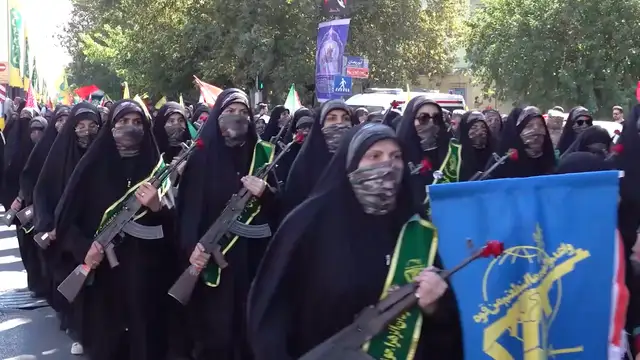
The Revolutionary Guards hold immense political and economic power and control a parallel military structure. The regular army represents a separate institutional tradition. Meanwhile, significant parts of Iranian society - including commercial networks and urban populations - have repeatedly demonstrated dissatisfaction with the current political system.
If the regime were to weaken or collapse, several outcomes would be possible.
Iran could experience a military consolidation of power. It could face a turbulent and chaotic transition. Or it could move towards a more secular and democratic political order.
A transformation with global implications
The stakes extend far beyond Iran itself.
A transition towards a secular democratic system in a large Muslim-majority country would challenge long-standing assumptions about governance and political development in the region. It could reshape the political imagination of neighbouring societies.
For this reason, the potential collapse of the Islamic Republic would represent more than the fall of a single regime.
RECOMMENDED FOR YOU
Norway has Europe’s highest petrol prices, Russia and Belarus remain cheapest
It would weaken a decades-old network of proxy influence, alter regional alliances, disrupt ideological narratives and force global powers to adjust to a new strategic environment.
Iran would not become the next Soviet Union.
Yet the end of the Islamic Republic could still mark the end of an era - and the beginning of a new geopolitical chapter.
This story is written and edited by the Global South World team, you can contact us here.
