The world’s most polluted countries
Air pollution remains one of the world’s most pressing environmental and health threats. The latest IQAir 2024 World Air Quality Report paints a troubling picture, showing that millions of people still breathe air far above safe health limits.
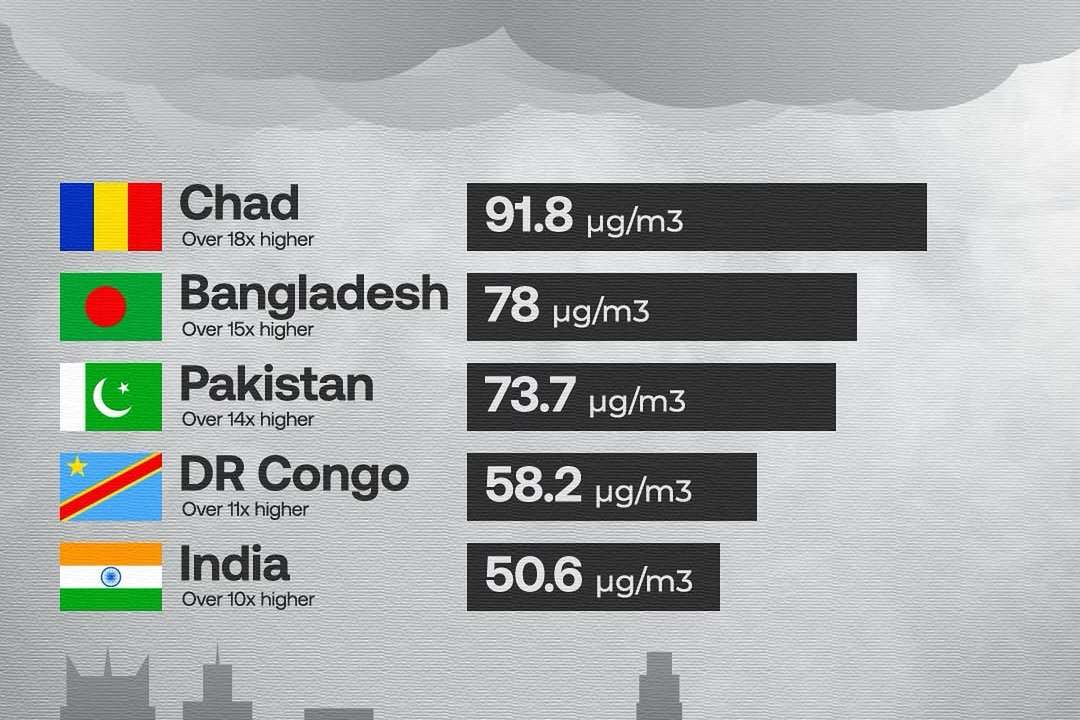
According to the report, Chad, Bangladesh, Pakistan, the Democratic Republic of Congo, and India were the world’s most polluted countries in 2024, with air quality levels many times higher than the guidelines set by the World Health Organisation (WHO).
Chad recorded the worst air quality globally, with an average PM2.5 concentration of 91.8 µg/m³, over 18 times the WHO annual guideline of 5 µg/m³. Bangladesh followed with 78 µg/m³, Pakistan with 73.7 µg/m³, the Democratic Republic of Congo with 58.2 µg/m³, and India with 50.6 µg/m³.
The 2024 IQAir report is based on data from more than 40,000 air quality monitoring stations across 8,954 locations in 138 countries, making it one of the most comprehensive assessments of global air pollution to date. Alarmingly, the report found that 126 countries exceeded the WHO’s safe air quality limits, and only 17% of global cities met the recommended PM2.5 guideline.
South Asia remains the world’s most polluted region. Despite some progress, India, Bangladesh, and Pakistan continue to struggle with dense smog and industrial emissions. In India, air quality improved slightly, about a 7% reduction in PM2.5 levels compared to 2023, yet the country still ranked fifth overall.
The world’s most polluted city in 2024 was Byrnihat, India, with an annual average PM2.5 concentration of 128.2 µg/m³.
A major factor behind these high readings is the continued reliance on fossil fuels, combined with vehicle emissions, industrial output, and seasonal crop burning. In regions such as India and Pakistan, weather conditions, including low wind speeds and temperature inversions, trap pollutants close to the ground, turning cities into toxic basins.
Meanwhile, many African nations face growing challenges as rapid urbanisation collides with limited environmental monitoring. IQAir notes that in Africa, there is, on average, just one air quality monitor for every 3.7 million people.
The dangers of these trends became especially clear during the 2024 India–Pakistan smog crisis, when thick haze engulfed large parts of the two countries. In November 2024, some areas recorded PM2.5 levels as high as 947 µg/m³, forcing school closures and overwhelming hospitals with respiratory cases.
This story is written and edited by the Global South World team, you can contact us here.