Top 10 Countries with the highest renewable energy usage
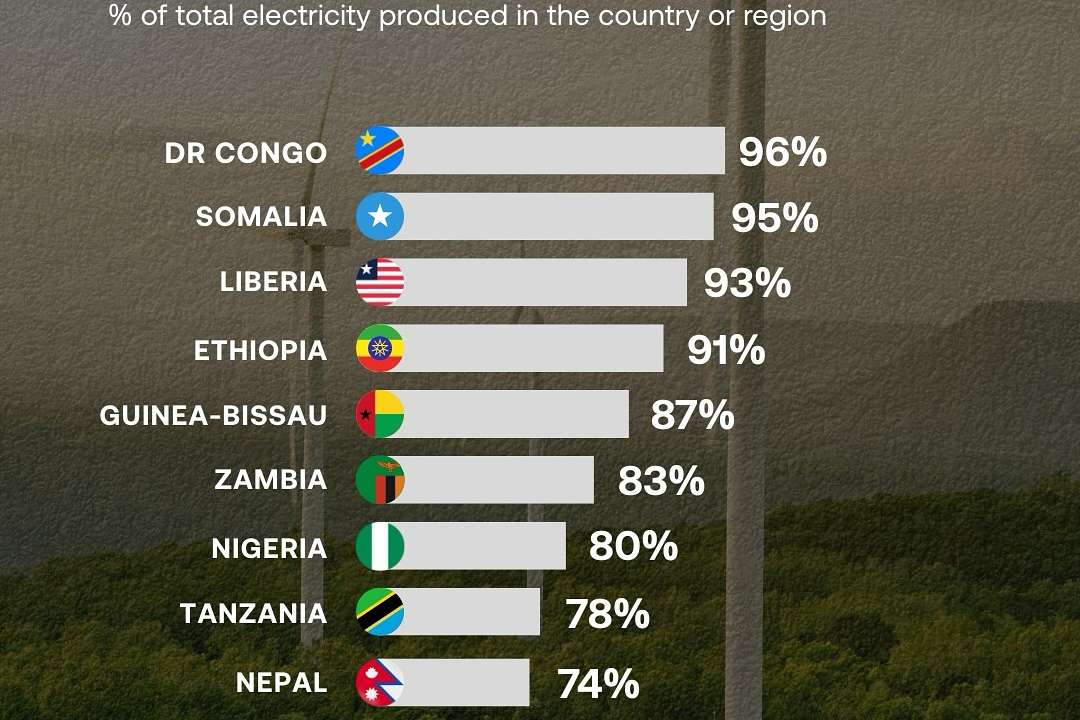
While wealthy nations are pouring billions into solar, wind, and green hydrogen, many less industrialised countries already generate the majority of their electricity from renewable sources.
According to recent data confirmed by the Energy Institute’s Statistical Review of World Energy 2025, a surprising number of nations, particularly in Africa, have overwhelmingly renewable electricity grids.
Here are the top 10 countries with the highest share of renewable electricity production:
- DR Congo – 96%
- Somalia – 95%
- Liberia – 93%
- Ethiopia – 91%
- Guinea-Bissau – 87%
- Zambia – 83%
- Nigeria – 80%
- Tanzania – 78%
- Nepal – 74%
- Kenya – 68%
What these numbers show is that countries often overlooked in global energy conversations are, in fact, global leaders when it comes to renewable reliance. Much of this dominance comes from hydropower, supported in some cases by biomass and smaller-scale solar and wind systems.
RECOMMENDED FOR YOU

Asia and Europe dominated the world’s biggest cities in 1700
In places like DR Congo and Ethiopia, vast river systems provide clean electricity, while in Kenya and Tanzania, investments in geothermal and hydropower have transformed their national energy profiles.
The 2025 Statistical Review of World Energy highlights the significance of these shifts in a broader global context. Worldwide, energy demand rose by around 2% in 2024, but electricity demand grew even faster at nearly 4%, creating pressure to expand capacity quickly.
For the first time, low-carbon electricity sources (renewables plus nuclear) accounted for more than 40% of global electricity production, thanks largely to record additions of solar and wind. Yet fossil fuels continue to rise in absolute terms, showing the world is still in a difficult transition phase.
Africa’s dominance in renewable share is not just about resources, but also about constraints. Many of these nations lack the infrastructure to rely heavily on coal, oil, or gas. Electricity demand is relatively low compared to industrialised economies, which means that even modest renewable installations can supply the majority of power.
At the same time, dependence on hydropower makes these systems vulnerable to drought and climate variability, raising questions about resilience and reliability.
Globally, the conversation around renewables is moving beyond capacity building to issues of finance, policy, and grid integration. Recent news reflects a major pact cut public funding for fossil fuels by as much as 78% in 2024, while clean energy investments in 2025 are projected to reach $2.2 trillion, nearly double fossil fuel financing.