U.S. leads Iran and Israel in 2025 military strength rankings
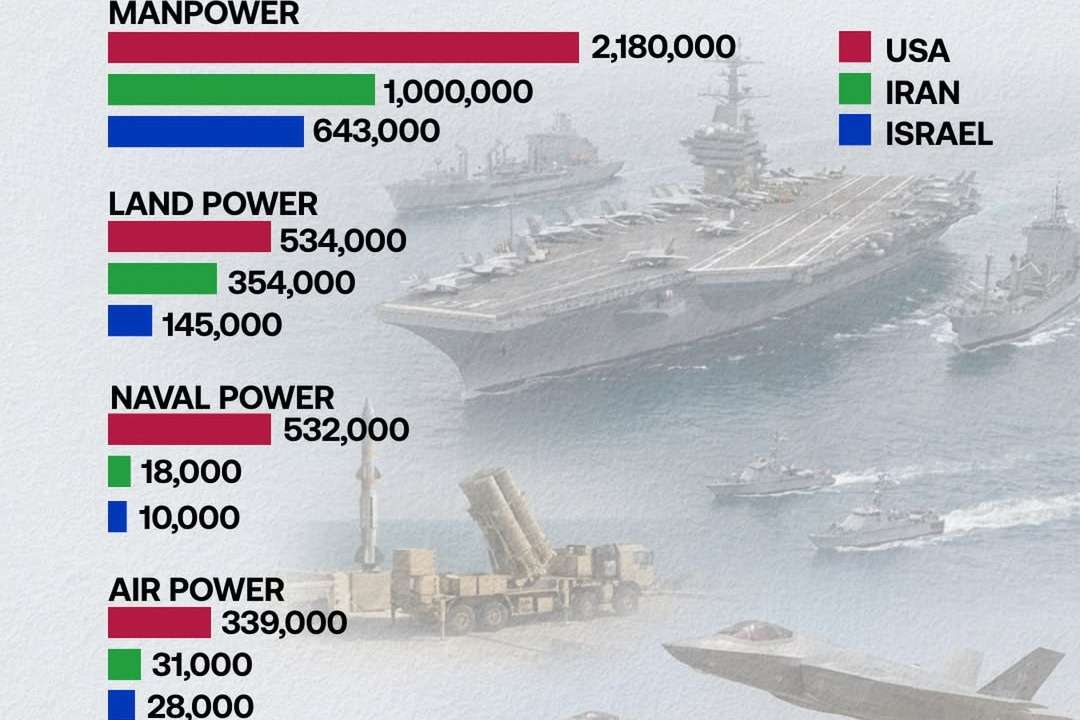
The United States maintains a commanding lead over Iran and Israel in overall military capacity in 2025, according to the latest Military Power Rankings.
The United States maintains a commanding lead over Iran and Israel in overall military capacity, according to the 2025 Military Power Rankings.
The comparative assessment, compiled by Military Power Rankings 2025 and cited by defence analysts, measures manpower, land, naval, air and nuclear capabilities.
The United States fields approximately 2.18 million military personnel, compared with 1 million for Iran and 643,000 for Israel. The figures include active-duty forces and reserve components.
In land forces, the United States deploys around 534,000 personnel, ahead of Iran’s 354,000 and Israel’s 145,000. While the U.S. Army remains the largest and most technologically advanced of the three, analysts say Iran’s ground doctrine emphasises missile units and asymmetric operations rather than conventional manoeuvre warfare.
RECOMMENDED FOR YOU

Six countries account for three-quarters of Europe’s unicorn startups
Naval strength shows the widest gap. The United States Navy accounts for roughly 532,000 personnel and operates the world’s largest fleet, including 11 nuclear-powered aircraft carriers.
Iran’s naval forces total about 18,000 personnel, with a focus on fast-attack craft and anti-ship missile systems designed for operations in the Strait of Hormuz, Iranian state media, including Fars News Agency, have reported. Israel’s navy comprises approximately 10,000 personnel and centres on coastal defence and submarine-based deterrence in the Mediterranean.
The United States Air Force also includes around 339,000 personnel and operates advanced fifth-generation aircraft such as the F-22 and F-35. Iran’s air force numbers about 31,000 personnel and relies largely on ageing aircraft, though Tehran has invested heavily in drone and missile capabilities. Israel’s air force, with roughly 28,000 personnel, is widely regarded as one of the most technologically capable in the region and operates F-35 stealth fighters.
In nuclear capabilities, the United States is estimated to possess around 5,000 nuclear warheads. Israel is widely believed to maintain an undeclared arsenal of approximately 80 to 90 warheads, although it neither confirms nor denies possession. Iran does not possess nuclear weapons, though its nuclear programme remains under international scrutiny amid ongoing diplomatic tensions.
On Feb. 28, 2026, the United States and Israel launched coordinated military strikes against targets across Iran in a major escalation of regional tensions. The offensive, variously referred to as Operation Epic Fury by the U.S. and Operation Lion’s Roar by Israel, targeted Iranian military infrastructure, command and control facilities and missile sites.
Explosions were widely reported in Tehran and other cities, and Iranian air defences and missile launchers were struck. The strikes were described by both governments as pre-emptive and aimed at degrading Iran’s nuclear and missile capabilities, amid stalled diplomatic negotiations over Tehran’s nuclear programme.
Iran’s Supreme Leader, Ayatollah Ali Khamenei, was reported killed in the initial attack by Iranian state media and later confirmed by multiple outlets, marking one of the most significant developments in the conflict.
The offensive sparked immediate retaliation from Iran, including missile and drone strikes against Israeli territory and U.S. military bases in the region, leading to a wider conflict.
RECOMMENDED FOR YOU

Olympic flame arrives on African soil for first time as Senegal begins Dakar 2026 countdown
Explosions were reported overnight in Tehran and the nearby city of Karaj, with Iranian media saying airstrikes also hit Isfahan, Yazd and Khuzestan on Monday, March 2.