Why a handful of islands have the world’s cleanest air
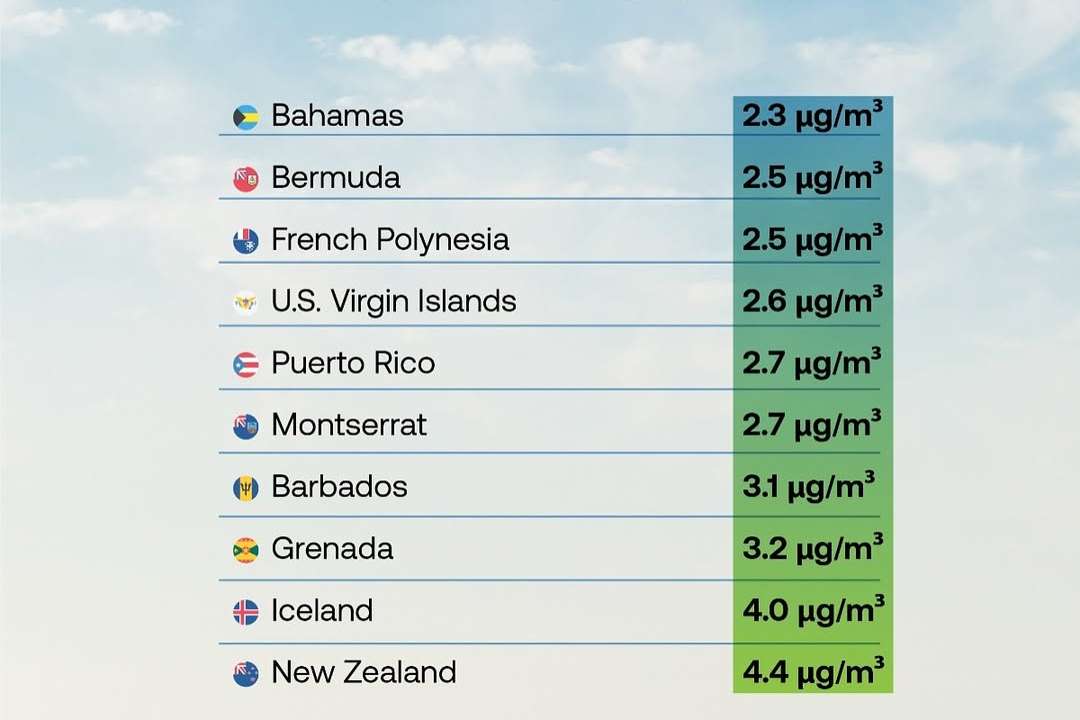
The air quality ranking isn’t led by vast industrial economies but by tiny island territories with clean skies and windswept coastlines.
The air quality ranking isn’t led by vast industrial economies but by tiny island territories with clean skies and windswept coastlines.
The IQAir 2024 World Air Quality Report reveals that the Bahamas, Bermuda and French Polynesia recorded average fine‑particulate (PM₂.₅) concentrations of 2.3–2.6 µg/m³, well below the World Health Organisation’s guideline of 5.0 µg/m³.
Other island or coastal territories, such as the U.S. Virgin Islands, Puerto Rico, Montserrat, Barbados, Grenada, Iceland, and New Zealand, also recorded annual PM₂.₅ levels below 4.5 µg/m³. These values underline how geography, low industrial activity and persistent ocean winds help dilute air pollution.
IQAir cautions that these islands are rare exceptions in a world choked by pollution. The 2024 report compiled measurements from more than 40,000 ground‑level monitoring stations across 138 countries and territories and found that only 12 countries, regions and territories complied with the WHO’s annual PM₂.₅ guideline.
RECOMMENDED FOR YOU
Six countries account for three-quarters of Europe’s unicorn startups
In 2024, just 17 % of cities met or were below the 5 µg/m³ limit, up from 9% the previous year. Meanwhile, 99 % of the global population lives in areas that exceed those limits, underscoring how exceptional the clean‑air champions in the ranking are.
The Air Quality Life Index (AQLI), produced by the University of Chicago’s Energy Policy Institute, translates pollution levels into public‑health impacts. Its 2024 report warns that if PM₂.₅ pollution were reduced to meet WHO guidelines, the average person could gain nearly two additional years of life, saving roughly 14.9 billion life‑years globally.
Air pollution remains the leading external threat to human health, ahead of smoking, alcohol, car accidents and HIV/AIDS.