Women in uniform: Countries leading the way in military gender diversity
Women have long contributed to military operations, but only in the past two decades have many countries started to integrate female soldiers into combat and leadership roles.
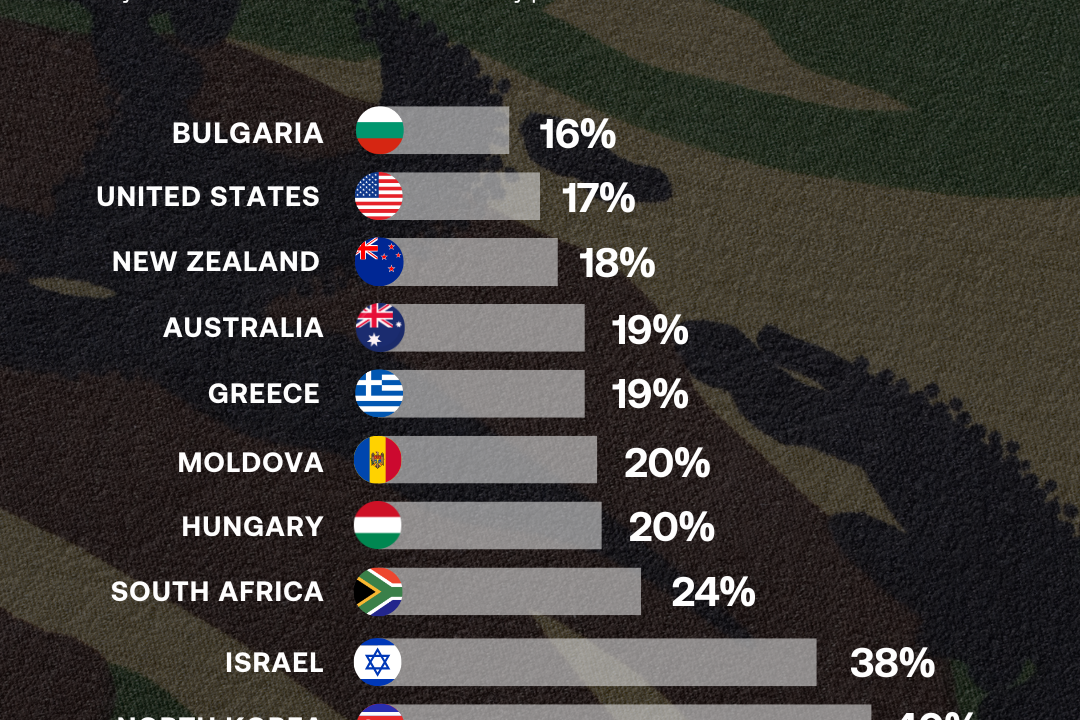
New data compiled by NATO and Global Firepower show that female representation in the armed forces varies widely. The data ranks countries by the estimated percentage of women in their military personnel, revealing some surprising leaders.
According to the chart, North Korea has the highest share of women in uniform: an estimated 40 % of its military personnel are female. Israel, where military service is mandatory for most women, follows with 38 %. South Africa comes third at 24 %, benefiting from inclusive post‑apartheid policies.
Several NATO or NATO‑partner nations hover around one‑fifth: Hungary and Moldova each report 20 % women in their armed forces, while Australia and Greece are at 19 %. The United States is listed at 17 %, and Bulgaria at 16 %.
The ranking highlights how conscription policies and cultural factors influence gender balance. Israel and North Korea conscript women, boosting numbers. South Africa has instituted gender‑mainstreaming policies since the 1990s. In contrast, many European and North American militaries rely on voluntary recruitment and have been slower to achieve parity.
NATO’s reporting shows that women remain under‑represented across its member states. In 2019, Spain’s defence minister Margarita Robles noted that women constituted 12.7% of the country’s 120,000 servicemembers, a figure she said put Spain “ahead of the NATO average” of about 10.9 %.
That average has been inching upward – NATO’s 2023 summary of national reports indicated that women account for roughly 12–13% of armed forces personnel across the alliance – but few countries approach the high levels seen in Israel or North Korea.
The United States is a notable case. The U.S. Department of Defence’s 2021 demographics report stated that women made up 17.3% of active‑duty personnel, totalling more than 231,000 service members.
This share has grown steadily from about 15 % a decade earlier, reflecting efforts to open all combat roles and integrate women more fully. Despite this progress, the U.S. still lags behind countries like New Zealand and Australia, which report 18–19% female participation.