A look at Europe’s many linguistic versions of London
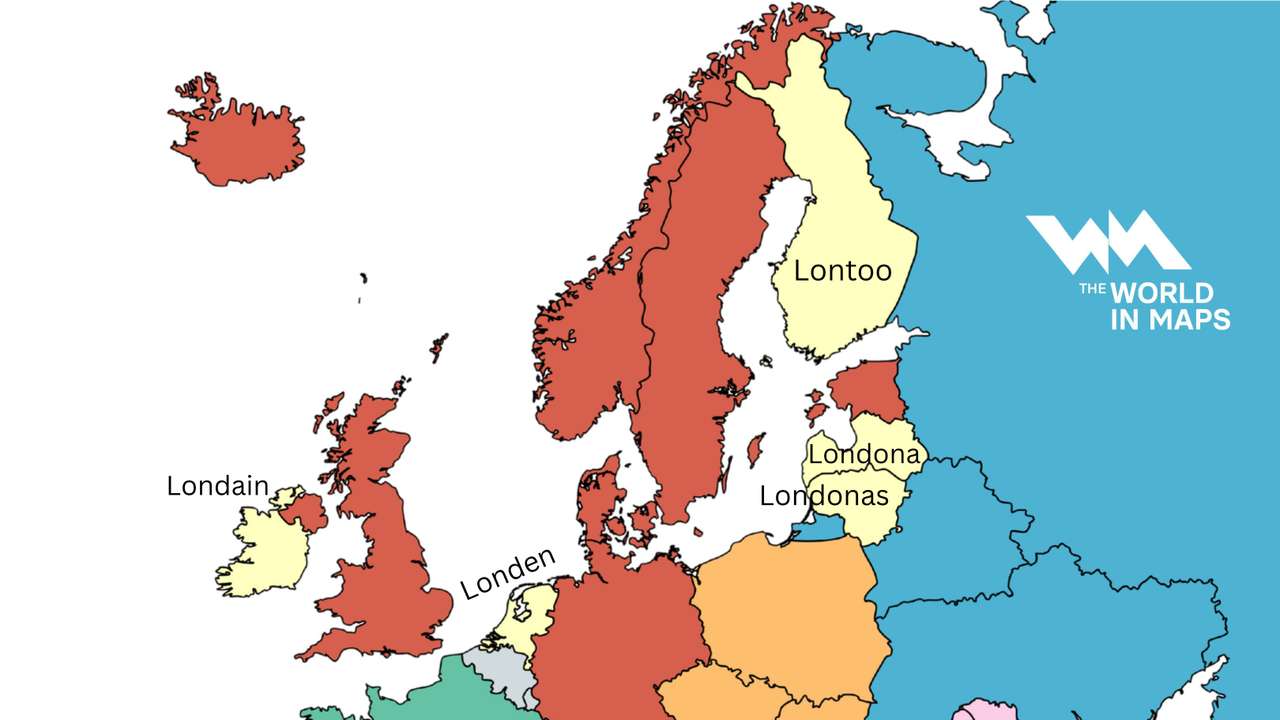
A new linguistic map by The World in Maps shows how the name “London” changes across Europe. While English speakers know it simply as London, its name takes different forms depending on the language.
In France, Spain, and Portugal, it appears as Londres. In Italy and Romania, it becomes Londra. Across Poland and Czechia, it’s Londyn and Londýn, while in Finland it’s Lontoo. Greek speakers use Λονδίνο, and in Welsh, the city is known as Llundain.
The name “London” comes from Londinium, the term used by the Romans during their occupation of Britain in the first century AD. Linguists believe it derived from a pre-Roman Celtic or Brittonic root, possibly Londonjon, later adopted into Latin and then Old English. Over centuries, it evolved into the modern “London.
The map reflects not only Europe’s linguistic diversity but also London’s own. According to Milestone Localisation, more than 300 languages are spoken in the city today, including Bengali, Polish, Urdu, Yoruba, and Arabic. London is among the most linguistically diverse cities in the world.
RECOMMENDED FOR YOU

Sanchez pledges to restore normality in Ceuta after mass migrant arrivals
The variation in London’s name highlights how languages adapt foreign place names to local speech patterns. These differences also show how deeply the city is embedded in global culture — from Londyn in Polish newspapers to لندن in Arabic broadcasts.
As discussions about migration and cultural identity continue across Europe, the map serves as a reminder of how interconnected languages and histories are. The city’s name, spoken differently in dozens of languages, remains a shared reference point across the continent.