Visit by Britain's Starmer shows drawbacks of 'China pivot' in countering Trump
By Farah Master, Colleen Howe and Liz Lee
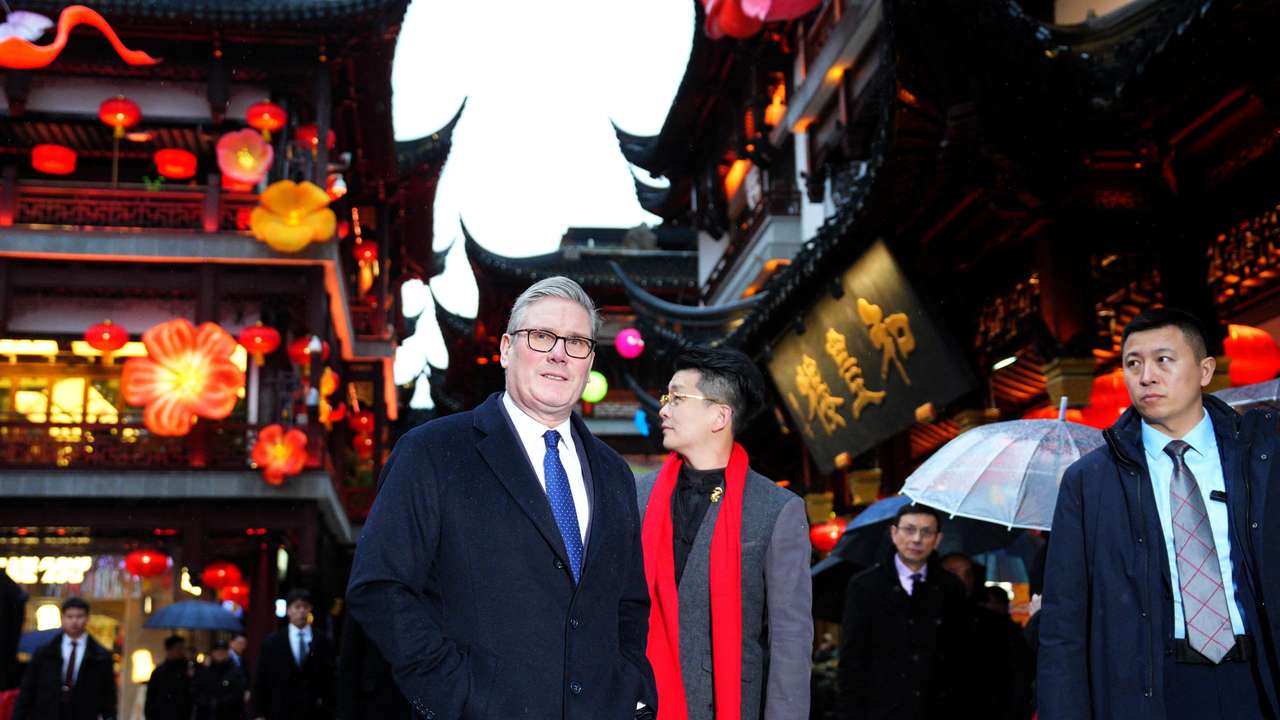
British Prime Minister Keir Starmer's visit to China is the latest win Beijing can tout in its rivalry with Washington, but the deals he brings back to London also show the limits of the balancing act that middle powers may try to play.
He follows Canadian counterpart Mark Carney, who struck a trade deal on a similar visit weeks ago, before heading to Davos to herald a new global trade order as U.S. President Donald Trump disrupts long-standing ties with allies.
European leaders have also visited, as have India's Narendra Modi and others since Trump began his second term a year ago, but it is less clear what tangible long-term economic and security benefits such visits yield for Western powers.
RECOMMENDED FOR YOU
Six countries account for three-quarters of Europe’s unicorn startups
"Traditional U.S. allies feel hard done by and are now hedging their bets, but they are far from being able or willing to substitute China for the United States," said John Quelch, an expert in global strategy at Duke Kunshan University.
From the perspective of London, Ottawa and other Western capitals, the visits demonstrate to Trump that alternatives exist if he keeps up pressure on issues from Greenland to renegotiating the USMCA trade deal among the United States, Canada and Mexico.
But these are "superficial gestures amid stalled global growth," said Alicia Garcia-Herrero, chief Asia-Pacific economist at Natixis.
"These visits highlight the severe limits of any 'pivot' to China," she said. "They expose middle powers' vulnerability, chasing scraps while China's export flood overwhelms their industries."
And they benefit Beijing, by supporting the narrative of a broad pivot to China as the world's "reliable partner", in contrast with Trump's chaotic tariff policies and his growing list of threats and demands towards partners and rivals alike.
"President Trump’s efforts to decouple the United States from China are also decoupling the United States from the world," Quelch added.
STARMER SCORES WINS ON VISAS, WHISKY
The deals clinched by Western powers on such visits come in return for deeper integration with a country that ran a trade surplus the size of the Dutch economy last year but where consumption is too weak for even its own producers to prosper at home.
RECOMMENDED FOR YOU

Senegalese protest rising cost of living in Dakar
On his trip to the world's second largest economy, Starmer secured 30-day visa-free access for Britons travelling to China and lower tariffs on whisky, while British drugmaker AstraZeneca unveiled a $15 billion investment in China.
He got nothing beyond "frank dialogue" on tension arising from China's increasingly assertive stance on Taiwan, its stronger ties with Russia after the Ukraine invasion and a rights crackdown on Britain's former colony of Hong Kong.
British and U.S. politicians who criticised Starmer's trip also aired accusations of espionage and human rights abuse, which Beijing denies.
Similarly, Carney left China with expectations that Beijing will cut or drop tariffs on canola, lobsters, crabs and peas, but that triggered threats of 100% tariffs from Trump, who warned Ottawa about allowing Chinese EVs into North America.
And even before Starmer has wrapped up his China visit, Trump warned Britain it was dangerous to get into business with Beijing, after the prime minister extolled the economic benefits of resetting relations with China.
CHINA'S EXPORT-DRIVEN GROWTH POSES RISKS FOR WEST
China's imports last year were flat at $2.6 trillion, but they were largely driven by energy and commodities from emerging markets, rather than the West.
Its trade surplus, however, jumped a fifth, to a record $1.2 trillion, as its manufacturers responded to Trump's tariff measures by muscling into virtually every other market in the world, at the expense of domestic producers.
RECOMMENDED FOR YOU
Sheinbaum rings historic bell as thousands fill Zocalo for Mexican Independence Day
Such a pace of growth puts China's trade surplus on track to roughly reach the size of the $3-trillion French economy by 2030 and the $5-trillion German economy by 2033.
Its exports to the European Union last year jumped 8.4%, while imports dipped 0.4%. China shipped 7.8% more to Britain, while buying 4.7% less. With Canada, sales grew 3.2% while purchases plunged 10.4%.
"This makes it an especially risky proposition for countries trying to protect or grow their own manufacturing industries to substantially increase trade integration with China," said Eswar Prasad, a former China director at the International Monetary Fund.
"China hardly provides a safe harbour for countries trying to cope with the adverse economic effects of U.S. tariffs," added Prasad, who now teaches trade policy at Cornell University.
Still, say some analysts, significant trade wins with China may not be as important - or even realistic - for countries such as Britain or Canada right now.
Resetting ties may be the best they can get, but that could still be valuable, as previous deterioration in relations exposed critical supply chain dependencies on China.
The Asian giant's trade countermeasures helped to widen two-way trade imbalances, rather than narrow them, analysts said.
The visits by Starmer and Carney are "a propaganda coup for Beijing," said Noah Barkin, Europe-China expert at the German Marshall Fund and Rhodium Group, while warning, "This is not a pivot to China. It is about reducing tension with Beijing."
RECOMMENDED FOR YOU
Norway has Europe’s highest petrol prices, Russia and Belarus remain cheapest
He added, "No country wants to be in open conflict with the two superpowers at the same time."
This article was produced by Reuters news agency. It has not been edited by Global South World.