Are we about to see the greatest FIFA World Cup ever?
Key Takeaways
- The 2026 FIFA World Cup will begin on 11 June 2026 and conclude on 19 July 2026.
- It will be the first World Cup to feature 48 teams, expanding from the previous 32-team format.
- The tournament will also be the first to be jointly hosted by three countries: the United States, Mexico and Canada.
- The United States will host matches in 11 venues, Mexico in three cities, and Canada in two cities.
- The opening match will see Mexico face South Africa at the Estadio Azteca in Mexico City.
- The final will be played at MetLife Stadium in East Rutherford, New Jersey.
- A total of 104 matches will be played, up from 64 in previous editions.
- Teams will be divided into 12 groups of four, with the top two teams in each group and the eight best third-placed teams advancing to a new Round of 32 knockout stage.
When the FIFA World Cup kicks off on 11 June 2026, fans will be watching a tournament unlike any that has come before it.
From the number of teams involved to the countries hosting it, the 2026 edition will introduce several major changes to football’s biggest competition.
For the first time in World Cup history, 48 nations will compete for the trophy, expanding the tournament from its traditional 32-team format. The expansion means more countries, more matches, and more opportunities for teams to make history.
The tournament will also be the first to be hosted by three countries. The United States will stage matches across 11 venues, while Mexico will host games in three cities and Canada in two. The competition will run until 19 July 2026, with the final scheduled for MetLife Stadium in East Rutherford, New Jersey. The opening match will see Mexico face South Africa at the Estadio Azteca in Mexico City.
The expanded tournament will feature 104 matches, a significant increase from the previous 64. Teams will be divided into 12 groups of four, with the top two teams from each group advancing, along with the eight best third-placed teams. Those 32 teams will then move into a newly introduced Round of 32 knockout stage.
RECOMMENDED FOR YOU

Flávio Bolsonaro rejects Brazil election results, seeks annulment of Lula's victory
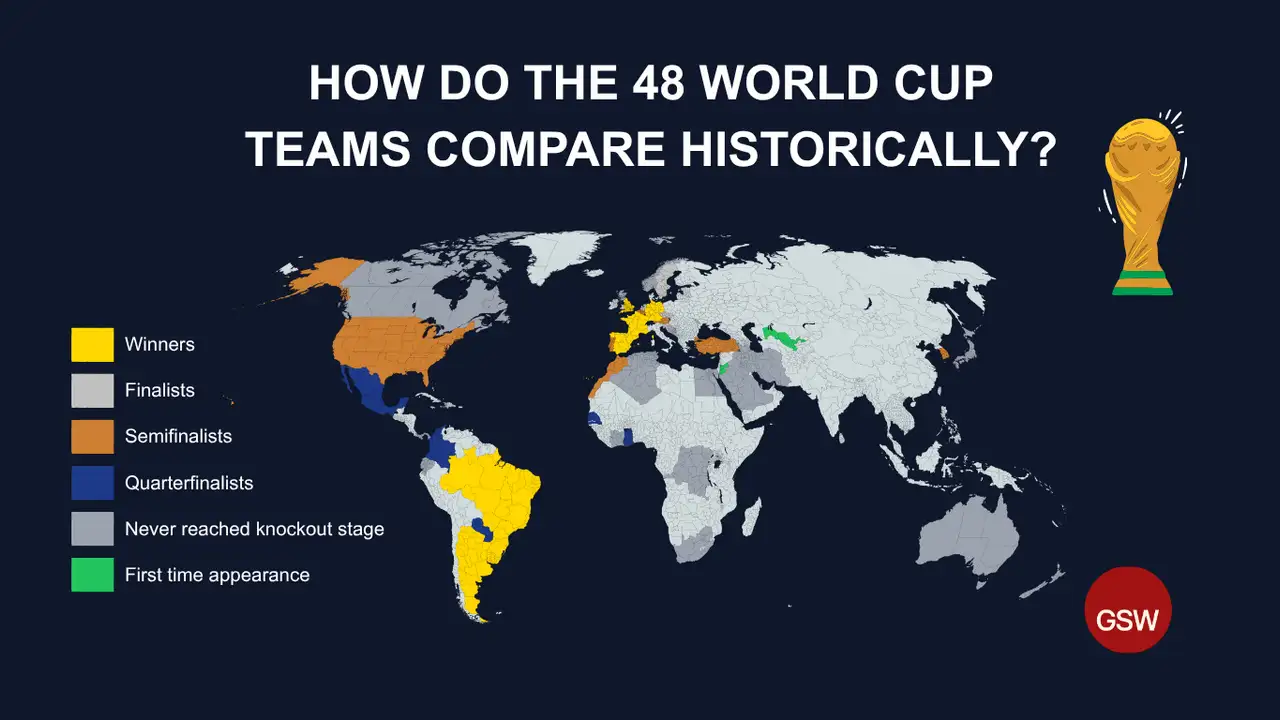
The list of qualified teams includes some of football’s most successful nations. Former champions Brazil, Argentina, Germany, France, England, Spain and Uruguay are all back. Brazil arrives as the tournament’s most successful nation and is identified as a five-time World Cup winner.
Several countries that have reached World Cup finals without lifting the trophy are also in the field, including Croatia, the Netherlands, Sweden and Czechia.
Among the teams with semifinal appearances in their history are Morocco, the United States, Austria, Belgium, South Korea, Portugal and Türkiye. Morocco enters the tournament as the highest-ranked African team, ranked eighth in the world.
Other nations, including Senegal, Switzerland, Mexico, Colombia, Ghana and Paraguay, will be aiming to improve on previous quarter-final appearances.
The tournament also features a large group of countries that have never gone beyond the quarter-finals. Among them are Japan, Australia, Algeria, Norway, Ecuador, Saudi Arabia, Tunisia, South Africa, Egypt, Scotland, Canada, IR Iran, Iraq, DR Congo, Haiti, New Zealand, Panama, Qatar, Côte d'Ivoire, and Bosnia and Herzegovina.
Some teams are returning after long absences. Scotland is back at the World Cup for the first time since 1998, while Iraq returns for the first time since 1986.
Perhaps the biggest stories, however, belong to four nations that will experience the World Cup for the first time. Cabo Verde, Curaçao, Jordan and Uzbekistan have all secured historic debuts and will be making their first appearances on football’s biggest stage.
This story is written and edited by the Global South World team, you can contact us here.
