Asia and Europe dominated the world’s biggest cities in 1700
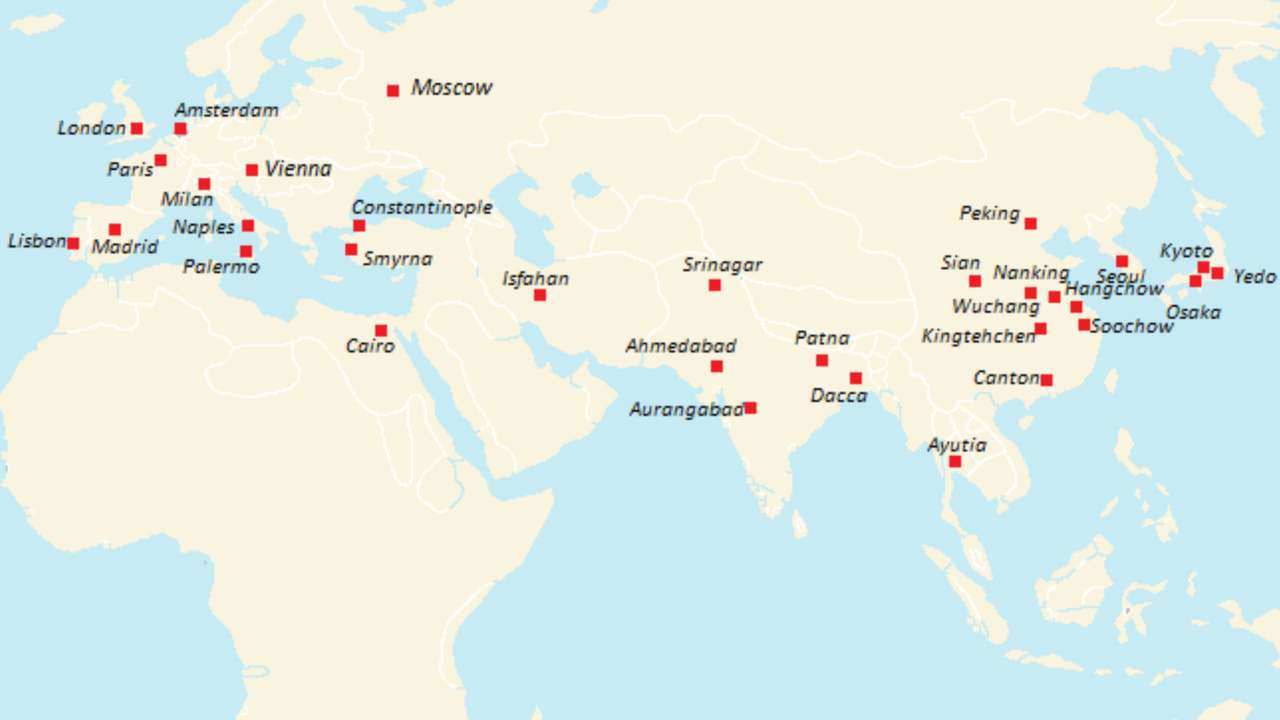
The world’s largest cities looked very different in 1700, with major urban centres concentrated across Europe and Asia, centuries before rapid industrialisation produced today’s megacities.
Main points
- Asia was home to several of the world’s largest cities
- Istanbul and Edo each had about 700,000 people
- London had become Europe’s largest city by 1700
The world’s largest cities looked very different in 1700, with major urban centres concentrated across Europe and Asia, centuries before rapid industrialisation produced today’s megacities.
Historical population estimates are not exact, but research based on the work of urban historians Tertius Chandler and George Modelski provides one of the most detailed records of city populations before modern censuses. Researchers have since digitised and mapped their historical data.
The map highlights cities believed to have had populations of roughly 100,000 or more around 1700, including London, Paris, Amsterdam, Moscow, Istanbul, Cairo, Isfahan, Beijing, Nanjing, Hangzhou, Guangzhou, Kyoto and Edo, now Tokyo.
Around 1700, Istanbul, then widely known in Europe as Constantinople, and Edo are both estimated at 700,000 people, making them two of the largest cities in the world. Beijing was also enormous, with estimates around 650,000.
RECOMMENDED FOR YOU

Argentina equals Germany's record with fourth FIFA World Cup final defeat
China already had a particularly strong network of large cities. Beijing, Nanjing, Hangzhou, Suzhou and Guangzhou were among its important urban centres, reflecting a long-established urban system that predated the industrial transformation of Europe. Historical research shows that Chinese cities remained among the world's largest for centuries.
Japan also had several major cities. Edo was expanding rapidly under the Tokugawa shogunate, while Kyoto and Osaka were important political, cultural and commercial centres.
Europe also had a growing collection of large cities, but London stood out.
Its population rose from roughly 120,000 in 1550 to around 550,000 to 575,000 by 1700. By then, London had overtaken other European cities in size and accounted for roughly one in 10 people in England.
Paris was also approaching the half-million mark, while Naples, Lisbon, Amsterdam, Milan and Moscow were among Europe's other large urban centres. Estimates cited in historical urban research put Istanbul at about 700,000, London at 550,000, Paris at 530,000 and Naples at just over 200,000 around 1700.
This story is written and edited by the Global South World team, you can contact us here.