Australia is one strait away from hunger: Opinion
The fertiliser crisis in the Middle East exposes a vulnerability we had chosen to ignore. The answer is not more diplomacy - it’s production.
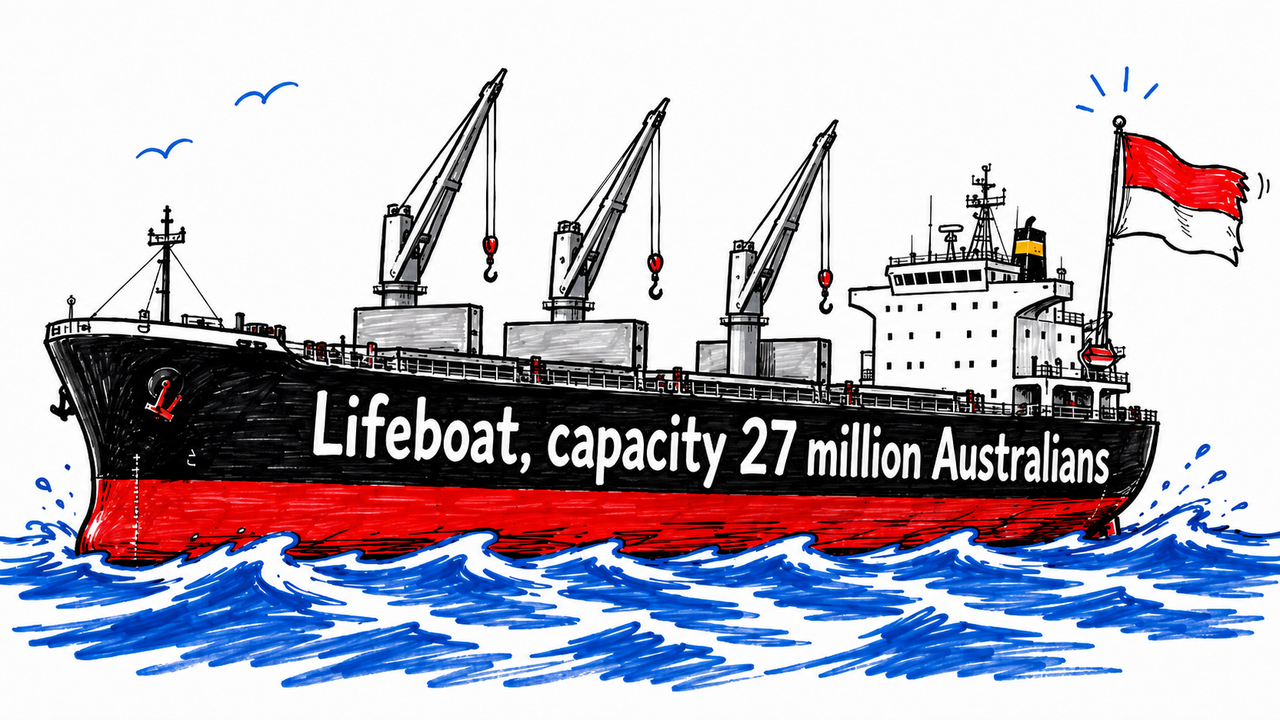
A ship called MV Medi Luna docked at the Port of Brisbane on 22 June 2026. It carried 47,250 tonnes of urea - white pellets of compressed nitrogen that keep Australia’s wheat, canola and barley alive. The ship sailed not from Qatar or the UAE, as would normally be the case, but from Bontang, East Kalimantan, from the terminal of PT Pupuk Kalimantan Timur, Indonesia’s largest fertiliser producer. The moment was hailed as a diplomatic triumph - proof of Australia’s close partnership with its northern neighbour. President Prabowo Subianto and Prime Minister Albanese reportedly exchanged personal phone calls to celebrate the arrangement.
It was a crisis response dressed up as diplomacy.
For those who have watched Australia’s agricultural supply chains with growing alarm, the arrival of the MV Medi Luna was not a triumph. It was a confession - that Australia, a continent that feeds 100 million people and exports more agricultural produce per capita than almost any other nation on earth – relies for its own food on a 21-mile-wide passage in the Persian Gulf.
The Strait of Hormuz is Australia’s farm gate. And someone else has the key.
RECOMMENDED FOR YOU
Six countries account for three-quarters of Europe’s unicorn startups
How Australia got here
Australia consumed 8.7 million tonnes of fertiliser in 2024, valued at A$5.5 billion (US$3.8 billion). Of that, 7.9 million tonnes - more than 85 per cent - were imported. Domestic production has collapsed to just 1.3 million tonnes, 15 per cent of national consumption. When Incitec Pivot shut the Gibson Island urea facility near Brisbane in 2022, citing an inability to secure affordable long-term gas supply, Australia lost its last significant domestic nitrogen production capacity. From that point on, Australian farmers became entirely dependent on the goodwill of Middle Eastern petrochemical states and the uninterrupted passage of cargo ships through one of the most contested waterways in the world.
Perdaman’s planned new facility Karratha, Western Australia won’t go near to closing the shortfall.
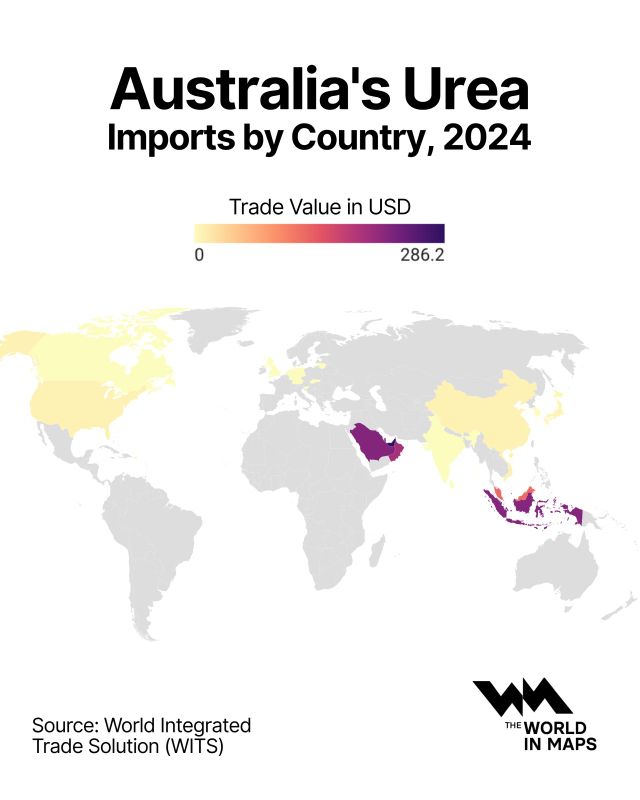
Australia imports approximately 3.85 million tonnes of urea annually. More than half comes from the UAE, Qatar, and Saudi Arabia - countries whose gas production and export terminals are anchored in the Persian Gulf. More than 60 per cent of that urea travels through the Strait of Hormuz, a passage barely 21 miles wide at its narrowest point. As the UN has confirmed, up to 30 per cent of internationally traded fertilisers - nitrogen, phosphate, sulphur - move through this chokepoint. When the Strait closes, Australian farming is suffocated.
When the gulf closed
Following the US-Israeli strikes on Iran, maritime traffic through the Strait of Hormuz declined by more than 95 per cent. Qatar Energy halted downstream urea production. Saudi and UAE terminals fell silent. Nearly a million metric tonnes of fertiliser cargo were physically stranded in the Gulf, with major producers declaring force majeure. For Australian farmers entering their critical winter-crop planting window - April through June - the timing could not have been worse.
The price response was immediate and severe. Urea, which had traded at around A$675 per tonne in February 2026, broke through A$1,000 per tonne by the end of March - a 50% increase in seven weeks. As Professor Marit Kragt of the University of Western Australia observed: “The current impacts are much more profound. We seem to have not learned anything.”
She was right. This was Australia’s third major fertiliser supply chain disruption this decade. COVID-19 severed Chinese export pipelines. Russia’s invasion of Ukraine in 2022 pushed prices to historic highs and shuttered the Gibson Island plant, at first temporarily and then permanently. After each disruption, Australia scrambled and promised to rethink its supply chains. After each one, it didn’t.
By April 2026, according to government figures, Australia had secured only 20 per cent of the urea it needed for the current farming season - still 1.25 million tonnes short. The government threw A$7.5 billion into a Fuel and Fertiliser Security Facility. Minister for Agriculture Julie Collins worked around the clock. Prime Minister Albanese cut short a trade tour to return to Geelong after a fire at one of Australia’s two fuel refineries added a second crisis to the first. To be clear, the country was never in danger of famine. But it is in danger of something that, for Australian farming, is almost as bad: a season in which the numbers just don’t add up.
What farmers actually lose
The arithmetic of fertiliser deprivation is merciless. Canola requires around 80 kilograms of nitrogen per hectare to reach optimal yield. Without it, farmers have three choices: plant anyway and accept lower yields, switch to lower-input crops like barley, oats or pulses, or leave land fallow. Each choice is a loss. ABARES forecast in March 2026 that the gross value of Australian agricultural production would fall to around A$95 billion in 2026–27, down from an expected A$101 billion the year before - a A$6 billion contraction driven substantially by fertiliser uncertainty and rising input costs. Farm profits were forecast to decline following several strong seasons, not because of drought or flood or disease, but because a geopolitical event 10,000 kilometers away had closed the pipeline through which Australia’s fields are fed.
RECOMMENDED FOR YOU

Madagascar Roundup: Child food poverty hits 77%, growth rebound forecast for 2027 and northern risk mapping begins
The FAO has estimated that cereal producers globally could face income losses of up to 5 per cent in 2026, with lasting impacts through 2030. For Australian wheat and canola farmers competing in global markets, a 5 per cent yield reduction means a mortgage payment, a school fee, a piece of machinery not purchased, a farm debt that rolls forward another year.
And the damage is not limited to farms. One in five Australian households currently skips meals or goes full days without food, according to the 2025 Foodbank Hunger Report. Claiming that Australia is food-secure simply because it exports more calories than it consumes - as governments have repeatedly done - is, as Kimberley Reis of Griffith University puts it, “a mind-numbingly unenlightened thing to say.” Food security isn’t an abstraction about aggregate calories. For the household facing a grocery bill inflated by a conflict it cannot influence, in a country that chose not to build the buffer it needed, it is a weekly calculation.
Indonesia steps in
The deal with Indonesia was important, and welcome. PT Pupuk Indonesia, the state-owned fertiliser producer whose subsidiary PT Pupuk Kalimantan Timur operates the Bontang terminal, has a production capacity of 9.4 million tonnes of urea annually. Against domestic demand of 6.3 million tonnes, that leaves a meaningful export surplus. Indonesia is, in fact, the world’s fourth-largest urea producer. It was able to help when the Gulf could not, and it chose to do so.
The government-to-government framework coordinated by President Prabowo and Prime Minister Albanese - formalized into a commercial deal between Incitec Pivot Fertilizers and PT Pupuk Indonesia - will deliver 250,000 tonnes of urea to Australia by year’s end, with the potential to scale to 500,000 tonnes in a second phase worth approximately USD 440 million. The first cargo of 47,250 tonnes, loaded from PT Pupuk Kalimantan Timur’s terminal in Bontang, arrived in Brisbane on 22 June 2026. Indonesian Ambassador Siswo Pramono called it a demonstration of Indonesia’s growing contribution to regional food security. Australian officials called it a testament to the strength of the bilateral relationship.
It is both of those things. But the deal also illustrates exactly how fragile Australia’s position remains. In a moment of acute crisis, the country’s fertiliser security rested entirely on the discretion of a foreign government - one that, however friendly, had no obligation to prioritize Australian farmers over its own. Indonesia’s domestic fertiliser stockpile stood at 1.23 million tonnes as of June 2026, and its domestic subsidized distribution was running 30 per cent above the previous year. It could afford to be generous. In a different configuration of crisis, the answer from Jakarta or Riyadh or Doha might not be yes.
Alliances and bilateral frameworks are instruments of statecraft, not substitutes for industrial policy. The 250,000 tonnes secured from Indonesia covered roughly 20 per cent of what was still needed for the season. The remaining 80 per cent had to be sourced from wherever it could be found, at whatever price the disrupted market demanded. Prime Minister Albanese is right that strong regional relationships matter. What he hasn’t said is that relationships work best when there is something to offer in return. Australia imports its key fertiliser. It does not make any.
The case for domestic production
Australia has all the ingredients to be a world-class urea producer. It has vast natural gas and coal resources - not the coal of conventional open-cut mines, but deep seams, stranded deposits, coal that cannot be sold on export markets but can, through the proven technology of underground coal gasification, be converted into the syngas that feeds an ammonia and urea plant. It has the land, the port infrastructure, the regulatory frameworks, and - if it chose to deploy them - the sovereign capital.
For decades, Australia has debated sovereign fuel reserves, domestic manufacturing capacity, critical minerals supply chains, and defense self-sufficiency with varying degrees of urgency. Fertiliser has always been way down the list. The two largest short-term threats to Australian agricultural output are drought and a closed strait. We build dams for the first. We are still debating the building of plants for the second.
RECOMMENDED FOR YOU

Russia signs BRICS Pay and technology deals in New Delhi
The question is when
Australia feeds 100 million people, including almost 30 million Australians. That is a responsibility, and currently, a gamble. Every tonne of wheat sown in the Wheatbelt, every canola crop planted across the Eyre Peninsula, every nitrogen application on every paddock from Western Australia to Queensland depends on an unbroken supply chain that passes through one of the world’s most contested maritime chokepoints.
The current crisis will pass. The Strait of Hormuz will reopen, as it has before. Urea prices will fall. Shipments will resume. And Australian agriculture ministers will announce that the supply chain has been “diversified” - meaning a few more cargo shipments from Southeast Asian producers have been penciled into trade agreements, and a working group has been established.
It can be done, as Perdamon’s Project Ceres demonstrates. But one plant won’t be enough.
Another domestic urea and ammonia plant, built in South Australia or Western Australia or Queensland, fed by gas produced beneath Australian soil, employing Australian workers, would still not entirely eliminate the risk of another disruption. But it would mean that the next time a strait closes or a government says no, Australia farmers aren’t scrambling. The MV Medi Luna was a lifeline. The question is whether Australia will use the time between crises, or simply wait to need another one.
This story is written and edited by the Global South World team, you can contact us here.
