Brazil election 2026: Lula overturns Flávio Bolsonaro's lead in more than 200 municipalities to win presidency
Key Points
- Lula gained ground in 96.7% of Brazil's municipalities.
- At least 211 municipalities switched from Bolsonaro to Lula.
- Lula won the presidential runoff with 51.79% of valid votes.
Brazil's President Luiz Inácio Lula da Silva strengthened his support across nearly 97% of the country's municipalities between the first and second rounds of the 2026 presidential election, helping him overturn an early lead held by right-wing rival Flávio Bolsonaro.
An analysis of official election data by Brazilian newspaper Folha de S.Paulo found that Lula gained ground in 96.7% of municipalities, either increasing his lead or narrowing his deficit against Bolsonaro.
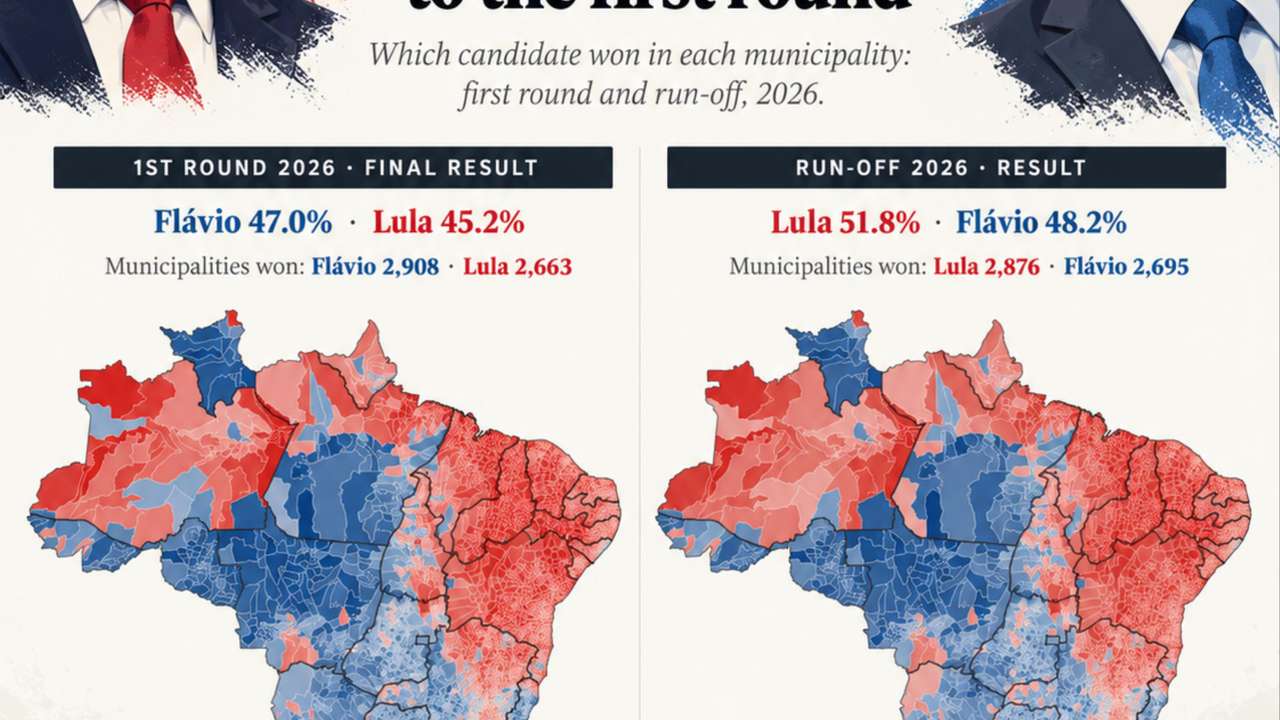
Lula turned around results in 211 municipalities that had voted for Bolsonaro in the first round, while only one municipality switched in Bolsonaro's favour. The gains included 76 municipalities in Minas Gerais and 32 in São Paulo.
The shift helped Lula secure 51.79% of valid votes in Sunday's runoff, compared with Bolsonaro's 48.21%, according to Brazil's Superior Electoral Court (TSE).
RECOMMENDED FOR YOU

‘Why would you need courage to speak the truth?’ Nobel Peace Prize winner Navi Pillay asks
Lula received 64.26 million votes against Bolsonaro's 59.83 million, winning by approximately 4.43 million votes. The result gave the Workers' Party leader an unprecedented fourth non-consecutive presidential term.
The electoral map showed Lula expanding his support beyond his traditional strongholds in northeastern Brazil. He won the most votes in 2,875 municipalities, compared with Bolsonaro's 2,695, while one municipality recorded a tie.
Minas Gerais proved particularly important, becoming the only state to switch from Bolsonaro in the first round to Lula in the runoff. Lula also improved his performance in São Paulo and Rio de Janeiro, despite Bolsonaro winning both states overall.
The results marked a historic comeback. Bolsonaro had led the first round with 47% of valid votes against Lula's 45.2%, but the incumbent reversed the national result in the October 25 runoff.
The figures highlight how changes in local voting patterns helped determine the outcome of Brazil's election, even in areas where Bolsonaro retained majority support.