Cameroon Roundup: Invasion of illicit weapons, religious oversight, a new disarmament push

National Assembly closes June session with mining transparency and land reform in focus
Cameroon’s National Assembly closed its June parliamentary session after placing mining transparency, land governance, public finances and diplomacy at the centre of its agenda. The session had opened on 9 June 2026 under the new Speaker, Théodore Datouo, at the Paul Biya Glass House in Yaoundé. It was the second ordinary session of the 2026 legislative year and the first June session under Datouo following the death of long-serving Speaker Cavaye Yéguié Djibril. Datouo called on Parliament to strengthen oversight of the mining sector, saying citizens in resource-producing communities often feel disconnected from the wealth extracted from their land. He urged ministries to improve the traceability of public revenue and demanded reforms to address what he called “reprehensible practices” in land administration, where disputes continue despite the existence of formally issued land certificates. The Speaker also linked future budget decisions to the daily concerns of Cameroonians, including youth unemployment, the rising cost of living and limited access to water and electricity.
More than 400 delegates gather in Yaoundé for Francophonie parliamentary assembly
Yaoundé is hosting the 51st Session of the Parliamentary Assembly of La Francophonie, bringing together lawmakers and political leaders from across the French-speaking world between 7 and 12 July 2026. Organisers projected attendance of about 400 participants, including more than 300 parliamentarians and state representatives, around 80 young leaders, and at least 15 heads of parliamentary chambers. The preparations were led by Hilarion Etong, president of the Parliamentary Assembly of La Francophonie and head of its Cameroonian section. At a press conference on 25 June, Etong said an organising committee established in January had worked through 17 specialised subcommittees, insisting that “no sector has been neglected”. The assembly’s two principal themes are multilateralism and state sovereignty, and the response of Francophone parliaments to climate change.
MINAT tightens scrutiny of religious organisations after child’s killing
The Ministry of Territorial Administration, led by Paul Atanga Nji, has intensified scrutiny of religious bodies following the killing of a girl allegedly branded a demon by members of the Cameroon Life and Peace Evangelical Mission. On 8 July 2026, the ministry formally called the church’s leadership to order over the incident. The same day, it issued a separate warning instructing Jehovah’s Witnesses to respect the national anthem and state institutions. The intervention comes amid a much wider campaign against unauthorised revival churches. Cameroonian authorities have said that roughly 1,400 revival churches operate nationally, while only a small proportion hold legal recognition. Previous closure operations were justified by complaints involving noise, fraud, family disruption and the exploitation of worshippers. The latest action shows that the government is extending its focus beyond registration and noise violations to allegations of abuse, criminal conduct and disregard for state symbols. The killing has sharpened debate over whether administrative controls alone are sufficient or whether stronger criminal accountability and child-protection mechanisms are required.
Cameroon converts national disarmament strategy into regional action plans
Cameroon’s National Committee for Disarmament, Demobilisation and Reintegration, known as the CNDDR, opened a two-day workshop in Yaoundé on 6 July 2026 to translate the country’s first national DDR strategy into regional action plans. The national strategy was technically approved in December 2025, but the new process is intended to adapt it to the distinct security conditions in the Far North, North-West and South-West regions. CNDDR national coordinator Faï Yengo Francis explained that a single national framework could not be applied uniformly. “The regions are not identical,” he said, adding that each one must present a local plan that can be debated, amended and aligned with the national strategy. Since the CNDDR was created by presidential decree in November 2018, more than 4,000 former combatants have reportedly been disarmed and demobilised through centres in Mora, Buea and Bamenda. In December 2024, a major reintegration operation in the Far North released 708 former combatants, including 447 children associated with armed groups and more than 100 women.
RECOMMENDED FOR YOU
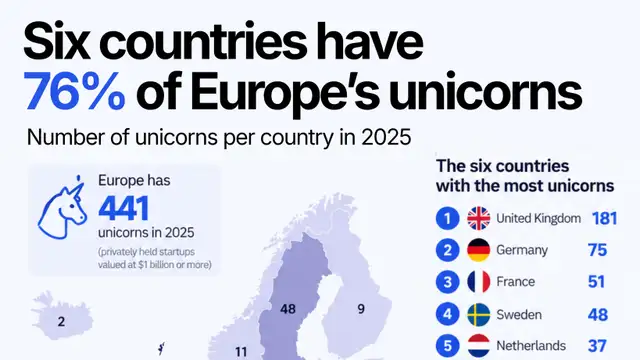
Six countries account for three-quarters of Europe’s unicorn startups
Illegal weapons in circulation estimated at up to 185,000
Cameroon is estimated to have between 150,000 and 185,000 illegal firearms in circulation, underlining the scale of the country’s arms-control challenge. The estimate comes as authorities confront separatist violence in the North-West and South-West, Boko Haram attacks in the Far North and criminal trafficking across borders shared with conflict-affected states. The illicit stock is believed to exceed the number of legally authorised civilian weapons, increasing the risk that firearms move between armed groups, criminal networks and local communities. Cameroon’s geography makes enforcement especially difficult: the country borders Nigeria, Chad and the Central African Republic, all of which have experienced significant armed conflict and arms trafficking. The figures reinforce the importance of the DDR plans now being developed. Disarmament cannot succeed through demobilisation centres alone if trafficking networks continue to replenish weapons supplies. Authorities therefore face a combined task of controlling borders, tracing weapons, dismantling trafficking routes and creating credible reintegration pathways for former fighters.
This story is written and edited by the Global South World team, you can contact us here.