China remains world's largest economy by purchasing power
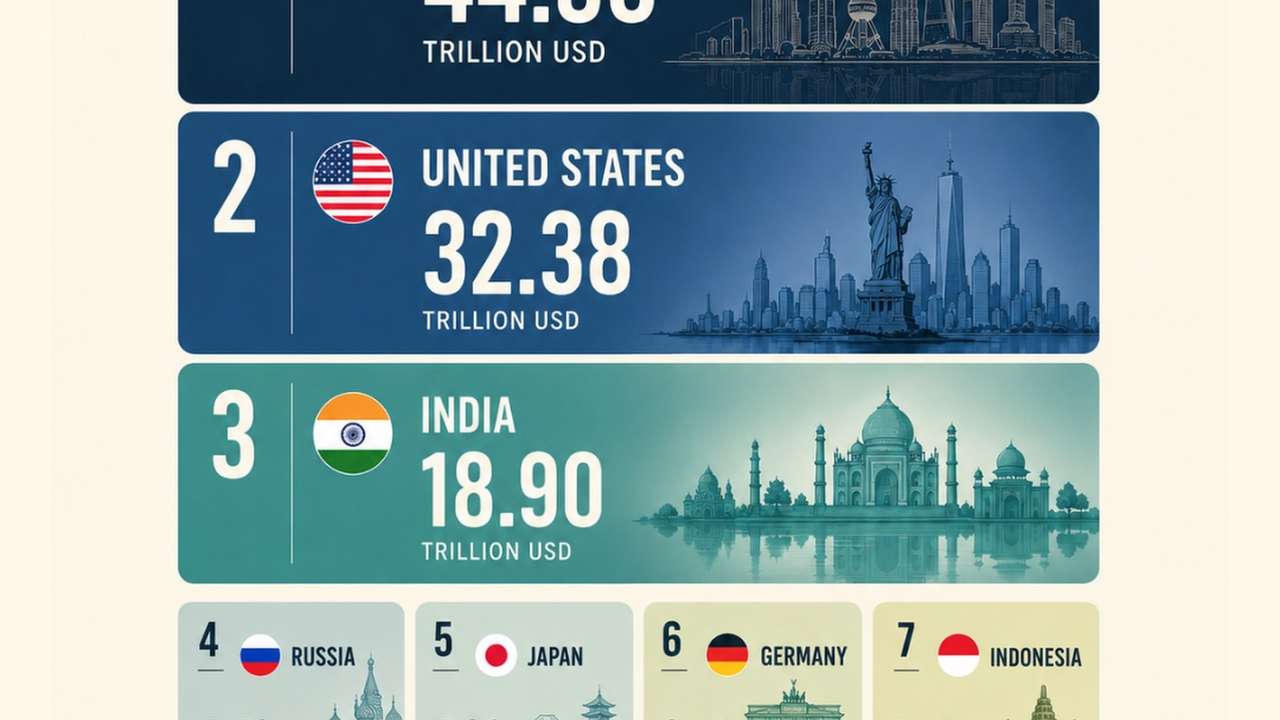
China retained its position as the world's largest economy when measured by purchasing power parity (PPP), with gross domestic product reaching US$44.30 trillion, according to the International Monetary Fund's (IMF) World Economic Outlook published in April 2026.
Main Points
- China remains the world's largest economy by purchasing power
- India ranks third in global PPP-adjusted GDP
- The United States remains second in the PPP rankings
China retained its position as the world's largest economy when measured by purchasing power parity (PPP), with gross domestic product reaching US$44.30 trillion, according to the International Monetary Fund's (IMF) World Economic Outlook published in April 2026.
Purchasing power parity adjusts for differences in price levels between countries, providing a measure of the volume of goods and services produced rather than market exchange rates. The IMF and World Bank use PPP to compare the real size of economies and living standards across countries.
The United States ranked second with a PPP-adjusted GDP of US$32.38 trillion, while India consolidated third place at US$18.90 trillion, extending its lead over other major economies as rapid economic growth and its large population continue to expand domestic output.
Russia ranked fourth with US$7.53 trillion, ahead of Japan on US$7.26 trillion and Germany at US$6.41 trillion. Indonesia placed seventh with US$5.45 trillion, reflecting the growing economic weight of Southeast Asia's largest economy.
RECOMMENDED FOR YOU
Indonesia plans free public education from kindergarten
Brazil ranked eighth with a PPP GDP of US$5.23 trillion, followed by France at US$4.73 trillion and the United Kingdom at US$4.72 trillion, completing the top 10.
The rankings differ significantly from nominal GDP comparisons, where the United States remains the world's largest economy. Under PPP, countries with lower domestic prices, particularly large emerging markets such as China and India, move higher because the same amount of money purchases more goods and services than in advanced economies.
According to the IMF, PPP exchange rates are designed to equalise the purchasing power of different currencies by accounting for variations in the cost of comparable goods and services. Economists therefore use PPP to assess the relative scale of economies, productivity and long-term development rather than international financial market strength.
China has led the world in PPP-adjusted GDP since overtaking the United States in 2014, reflecting decades of industrialisation, urbanisation and manufacturing-led growth. India has also climbed steadily, driven by strong domestic consumption, investment and an expanding services sector, making it the third-largest economy on a PPP basis despite ranking lower in nominal GDP.
This story is written and edited by the Global South World team, you can contact us here.