Colombia's new economic frontier: Why South America's bridge country deserves a second look — Opinion
Key Takeaways
- Colombia is Latin America's fourth-largest economy. After GDP growth slowed to 0.6% in 2023, most forecasts expect growth of between 2% and 3% in 2026, with stronger expansion projected in 2027. At the same time, inflation remains above target, the fiscal deficit has widened, and public debt has increased, presenting ongoing economic challenges.
- Despite those pressures, several indicators remain positive. Colombia has recorded a strong coffee harvest, resilient private consumption, growing service exports, increasing remittance inflows and international reserves covering roughly ten months of imports, providing a buffer against external shocks.
- Compared with neighbouring economies, Colombia combines several structural advantages. Brazil remains the region's largest economy, Chile offers stronger macroeconomic stability, Peru has a larger mining sector, while Argentina continues to implement economic reforms after years of instability. Colombia's combination of diversified natural resources, access to two oceans and broad export base distinguishes it within the region.
- Energy, mining, tourism, agriculture and services remain among Colombia's key growth sectors. Copper exploration has become an increasing priority as authorities seek to develop new strategic mining projects, while tourism and service exports have continued to expand in recent years.
- Colombia's investment outlook has also attracted attention following the election of President-elect Abelardo de la Espriella. His incoming administration has pledged to reduce taxes, simplify regulations, strengthen security, expand oil and gas development and encourage private investment.
A country built by geography
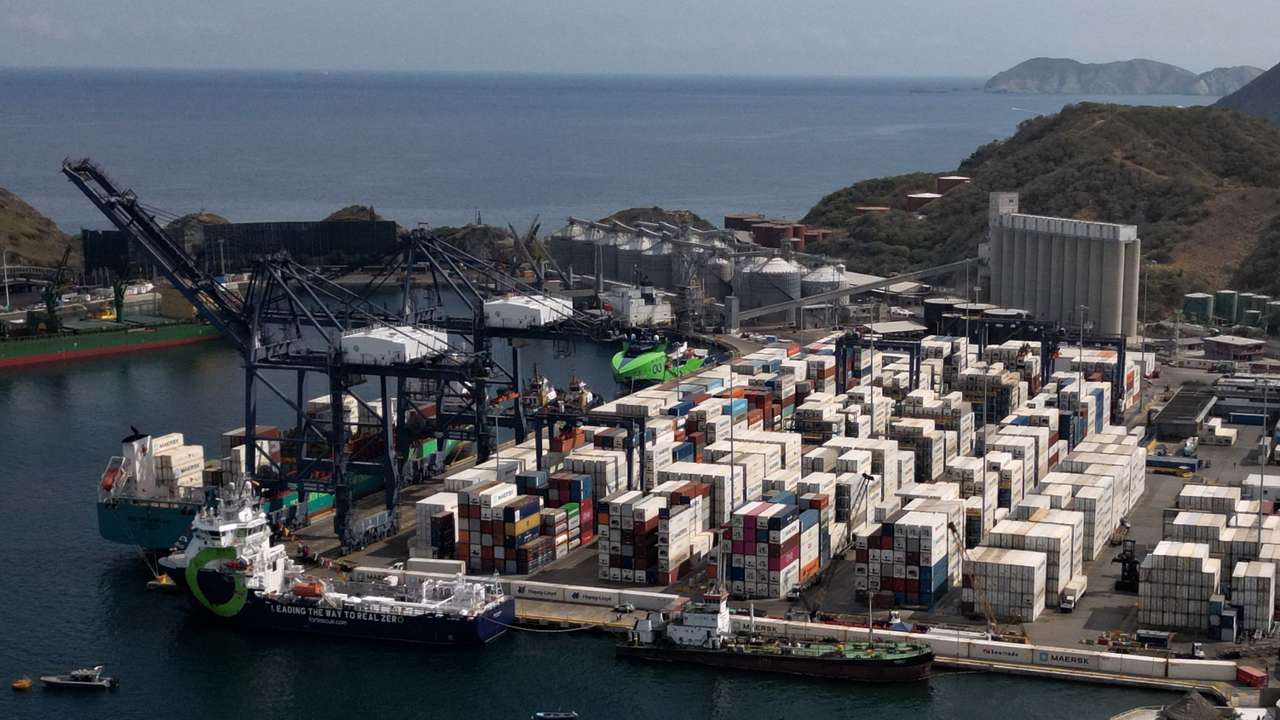
Colombia occupies a position no other South American country shares: it has coastlines on both the Pacific and the Caribbean, sitting right beneath the southern approach to the Panama Canal. That geography does a lot of the economic heavy lifting. A container leaving Buenaventura on the Pacific or Cartagena on the Caribbean gets to North America, Europe, or Asia without the extra transit time that landlocked or single-coast neighbours like Bolivia, Paraguay, or even Pacific-only Peru and Chile have to absorb.
Then there's the equatorial position, near-constant daylight and rainfall for agriculture, four mountain ranges (the three Andean cordilleras plus a few outlying massifs) creating dozens of microclimates packed close together, and a slice of the Amazon in the south. Put it together, and you get one of the most naturally diversified resource bases in the hemisphere: coffee and flowers from the temperate highlands, oil and coal from the eastern plains and Caribbean basin, gold, nickel, and emerging copper from the Andean belt, plus a services and tourism sector growing fast around Bogotá, Medellín, and the coast.
Economically, Colombia is Latin America's fourth-largest economy, and it's built one of the region's more resilient middle-income economies over the last two decades: steady rather than spectacular, which is probably why it gets overlooked next to Brazil's scale or Argentina's boom-and-bust drama.
The numbers right now
2026 has been a mixed year for Colombia, and any honest account needs to say so. Growth has recovered from a weak 2023 (0.6%) to a steadier path: most forecasters now put 2026 GDP growth somewhere between 2.2% and 2.8%, with some houses (BBVA, Allianz Trade) projecting acceleration toward 3.5% in 2027. Inflation has re-accelerated though, to around 5.5% in core terms, which pushed the central bank to raise rates back above 11%. A very public dispute between the Finance Minister and the central bank in early 2026 has also raised questions about monetary policy independence for the first time since the 1991 constitution.
RECOMMENDED FOR YOU
Six countries account for three-quarters of Europe’s unicorn startups
The fiscal picture is the bigger concern. Colombia suspended its fiscal rule in mid-2025, and the deficit has run as high as 6–7% of GDP, pushing public debt above 60%. Foreign direct investment inflows, roughly USD 6.6 billion in 2025, grew only modestly and remain below their post-pandemic peak. None of this is catastrophic by regional standards, but it's real, and it's why Colombia still trades below investment grade with some rating agencies.
Look past the headline numbers, though, and the picture brightens: a record coffee harvest, oil reserves that have outperformed expectations, remittances up over 8% to nearly USD 9 billion, double-digit growth in service exports, and a private consumption base (73% of GDP) that's proven remarkably sticky even through the inflation spike. Reserves sit near USD 66–67 billion, about ten months of import cover, which gives the country real shock-absorption capacity.
How Colombia stacks up against its neighbours
Brazil remains the region's undisputed heavyweight: roughly ten times Colombia's economy, the deepest capital markets, the most mature industrial base, including in defence (Embraer, a nuclear submarine program, satellite launches). That scale comes at a cost, though: it's harder and slower to enter as a mid-sized foreign investor, and Brazil's own fiscal and political cycles are at least as volatile as Colombia's.
Peru offers a more investor-friendly mining concession framework on paper, and it edges out Colombia in raw gold and copper output. But its parallel economy is arguably in worse shape. Peru's own data shows that of roughly 200 tonnes of gold exported in a recent year, less than half could be traced to a verifiable legal origin, and violence tied to informal mining keeps escalating, including a widely reported 2025 massacre in the Pataz region. Colombia's formalisation approach, incomplete as it is, gets cited internationally as a more structured model than Peru's indefinite "in-process" registry.
Chile is the clean, stable comparator: best sovereign credit rating in the region, most predictable rule of law, a copper-driven economy with a genuine sovereign wealth cushion. It doesn't have Colombia's resource diversity or its dual-coast trade geography, though; Chile's whole economic identity runs through one commodity and one coastline.
Argentina is the highest-variance story in the region right now. A real re-armament and reform cycle is underway (its first new fighter jets in nearly forty years arrived in December 2025), but that comes bundled with a much longer history of currency crises and policy reversals than Colombia has had over the same period.
Mexico, while technically North American, is the other natural comparator for scale and manufacturing depth. But it carries its own concentrated exposure to US trade policy that Colombia, with a more diversified export base, doesn't share to the same degree.
Line them up together and Colombia looks like the balanced generalist of the group. Not the biggest, not the cleanest, not the fastest-growing, but the only one combining a genuinely diversified resource and export base, two-ocean access, and a growth rate that, fiscal noise aside, has been positive and improving for three straight years.
RECOMMENDED FOR YOU

Burkina Faso to stop importing armoured vehicles, Traore says
Sectors worth watching
Energy and mining: Oil and coal still anchor export revenue, but copper is the emerging story. Colombia holds an estimated 9.7 million tonnes of underexplored copper resources along the Andean belt, and the national mining agency opened tenders for 14 strategic copper zones in late 2025. Less than 3% of national territory currently carries a mining title, which is either a governance problem or a long runway, depending on where you sit.
Defence and security: Colombia spends more on defence as a share of GDP than any other South American country, and its domestic threat environment (dissident guerrilla factions, organised crime, and growing concern about drone-enabled attacks) has kept demand for counter-UAS, ISR, and tactical equipment structurally high, even as broader procurement slowed under the outgoing administration. Regional analysts expect Colombia's defence market to grow faster than the rest of South America through 2031, off a smaller base than Brazil but with a clearer near-term pull.
Services, tourism, and agriculture: The most consistently positive story in the 2026 data. Service exports and tourism revenue both grew close to 10% year-on-year, and financial services are forecast to be among the fastest-growing sectors in the broader economy.
A new government changes the calculus
Mid-2026 brought the biggest shift in this whole picture. Abelardo de la Espriella won Colombia's presidential runoff on June 21 with just under 50% of the vote, ending the Petro era, and takes office on August 7. His running mate, José Manuel Restrepo, is a former commerce and finance minister, a credible, market-facing figure rather than a political outsider, which matters for how investors are likely to read the transition.
The new administration's platform is pro-business and security-led, built around a few concrete commitments:
Deregulation and tax cuts aimed at four growth engines (hydrocarbons and mining, infrastructure, agriculture, and tourism), including plans to eliminate the financial transactions tax and cut fuel taxes to free up liquidity for businesses and consumers.
A smaller state, with proposals to cut government size by roughly 40% and redirect spending from bureaucracy toward productive incentives.
A reversal on hydrocarbons policy, reactivating oil and gas development after several years of a renewables-first stance that analysts say constrained investment in the sector.
RECOMMENDED FOR YOU

Sheinbaum rings historic bell as thousands fill Zocalo for Mexican Independence Day
A security-first growth thesis. The incoming government has set an explicit target of 6–7% annual GDP growth, arguing that ending the "Total Peace" negotiations, resuming operations against illegal armed groups, and restoring territorial control will do more to unlock private investment than any single fiscal measure. Whether that growth number is realistic or not, most institutional analysts covering the transition share the underlying logic: that Colombia's discount to regional peers is as much a security-risk discount as a policy one.
Closer alignment with the United States and Israel on security cooperation, including a possible link to Washington's broader regional security initiatives, alongside a more cautious posture toward Chinese investment in critical infrastructure than the outgoing government held.
For defence and security specifically, this is a meaningful inflexion point. A government elected on a mandate to confront rather than negotiate with illegal armed groups, paired with a stated intent to deepen military cooperation with the US and Israel, points toward sustained or accelerating demand for exactly the equipment categories already in structural demand (counter-UAS, ISR, tactical gear, precision capability), with the added tailwind of a government more willing to move procurement through quickly instead of trading it off against social spending, which the outgoing administration often did.
The investor read on this transition has been notably positive. Analysts at the Atlantic Council and elsewhere have framed the election as a likely trigger for the "return of capital" to Colombia, pointing to improved visibility on security, a return toward sound fiscal policy, and renewed US relations as the key drivers, the same three variables that have weighed most heavily on Colombia's investment case since 2022. Colombia held investment-grade ratings and OECD membership as recently as the early 2020s, before the prior administration's fiscal drift; the new government's stated aim is to rebuild that standing.
Nothing here is a sure thing. De la Espriella won by a margin of roughly 250,000 votes out of nearly 26 million cast, and he'll need to build coalitions in a fragmented Congress to pass anything beyond what can be done by decree. But the direction of travel (tax relief, deregulation, hydrocarbons reactivation, and a security posture explicitly designed to de-risk the country for private capital) is the clearest positive catalyst Colombia's investment case has had in years, and it lands directly on top of the structural advantages already covered above.
The honest risk list
Any serious investment case has to sit alongside the real headwinds too: a fiscal deficit that needs credible consolidation, inflation still well above target, a May 2026 election cycle that introduced political uncertainty, persistent security risk tied to illegal armed groups and narco-mining, and structurally low R&D and productivity investment, which the OECD flags as capping Colombia's long-run growth potential at around 2.5% unless addressed.
Why Colombia still makes the case
Colombia isn't the safest bet in South America, and it isn't the biggest. What it offers instead is more specific: a resource base diversified enough to weather single-commodity shocks, a trade geography no other South American economy can replicate, a growth trajectory that's been quietly improving rather than spectacularly booming, and, particularly relevant for defence, security, and commodities operators, sectors where genuine structural demand exists independent of the political cycle.
The countries that look "safer" on paper (Chile for stability, Peru for mining regulation) each trade that safety for something narrower: a smaller economic base, or in Peru's case, a supply-chain integrity problem that may be worse than Colombia's rather than better. Brazil offers scale, but at a cost of entry most mid-sized investors can't easily absorb. Colombia sits in the gap: developed enough to have real institutions and market access, undercapitalised enough that genuine first-mover advantage still exists in mining formalisation, copper, and defence modernisation, and positioned geographically in a way that will matter more, not less, as global supply chains keep looking for alternatives to single-choke-point routes.
RECOMMENDED FOR YOU
Norway has Europe’s highest petrol prices, Russia and Belarus remain cheapest
For an investor or operator already building relationships on the ground, rather than trying to enter cold, Colombia's combination of resource depth, dual-coast access, and structurally underserved sectors makes a stronger long-term case than its 2026 headline fiscal numbers suggest on their own.
The incoming government is what turns that calculus from wait-and-see to act-now. A pro-business administration cutting taxes, shrinking the regulatory state, and reactivating hydrocarbons is the kind of policy shift that tends to show up in job creation before it shows up in GDP statistics: construction, energy services, tourism, and agriculture are all labour-intensive sectors that respond quickly to lower financing costs and faster permitting. Layer defence spending on top of that: a government committed to confronting rather than negotiating with illegal armed groups will need to buy and maintain more equipment, train more personnel, and build out more domestic industrial capacity through INDUMIL, COTECMAR, and CIAC, all of which pulls in foreign contractors, local suppliers, and skilled labour at the same time. Security spending in Colombia has historically functioned as a de facto jobs and industrial-base program almost as much as a military one.
Put the three together: tax relief and deregulation pulling in private capital, restored security pulling in the foreign investors who were pricing in conflict risk, and defence procurement pulling through its own supply chain of contractors and jobs. This is the first time in several years all three growth levers have pointed the same direction at once. That's the real argument for treating 2026 as an inflexion point rather than just another data point in Colombia's long run of steady-but-unspectacular growth.
The article solely represents the views of Dean Tavakoli, C.E.O of Munimentum Systems Consultancy.
