Dollar strength lays bare economic divides across Southeast Asia
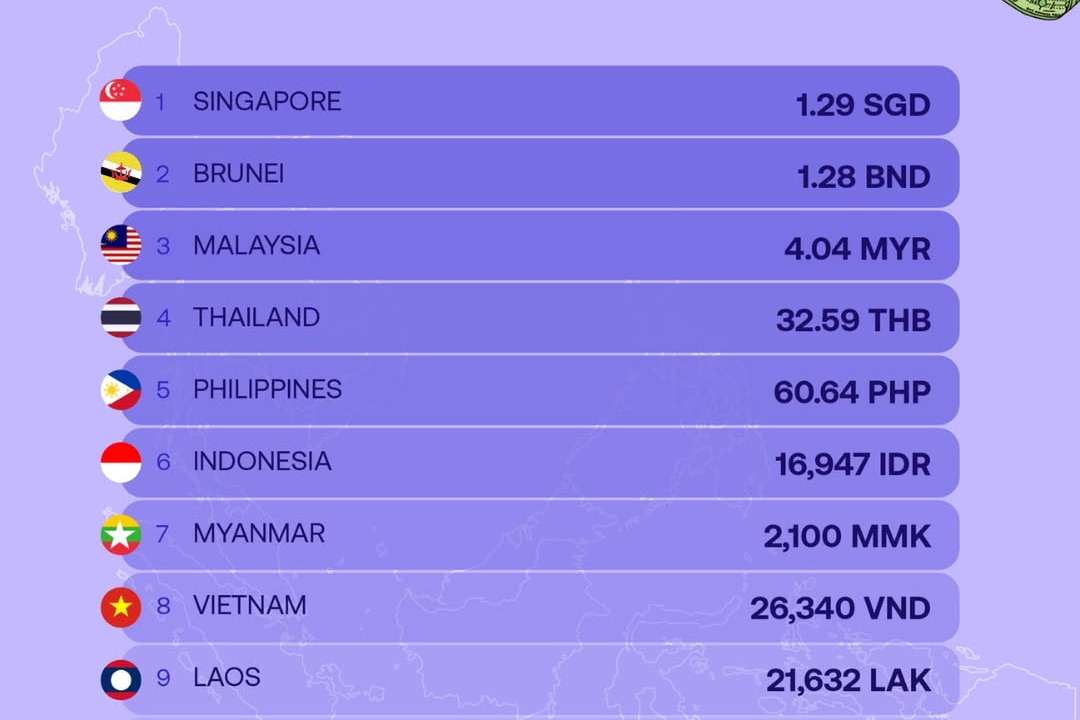
The value of the U.S. dollar across Southeast Asia is offering a clear lens into the region’s economic diversity, with exchange rates highlighting stark differences in currency strength, inflation pressures, and policy direction.
The value of the U.S. dollar across Southeast Asia is offering a clear lens into the region’s economic diversity, with exchange rates highlighting stark differences in currency strength, inflation pressures, and policy direction.
Recent figures show that $1 converts to about 1.29 Singapore dollars and 1.28 Brunei dollars, placing both nations at the stronger end of the regional spectrum. Their currencies have remained relatively firm, supported by stable macroeconomic conditions and, in Singapore’s case, a tightly managed exchange rate system.
Bloomberg has noted that sustained capital inflows and prudent monetary management continue to reinforce the city-state’s currency resilience.
Across much of the region, however, the dollar stretches further. In Malaysia, it trades at roughly 4.04 ringgit, while Thailand’s baht stands near 32.59 per dollar.
RECOMMENDED FOR YOU

More than 6 billion people are now online as global internet access reaches new high
The Philippine peso, at about 60.64 to the dollar, reflects ongoing pressures tied to inflation and external balances. According to Bloomberg analysis, currencies in these economies have remained sensitive to global financial tightening and shifts in investor sentiment.
Indonesia’s rupiah, hovering around 16,947 per dollar, illustrates this balancing act. While the country has benefited from commodity exports, Bloomberg reports that its currency remains exposed to global interest rate movements, prompting periodic intervention by the central bank to maintain stability.
The divergence becomes more pronounced in frontier markets. Vietnam’s dong trades at approximately 26,340 per dollar, while Laos and Cambodia register around 21,632 kip and 4,010 riel, respectively. Myanmar’s kyat, at roughly 2,100 per dollar, reflects deeper structural and economic challenges.
These variations go beyond exchange rates. They point to fundamental differences in purchasing power, economic structure, and policy frameworks. A stronger currency often signals stability but raises domestic costs, while weaker currencies can support exports yet reduce the ability to absorb imported inflation.
Monetary strategy plays a central role. Singapore’s reliance on exchange rate management contrasts with the interest rate-focused approaches seen in countries such as Indonesia and the Philippines. Bloomberg has highlighted how this divergence shapes currency performance, particularly during periods of global monetary tightening.
With the U.S. Federal Reserve maintaining a cautious stance on easing, the dollar has remained firm. Bloomberg suggests that this trend could persist in the near term, keeping pressure on Southeast Asian currencies and reinforcing the disparities seen across the region.
Taken together, the figures underline a simple but important reality: Southeast Asia is far from economically uniform. The reach of a single dollar continues to reflect the region’s varied economic conditions, offering insight into both opportunity and risk for policymakers, businesses, and investors alike.