East Germany still outperforms many European regions on GDP per capita
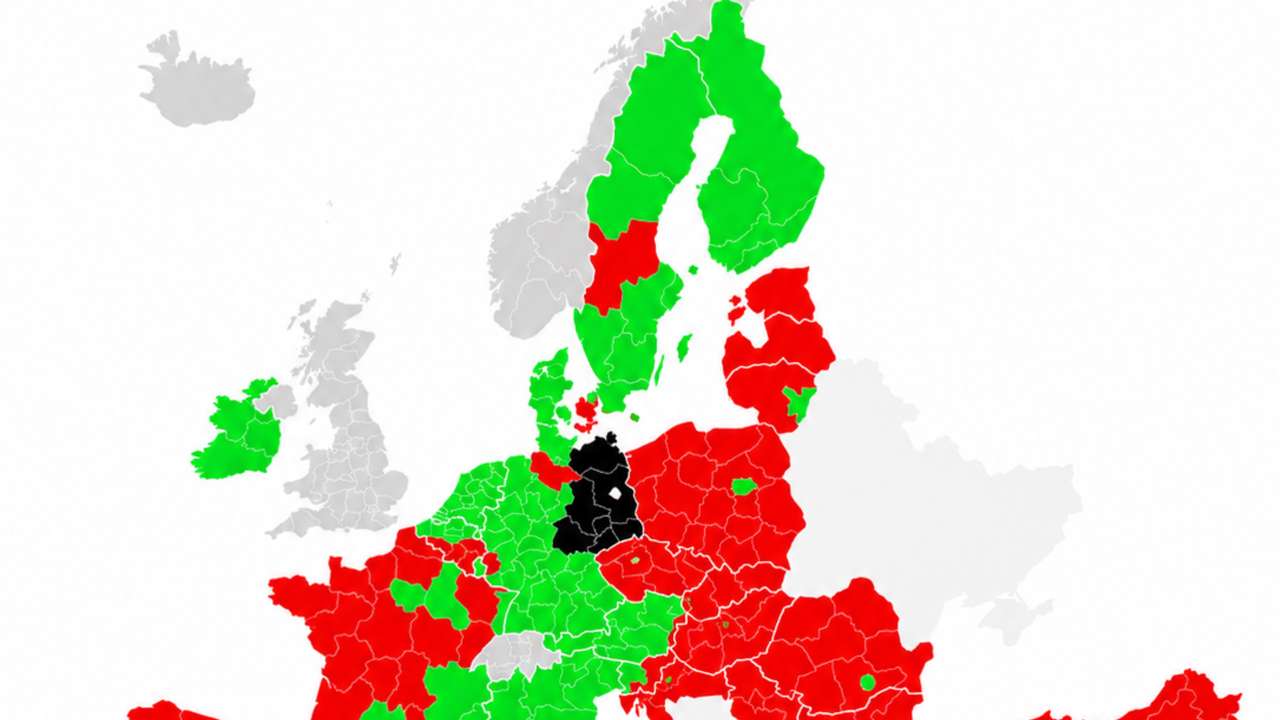
More than three decades after German reunification, the former East Germany still trails much of western Germany economically. But across Europe, the picture is more complicated: many regions in southern and eastern Europe record lower economic output per person.
Key points
- East Germany averages 33,630 PPS per person
- Many southern and eastern regions fall below it
- Berlin significantly raises East Germany’s average
More than three decades after German reunification, the former East Germany still trails much of western Germany economically. But across Europe, the picture is more complicated: many regions in southern and eastern Europe record lower economic output per person.
A map based on Eurostat's 2023 regional data compares European regions with the former East German states, excluding Berlin. It puts their average GDP per capita at about 33,630 purchasing power standards (PPS), with regions below that level shown in red and those above it in green.
Large parts of Poland, Romania, Bulgaria, Greece, Croatia, Portugal and Türkiye fall below the benchmark. Several regions of Spain, France and Italy do as well. By contrast, much of western Germany, the Netherlands, Belgium, Austria, Ireland and the Nordic countries shown on the map sit above it.
The comparison illustrates how Europe's economic divide does not run neatly along the former Iron Curtain.
RECOMMENDED FOR YOU

Argentina takes Britain to International Court, demands halt to Falklands oil project
Berlin changes the East German picture
The map excludes Berlin for an important reason. Modern Berlin contains territory from both the former East and West Germany and has a substantially higher GDP per capita than the surrounding eastern regions.
Using the data behind the map, Berlin recorded 46,800 PPS per person, compared with 36,700 in Leipzig, 35,600 in Dresden and 34,200 in Brandenburg. Mecklenburg-Vorpommern stood at 33,200, Saxony-Anhalt at 32,600, Thuringia at 32,500 and Chemnitz at 31,800.
Including Berlin lifts the calculated East German average from 33,630 to 36,664 PPS per person. However, these averages are calculations used for the map rather than an official Eurostat statistical region called “East Germany”.
The divide within Germany nevertheless remains visible in official figures. European Commission data for 2023 put Berlin's GDP per capita at 123% of the EU average, while Mecklenburg-Vorpommern was at 87%, Saxony-Anhalt at 86%, Thuringia at 85% and Chemnitz at 83%.
Europe has large regional gaps
The comparison also highlights why national averages can hide substantial differences within individual countries.
Eurostat reported that regional GDP per capita across the EU in 2023 ranged from 27.6% of the EU average in Mayotte, France, to 244.7% in Ireland's Eastern and Midland region. Only 92 of 244 EU regions with available data were at or above the EU average.
Some capital regions stand far above the rest of their countries. Prague, for example, recorded 73,500 PPS per person, while Budapest stood at 64,100 and the Warsaw capital region at 59,300, all comfortably above the East German benchmark used by the map.
This story is written and edited by the Global South World team, you can contact us here.