Ethiopia is one of Africa’s oldest states. But what kind of state is it becoming?
This is the country where one of humanity’s earliest known ancestors was discovered. It gave the world coffee. It has its own alphabet, its own calendar, and one of the longest continuous histories of statehood anywhere on Earth. Its victory over a European colonial power at Adwa inspired anti-colonial movements across Africa and beyond.
With more than 120 million people and dozens of languages, cultures and traditions, Ethiopia is often described as one of Africa’s great civilisations. Yet today, it is more often associated internationally with war, instability and contested elections than with its long history of statehood.
This week, Ethiopians went to the polls in a general election. But for Redie Bereketeab, the election raises a deeper question — not simply who wins power, but whether Ethiopia has built a state that all its peoples can recognise as their own.
A missing social contract
Bereketeab argues that many external actors, including the European Union, the United States, the United Nations and the African Union, are missing the central issue. Ethiopia’s crisis, he says, cannot be understood only through elections or individual conflicts. It is about state-building and nation-building.
Ethiopia has more than 80 ethnic groups. For Bereketeab, a durable state can only emerge if those groups are included in a domestic negotiation over how they want to live together. That process, he argues, is what creates a social contract. Without it, elections may produce governments, but not necessarily legitimacy.
RECOMMENDED FOR YOU

‘It is Bolsonaro!’ - Supporters rally against Lula ahead of Brazil runoff
That problem was visible in this vote. While long queues were reported in some areas, many Ethiopians could not participate because of conflict. Voting was suspended in parts of Oromia and Amhara, while the entire northern region of Tigray was excluded.
This matters because Ethiopia’s federal system is built around ethnicity and territory. If major regions are unable to take part properly, Bereketeab argues, the federal government cannot credibly claim to represent them.
A long historical struggle
The current crisis is often discussed through recent events: the war in Tigray, violence in Amhara, insurgency in Oromia, tensions with Eritrea, and the latest election. But Bereketeab sees these as part of a longer struggle over Ethiopian statehood.
He argues that Ethiopia has repeatedly tried and failed to build an inclusive national order. The imperial model before 1974 failed. The military socialist model that followed also failed. The ethno-federal system introduced after 1991, he says, has also failed to resolve the deeper question of shared belonging.
The result is a state that has often represented some groups while marginalising others. Those excluded from power, he argues, then turn to armed struggle or other extra-legal means to defend their interests.
Beyond the vote
Supporters of holding elections may argue that constitutional processes must continue, even in difficult conditions. But the harder question remains: how can democracy function when major regions are excluded from the political process?
For Bereketeab, the danger is that the vote may deepen rather than resolve Ethiopia’s crisis. If large sections of society feel unrepresented, conflict is likely to continue.
Ethiopia’s challenge, then, is not only electoral. It is existential. How does one of the world’s oldest and most diverse nations build a shared future?
RECOMMENDED FOR YOU
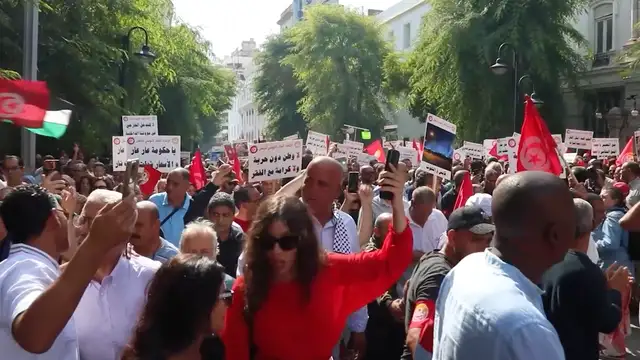
Thousands protest economic hardship and restrictions on freedoms in Tunisia
This election may decide who governs. But it is unlikely to settle the deeper question of whether Ethiopia’s state can hold all its peoples together.
World Reframed Episode 42. More episodes of World Reframed.
World Reframed is produced in London by Global South World, part of the Impactum Group. Its editors are Duncan Hooper and Ismail Akwei.
ISSN 2978-4891
This story is written and edited by the Global South World team, you can contact us here.
