EU smokers paying up to 91% tax on cigarettes
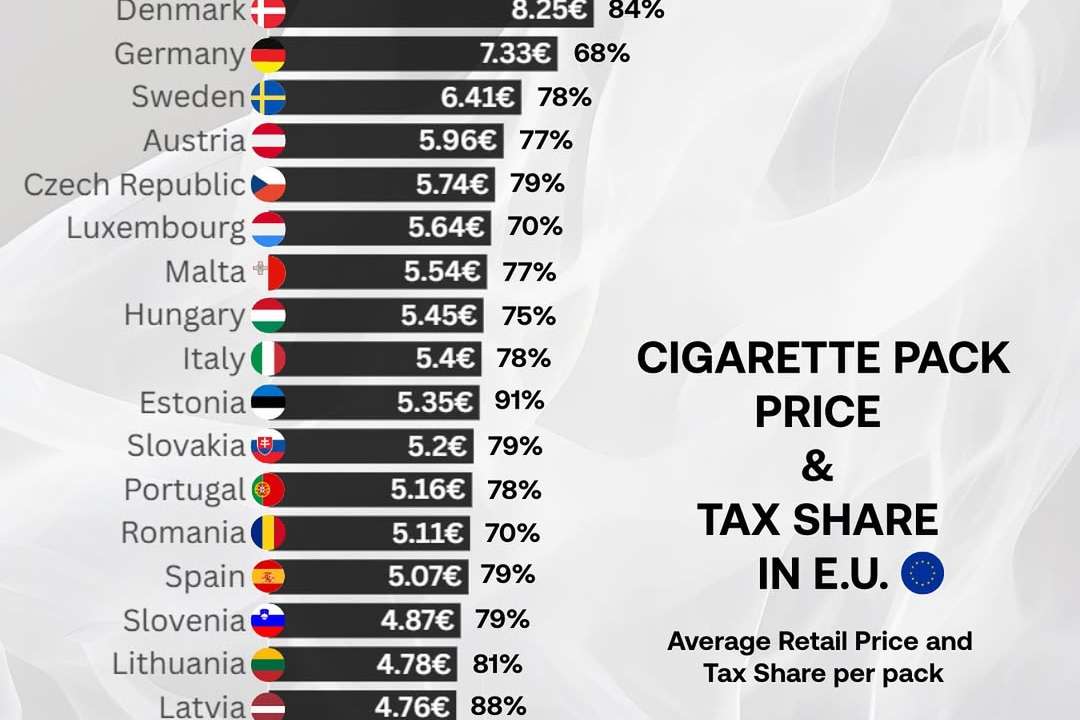
In the European Commission’s latest figures and independent compilations, smokers across the European Union are forking out more in taxes than for the tobacco product itself.
One visual breakdown shows that in countries like Ireland, France and the Netherlands, the tax portion of a 20-cigarette pack reaches as high as 90 % of its retail price.
Why this matters
According to the Commission’s guidance, EU Member States must apply a minimum excise duty on cigarettes equivalent to €90 per 1,000 cigarettes and at least 60 % of the weighted average retail selling price of cigarettes in that country.
In practice, most countries go beyond this baseline. A recent overview by the Tax Foundation notes that the tax share of the retail price in many states exceeds 80 %.
RECOMMENDED FOR YOU

GTA V dominates global search interest as Grand Theft Auto VI nears release
For example, according to data compiled via the “Taxes as a Share of Cigarette Price” dataset, many EU countries show tax shares of over 80 %.
Key take-aways
- In Ireland, smokers pay around 85% of the pack price in taxes (about €16 per pack in the visual).
- In the Netherlands and Finland, tax shares of 91% are shown.
- In Germany, it's lower — about 68% of the pack price is tax-related.
- Across the EU, the taxable burden shows wide variation from country to country.
- These high tax levels reflect both health-policy intent (to reduce smoking) and revenue-raising for governments.
The EU is considering a revision of the Tobacco Tax Directive to raise the minimum excise duty (to €215 per 1,000 cigarettes) and increase the share of tax for new nicotine products like heated tobacco and e-liquids.
There are concerns that overly high taxes may drive illicit cigarette markets, something noted in several EU states.
From a public-health standpoint, higher taxes are one of the tools used to curb smoking, especially in younger or lower-income populations where price sensitivity is stronger.
This story is written and edited by the Global South World team, you can contact us here.