Five countries that are situated on two continents
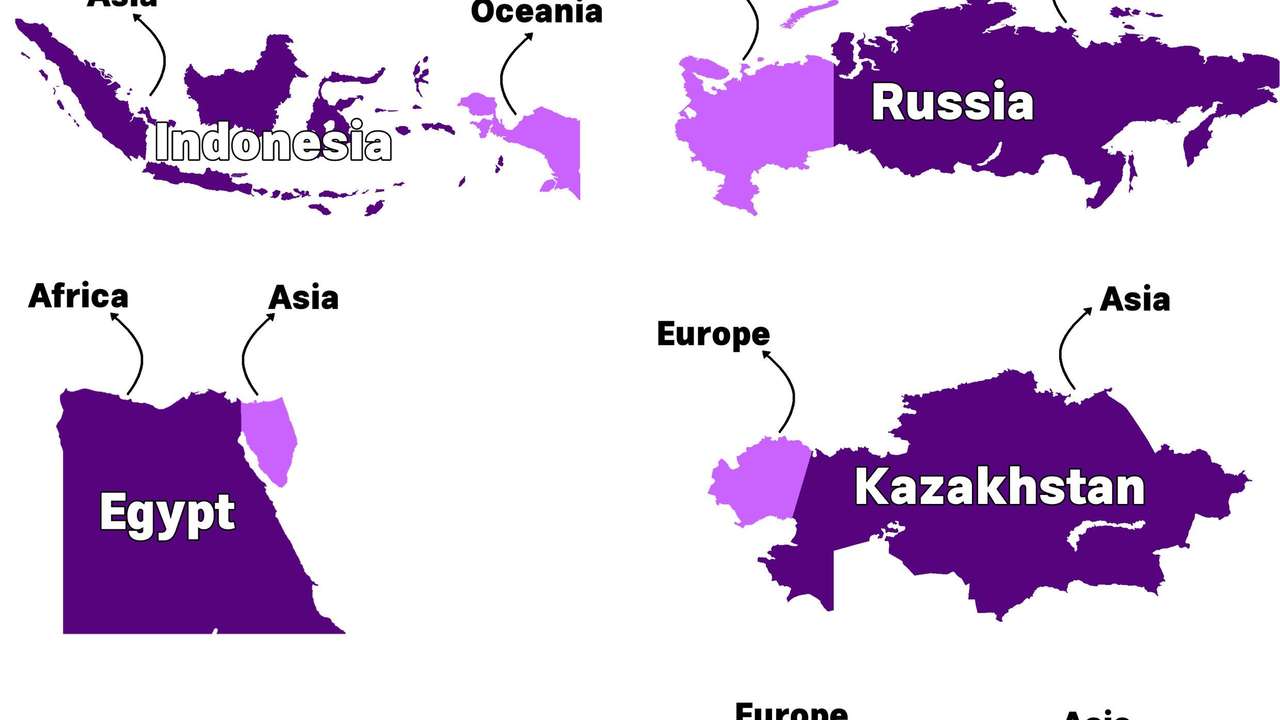
A handful of countries are uniquely positioned at the crossroads of continents. Five such nations, Indonesia, Russia, Egypt, Kazakhstan, Panama, and Türkiye, each straddle two continental regions.
A handful of countries are uniquely positioned at the crossroads of continents. Five such nations, Indonesia, Russia, Egypt, Kazakhstan, Panama, and Türkiye, each straddle two continental regions.
Indonesia, the world’s largest archipelago, stretches between Asia and Oceania, with the easternmost islands of Papua forming its easternmost reach. According to the CIA World Factbook, Indonesia encompasses over 17,000 islands, making its transcontinental footprint both vast and culturally diverse.
Russia remains the most iconic transcontinental nation, divided between Europe and Asia by the Ural Mountains. Roughly 77% of Russia’s landmass lies in Asia, but 75% of its population resides in the European portion, a contrast that has historically shaped its foreign policy and identity. Russia uses its European–Asian reach to justify political involvement across two major regions, shaping both European security and Asian energy strategies.
Egypt, long celebrated as the cradle of ancient civilisation, bridges Africa and Asia through the Sinai Peninsula. This region, in global headlines due to Red Sea tensions and shifting trade routes, underscores Egypt’s strategic role. Egypt’s Suez Canal handles about 12% of global trade. Current Houthi attacks in the Red Sea show how dependent the world still is on Egypt’s geography.
RECOMMENDED FOR YOU
SCO countries are making green development an engine of growth — Opinion
Kazakhstan, the world’s largest landlocked country, spans both Europe and Asia with a small but symbolically important portion west of the Ural River. Since the launch of China’s Belt and Road Initiative, Kazakhstan has become a pivotal transit hub for Eurasian trade. Kazakhstan also profits from rail and pipeline routes linking Europe and Asia.
Panama, linking North and South America, owes its global prominence to the Panama Canal, which now faces pressure from drought-induced restrictions on international shipping. Its transcontinental nature enhances its geopolitical value as both a physical and economic connector.
And Turkey, positioned between Europe and Asia, remains a central player in current diplomatic efforts involving Ukraine, NATO expansion, and Middle Eastern stability. The Bosporus Strait, one of the most critical shipping lanes, literally divides the country into two continents.