Global protests surge as more than 1,000 events are reported in one week
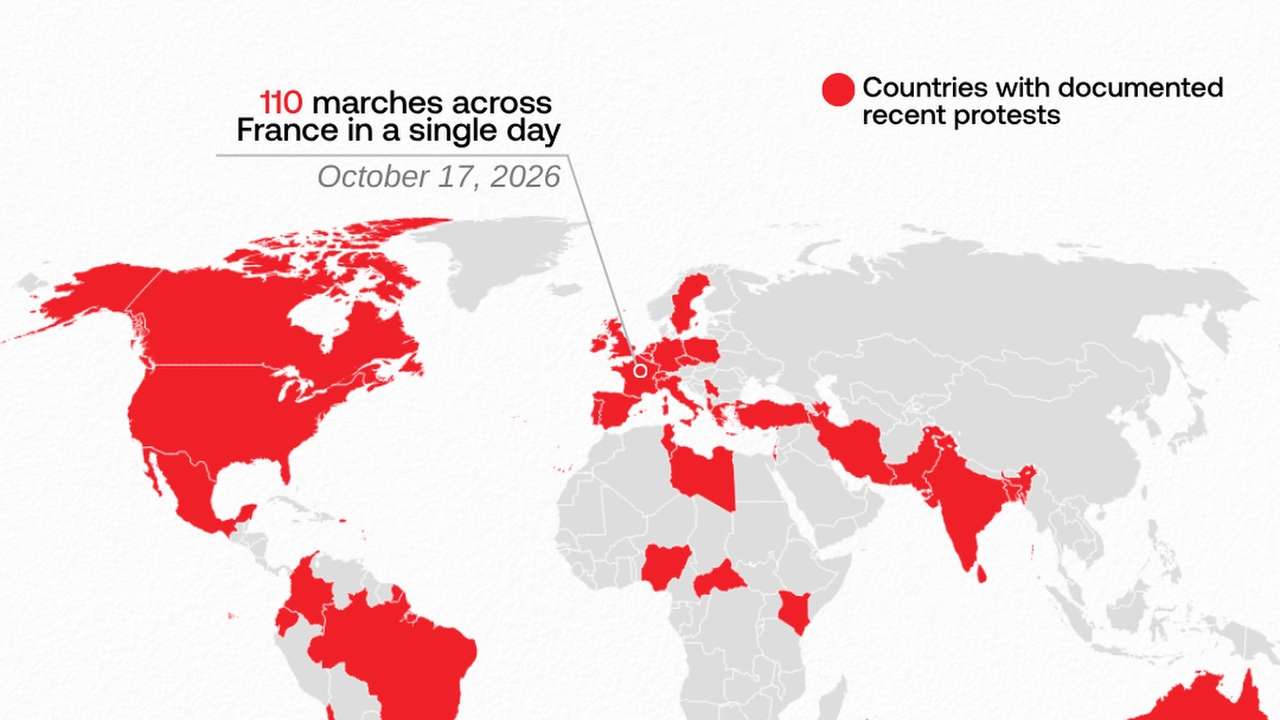
More than 1,000 demonstrations, strikes, riots and other mass gatherings were reported worldwide in the seven days to October 19, 2026, highlighting widespread public frustration over living costs, government policies and political conditions.
Main points
- More than 1,000 protest-related events were reported worldwide.
- France recorded 110 marches on October 17.
- Rising living costs and political tensions are driving unrest.
More than 1,000 demonstrations, strikes, riots and other mass gatherings were reported worldwide in the seven days to October 19, 2026, highlighting widespread public frustration over living costs, government policies and political conditions.
Data from Delta Watchfloor recorded 1,072 protest-related events during the period, with activity reported across Europe, the Americas, Africa, Asia and Australia.
France experienced one of the week's largest protest mobilisations, with 110 marches drawing about 550,000 people, according to Interior Minister Laurent Nuñez.
Organisers, including trade unions and student groups, estimated participation at 800,000.
RECOMMENDED FOR YOU
Six countries account for three-quarters of Europe’s unicorn startups
The demonstrations began amid anger over rising living costs, low wages and deteriorating public services, particularly education.
Although most participants marched peacefully, violence broke out in several cities, including Paris, Marseille and Lyon. Police used tear gas and water cannons during clashes, while shops and public buildings were damaged.
About 400 people were arrested nationwide, according to the Associated Press.
Protests extend across several continents
The unrest was not limited to France.
Reuters reported demonstrations in Belgium, Portugal and Italy on October 17, alongside further protests in Albania over corruption, employment and education.
Elsewhere, protest-monitoring platforms have tracked movements linked to economic hardship, government accountability and political disputes in countries including India, Argentina, Pakistan and Kenya.
The demonstrations reflect different national grievances rather than a single coordinated global movement.
Economic pressures and political demands fuel unrest
Rising prices, concerns about public services and dissatisfaction with political leaders have contributed to protests in several countries.
RECOMMENDED FOR YOU

Mauritania Roundup: Green hydrogen deal advances, schools prepare for new term and 100,000 livestock targeted
The Carnegie Endowment for International Peace's Global Protest Tracker has documented significant anti-government movements worldwide since 2017, showing how economic and political grievances can develop into sustained demonstrations.
However, the 1,072 events recorded by Delta Watchfloor should not be interpreted as 1,072 separate large-scale protest movements. Its figures include different types of reported gatherings and depend on available news coverage.
The latest data provides a snapshot of protest activity during one week, rather than proof that demonstrations have reached a record global level.