Governing parties lose 19 of 25 presidential elections in Latin America since 2020
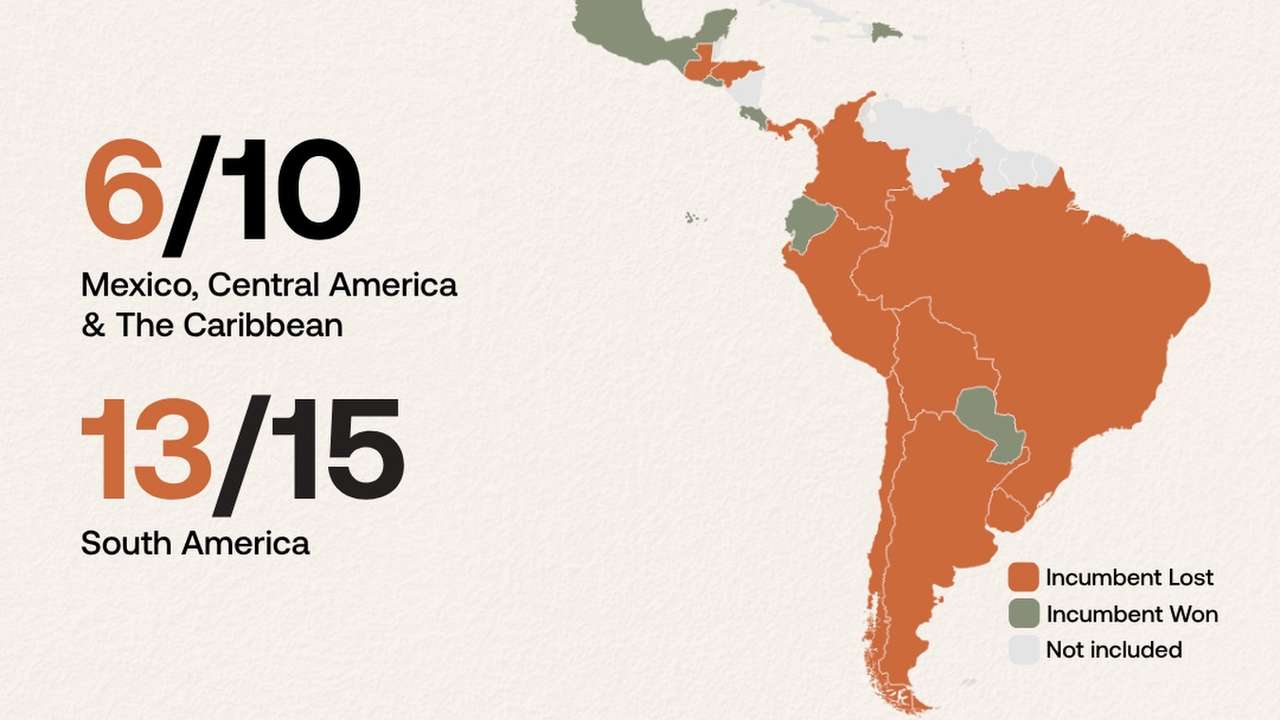
Governing parties have lost more than three-quarters of the presidential elections examined across Latin America since 2020, highlighting a wave of voter dissatisfaction that has affected governments across the political landscape.
Main points
- Governing parties lost 19 of 25 elections
- South America recorded 13 defeats in 15 contests
- Mexico and Paraguay were among the exceptions
Governing parties have lost more than three-quarters of the presidential elections examined across Latin America since 2020, highlighting a wave of voter dissatisfaction that has affected governments across the political landscape.
An analysis attributed to El Atlas and economist Daniel Schteingart, using results from national electoral authorities, found that parties in power lost 19 of 25 presidential elections, or 76%, between 2020 and 2026.
The pattern was particularly strong in South America, where governing parties lost 13 of 15 elections. In Mexico, Central America and the Caribbean, they lost six of 10.
South America records the most defeats
The trend has affected governments from both the left and right. In Brazil's 2022 election, Luiz Inácio Lula da Silva defeated incumbent President Jair Bolsonaro. Argentina's governing coalition lost to Javier Milei in 2023, while Uruguay's centre-right coalition was defeated by Yamandú Orsi in 2024.
RECOMMENDED FOR YOU

Gambia Roundup: Court orders exhumation, Darboe pledges justice reforms and rural women demand electricity
More recent government changes in Chile, Bolivia and Colombia have added to the pattern.
But not every governing party has lost. Paraguay's ruling Colorado Party retained the presidency in 2023, while Ecuadorian President Daniel Noboa won re-election in 2025.
Mexico and El Salvador break the trend
Mexico's governing Morena party retained the presidency in 2024 when Claudia Sheinbaum succeeded Andrés Manuel López Obrador. El Salvador's Nayib Bukele and Dominican Republic President Luis Abinader also secured victories that year.
The distinction matters because a governing party losing power is not the same as an incumbent president losing re-election. In many of the contests examined, the sitting president was not a candidate.
Schteingart noted that three of the four sitting presidents who sought re-election during the period covered by his analysis won. Jair Bolsonaro was the exception in 2022.
Brazil faces another test
The regional pattern has gained attention following Brazil's October 4 first-round election, in which Flávio Bolsonaro received 47.03% of valid votes against Lula's 45.16%.
The two candidates will meet in a runoff on October 25 after neither secured an outright majority. The first-round result does not count as a defeat for the governing party because the election has not yet been decided.
The figures also need to be read in context. The 19 defeats in 25 elections refer to the particular contests selected by Schteingart, rather than every election held across the region. A separate Bloomberg Línea review of 30 presidential elections found that governing parties lost 22, supporting the broader pattern while using a different sample.
RECOMMENDED FOR YOU

Ecuador Roundup: Six inmates escape prison, power shortages threaten industry and floods hit three provinces
Economic pressures, security concerns and dissatisfaction with political leaders may help explain individual results, but the election figures alone do not establish why voters rejected governing parties.
What they show is that holding the presidency has offered little guarantee of keeping it in Latin America's recent elections, regardless of which political party or ideology was in power.
This story is written and edited by the Global South World team, you can contact us here.