How Singapore plans to spend $1 billion on AI research by 2030

Singapore is investing $1 billion over five years, from 2025 to 2030, to strengthen its public research capabilities in artificial intelligence, as it seeks to cement its position as a global AI research hub.
The funding was announced by Minister for Digital Development and Information Josephine Teo during Singapore AI Research Week and will be drawn from the government’s Research, Innovation and Enterprise (RIE) 2025 and 2030 plans.
This is the second major round of public AI funding, following more than $500 million invested between 2019 and 2023. The RIE framework, overseen by the National Research Foundation, guides Singapore’s long-term strategy for research and innovation.
Where the money will go
The new investment will focus on three main areas: fundamental AI research, applied AI, and talent development.
RECOMMENDED FOR YOU
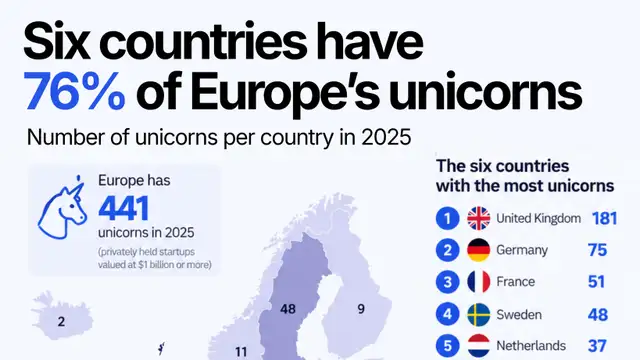
Six countries account for three-quarters of Europe’s unicorn startups
Fundamental AI research will concentrate on developing core AI models and technologies that can be adapted for multiple uses. To support this, Singapore will establish research centres of excellence within public research institutions. These centres will focus on long-term, complex challenges and work closely with local and international partners, with research findings shared openly.
Unlike existing AI centres set up with private companies, these new centres will be fewer in number but backed by larger investments.
Priority research areas
The centres will focus on four priority areas. One is resource-efficient AI, which aims to reduce the heavy energy and water demands of AI systems, a key concern for Singapore, given its dense concentration of data centres.
Another focus is responsible AI, which seeks to prevent misuse, such as the creation of harmful content. Researchers will also explore emerging AI methods, including systems that can handle multiple types of data or operate autonomously.
The final area is general-purpose AI, which can perform a wide range of tasks across different fields, such as analysing scientific research and supporting drug development.
This story is written and edited by the Global South World team, you can contact us here.