Iceland has more renewable freshwater per person than any other country
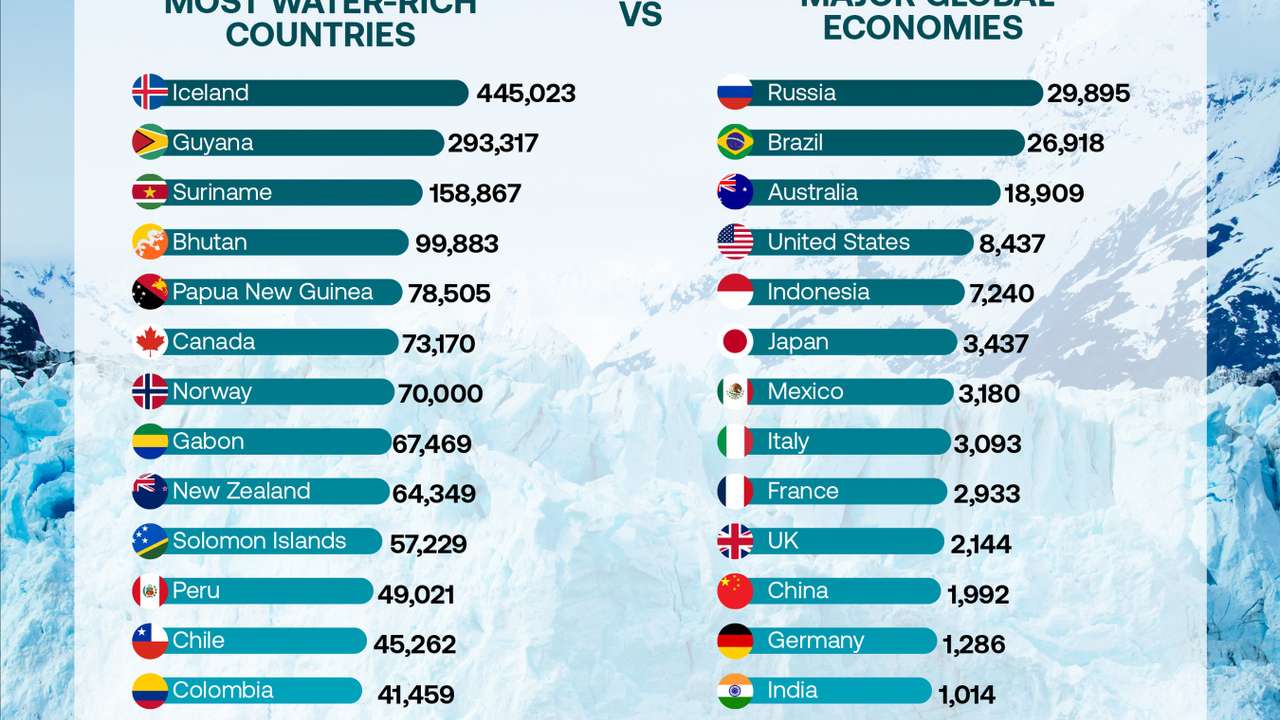
Iceland has more renewable freshwater available per person than any other country in the latest comparable World Bank dataset, highlighting a huge gap in natural water resources between countries.
Main Points
- Iceland has about 445,000 cubic metres of renewable freshwater per person
- India has just over 1,000 cubic metres per person
- Large water resources do not mean all the water is usable
Iceland has more renewable freshwater available per person than any other country in the latest comparable World Bank dataset, highlighting a huge gap in natural water resources between countries.
Data from the World Bank, sourced from the UN Food and Agriculture Organisation's AQUASTAT database, puts Iceland at 445,023 cubic metres of renewable internal freshwater resources per person in 2022. Guyana follows with 293,317 cubic metres, while Suriname has about 158,867 cubic metres.
Bhutan is next with about 99,883 cubic metres per person, followed by Papua New Guinea at 78,505, Canada at 73,170, Norway at 70,000 and Gabon at 67,469. New Zealand, the Solomon Islands, Peru, Chile and Colombia also have particularly high levels.
The numbers measure renewable internal freshwater resources, meaning water generated within a country's borders from rainfall that feeds rivers, lakes and groundwater. FAO defines the measure as the long-term average annual flow of rivers and recharge of aquifers generated from precipitation within the country.
RECOMMENDED FOR YOU
From Suomi to Zhongguo, why some countries have completely different names at home
Among the large economies highlighted in the graphic, Russia has 29,895 cubic metres per person, followed by Brazil at 26,918 and Australia at 18,909.
The United States has about 8,437 cubic metres per person, while Indonesia has 7,240. The figure falls to 3,437 in Japan, 3,180 in Mexico, 3,093 in Italy and 2,933 in France.
At the lower end, the UK has about 2,144 cubic metres per person, China 1,992 and Germany 1,286. India has just 1,014 cubic metres per person, according to the World Bank data shown for 2022.
That means Iceland has roughly 439 times more renewable internal freshwater per person than India, based on these figures.
Canada stands out because it combines a large economy and population with exceptionally high freshwater resources, recording more than 73,000 cubic metres per person.
The figures need an important qualification. A high number does not mean every cubic metre is available for households, farms or industry.
FAO says renewable water-resource figures describe natural water flows, not the amount that can actually be captured and used. Geography, infrastructure, seasonal changes, environmental requirements and economic constraints can all limit access.
The indicator also changes as populations grow. FAO reported in December 2025 that renewable water availability per person globally had fallen by another 7% over the previous decade, increasing pressure on freshwater supplies in already water-scarce regions.
RECOMMENDED FOR YOU
Asia produces the largest share of global GDP
This story is written and edited by the Global South World team, you can contact us here.