Israel election 2026: Netanyahu's bloc leads but falls short of parliamentary majority
Israel faces difficult coalition negotiations after its parliamentary election produced no clear winner, with Prime Minister Benjamin Netanyahu's allies leading the vote but lacking enough seats to govern alone.
Main points
- Netanyahu's bloc leads but remains short of the 61 seats needed to govern.
- Opposition parties hold 48 seats, while Arab-led parties could influence coalition talks.
- Official results are expected on November 4, followed by negotiations to form a government.
Israel faces difficult coalition negotiations after its parliamentary election produced no clear winner, with Prime Minister Benjamin Netanyahu's allies leading the vote but lacking enough seats to govern alone.
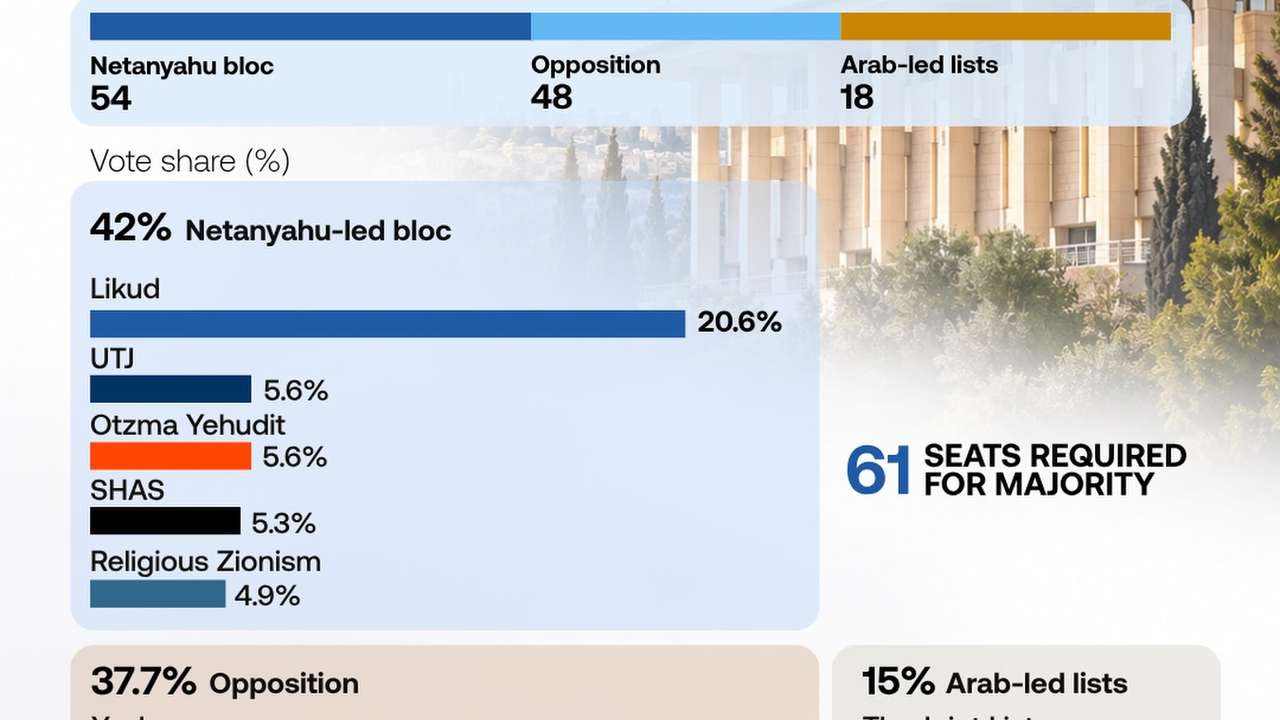
An October 29 election graphic showed Netanyahu's bloc projected to win 54 seats in the 120-member Knesset, compared with 48 for the main opposition and 18 for Arab-led parties.
However, later figures reported from Israel's Central Elections Committee put Netanyahu's bloc at 53 seats, the opposition at 48 and Arab-led parties at 19. A governing majority requires at least 61 seats.
Netanyahu's Likud remained the largest individual party, with 27 seats, while former military chief Gadi Eisenkot's Yashar party emerged as the leading opposition party with 21 seats.
RECOMMENDED FOR YOU
US tops Pakistan’s salt export markets by value
The results leave both camps dependent on negotiations with other parties, including Arab-led factions that could play an important role in determining the next government.
The election was Israel's first since the Hamas-led attacks of October 7, 2023, and the subsequent wars. Voter turnout reached 77.7%, its highest level since 1999, according to the election committee.
The Arab-led Joint List and Ra'am won 19 seats combined in the later count, potentially giving them significant influence in coalition talks. However, political differences between the main blocs could make forming a government difficult.
Reuters reported that President Isaac Herzog will consult parliamentary parties after the official results are published on November 4 before selecting a candidate to form a government. If negotiations fail, Israel could face another election.
The outcome leaves Netanyahu's political future uncertain despite Likud's lead, with no party or alliance yet securing a clear path to power.
This story is written and edited by the Global South World team, you can contact us here.