Most of South America’s capitals were founded in the 1500s although they look modern
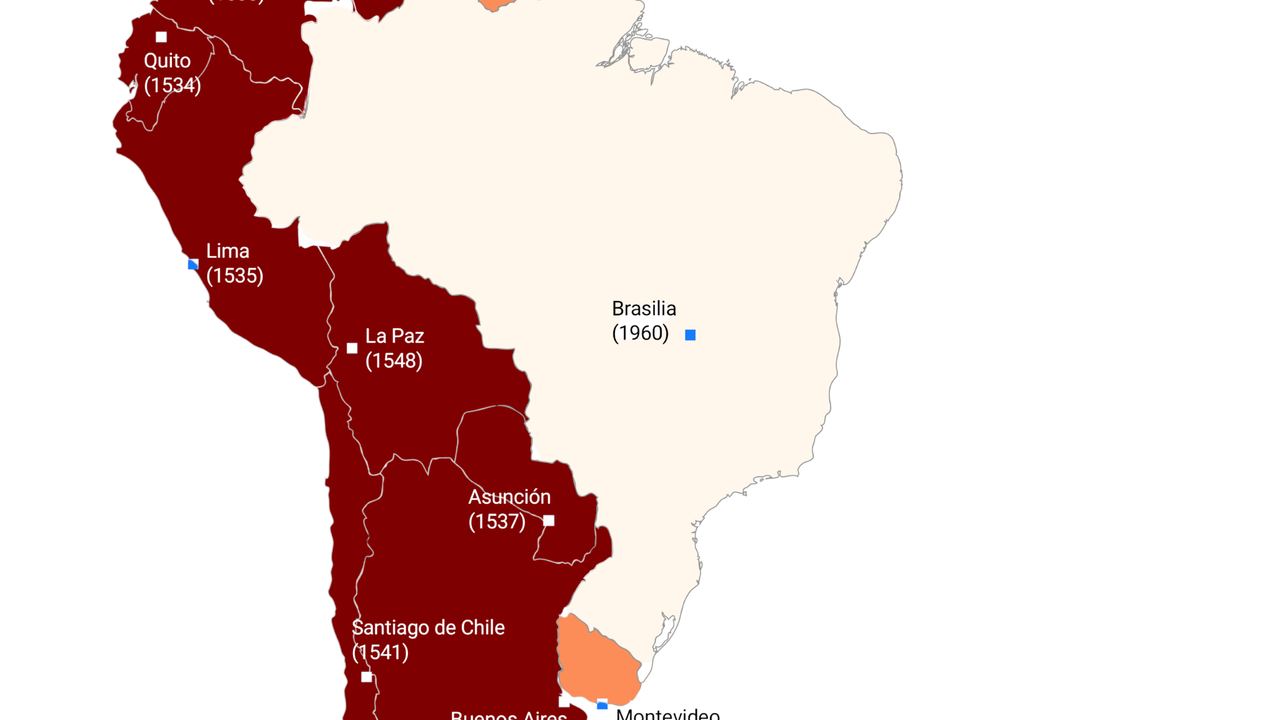
Historical records show that most of South America’s major capitals were founded in the 16th century, during the height of European colonial expansion.
Historical records show that most of South America’s major capitals were founded in the 16th century, during the height of European colonial expansion.
Cities such as Quito (1534), Lima (1535), Bogotá (1538), and Santiago (1541) all rose in the early wave of Spanish settlement, and today they continue to function as powerful administrative, cultural, and economic centres. Their endurance is a reminder that the region’s present is still deeply entwined with its colonial past.
This pattern stands in contrast to regions like North America, Africa, and parts of Asia, where many current capitals were either moved or built in the 19th and 20th centuries. South America’s most dramatic outlier is Brasília, inaugurated in 1960.
Built from scratch in Brazil’s interior, the city was designed to shift national power away from longstanding colonial coastal hubs. UNESCO describes Brasília as one of the most ambitious modernist urban projects ever attempted, a futuristic symbol of Brazil’s national aspirations and a landmark of urban planning.
RECOMMENDED FOR YOU

GTA V dominates global search interest as Grand Theft Auto VI nears release
One capital with a particularly complex history is Buenos Aires, which Britannica notes was founded in 1536, then abandoned due to resistance and lack of supplies, and later refounded in 1580, one of the few major capitals to undergo institutional rebirth in the colonial period.
Not all capitals emerged in the 1500s. Montevideo, founded between 1724 and 1730, grew out of territorial tensions between Spain and Portugal along the Río de la Plata. In northern South America, Georgetown (1771) and Paramaribo (1603) reflect British and Dutch colonial influence, adding linguistic and architectural diversity to the region.
These differing histories continue to shape regional politics today. Georgetown, for example, has been thrust into international headlines as the centre of the escalating Guyana–Venezuela border dispute, rooted partly in colonial-era territorial demarcations.
Understanding when South America’s capitals were founded helps explain modern challenges tied to infrastructure, identity, and governance. Many cities established in the 1500s were built for populations a fraction of today’s size, yet now must support millions.
The World Bank reports that South America is among the most urbanised regions in the world, with more than 80% of its population living in cities, placing immense pressure on streets, housing, and public services originally shaped centuries ago.
This story is written and edited by the Global South World team, you can contact us here.