Papua New Guinea leads world in language diversity with 843 living languages
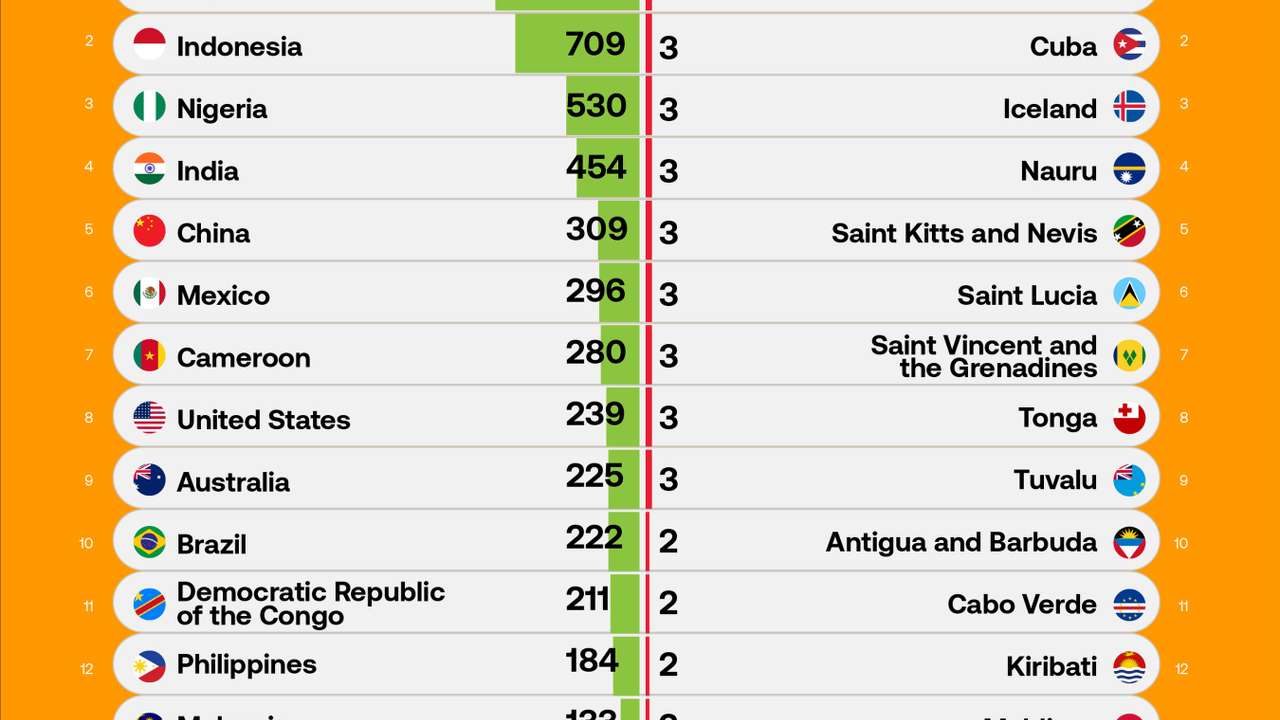
Papua New Guinea has more living languages than any other country, with 843 spoken across its population, according to 2025 figures from Ethnologue published by Our World in Data.
Main points
- Papua New Guinea has the most living languages at 843.
- Indonesia and Nigeria follow with 709 and 530.
- Several small island nations have fewer than five recorded languages.
Papua New Guinea has more living languages than any other country, with 843 spoken across its population, according to 2025 figures from Ethnologue published by Our World in Data.
The Pacific nation leads a global ranking that shows how unevenly languages are distributed, with some countries home to hundreds of languages while others have only a handful.
Indonesia ranks second with 709 living languages, followed by Nigeria with 530, India with 454 and China with 309.
Papua New Guinea's 843 languages account for nearly 12% of the world's approximately 7,159 living languages, despite the country having a relatively small population.
RECOMMENDED FOR YOU
Six countries account for three-quarters of Europe’s unicorn startups
Its extraordinary diversity is partly linked to its mountainous landscape, which historically separated communities and allowed different languages to develop over thousands of years.
Mexico ranks sixth with 296 languages, followed by Cameroon with 280, the United States with 239, Australia with 225 and Brazil with 222.
The Democratic Republic of the Congo also stands out with 211 languages, while the Philippines has 184 and Malaysia 133.
Small island nations record the fewest languages
At the other end of the ranking, Barbados, Cuba, Iceland, Nauru and several Caribbean and Pacific island nations have just two or three recorded living languages each.
Antigua and Barbuda, Cabo Verde, Kiribati, the Maldives, the Marshall Islands and North Korea are among the countries listed with two.
These differences reflect geography, migration and history. Large countries with many long-established communities often have more languages, while smaller nations may have fewer.
However, a country's number of languages does not necessarily show how widely they are spoken or how different its residents' mother tongues are.
What counts as a living language?
Ethnologue defines a living language as one that still has at least one person who speaks it as their first language.
RECOMMENDED FOR YOU

Burkina Faso to stop importing armoured vehicles, Traore says
The figures include indigenous languages and established non-indigenous languages passed on to new generations.
Some of these languages are widely used, while others are endangered and spoken by only a small number of people.
The rankings highlight both the world's linguistic richness and the risk of losing languages as younger generations increasingly adopt more widely spoken ones.
This story is written and edited by the Global South World team, you can contact us here.