Salif Keïta: The Malian football legend who made history with his unassuming skills
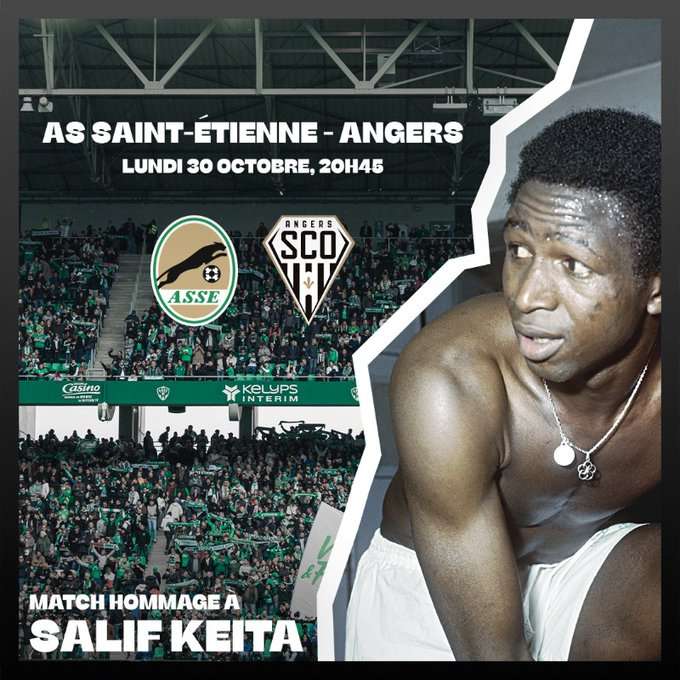
Few names resonate as powerfully as Salif “Domingo” Keïta in the realm of African football. Keïta’s legacy goes beyond the pitch, extending into realms that would profoundly influence the course of African and global football.
From humble beginnings
Salif Këita began his journey into football on the dusty streets of Bamako, Mali, where he grew up in a family of eight. His father, a haulage contractor, initially harboured dreams of an academic future for his son, but Salif's heart was set on a different path at a young age, football was the dream. Born in 1946, Salif started football as a neighbourhood hobby, little did he know this would be the start of great things.
At the tender age of 14, he joined the Pionniers club, a product of a "progressive" scouting system inspired by the socialist ideals championed by President Modibo Keïta. Këita's outstanding dribbling, shooting, and heading skills shot him into the ranks of Real Bamako, where he contested and, at times, lost in two African Champions League finals, one with Real and the other with Stade Malien, to whom he was loaned. He also took his first strides representing Mali on the international stage.
The France journey
RECOMMENDED FOR YOU

Six countries account for three-quarters of Europe’s unicorn startups
Këita’s aspirations transcended national acclaim when he crossed paths with the directors of the French club AS Saint-Étienne, through connections. His journey to France was extraordinary.
In September 1967, he embarked on a journey from Mali to Liberia and then to Orly, France. The directors of the "Greens" weren't present to welcome him at the airport but not giving up, Këita hailed a taxi and went to the Geoffroy-Guichard stadium.
Këita's arrival in France was not the first instance of an African player joining a French club but it marked a pivotal moment when the door to sub-Saharan African footballers, previously opened in the 1950s, had been partially closed. African federations aimed to retain their talents, and French teams were limited to fielding just two foreign players. However, with the blessing of the Malian football federation and a transfer certificate in hand, Këita pushed forward, even though French clubs tended to favour South American or Yugoslavian players.
In 1969, Këita secured a four-year professional contract. Guided by coach Albert Batteux and aided by Rachid Mekhloufi, an Algerian player, Këita became a football sensation. Playing as a centre forward, he scored an impressive 120 goals in 149 matches, notably netting the winner against Bayern Munich in the Champions Cup Round of 16 in October 1969.
With AS Saint-Étienne, he clinched three French league titles and a French Cup. In 1970, his exceptional performances earned him the prestigious African Ballon d'Or award. However, his quest for new horizons led to a tumultuous legal dispute with Roger Rocher, the president of AS Saint-Étienne.
A relentless path
Suspended for six months and embroiled in a contractual battle, Këita found himself signing with Olympique de Marseille in November 1972. The club's directors aimed to naturalize him to field him alongside European stars, but Këita resisted, staunchly defending his dignity as an African man. The local press, in turn, subjected him to racist critiques with unwavering resolve.
Venturing to Spain
RECOMMENDED FOR YOU

Gold rush spreads ebola - Doctor warns about movement of Ituri miners in eastern DRC
Këita's journey took him to Valencia from 1973 to 1975, under the guidance of Alfredo Di Stefano. Spain was not yet known for its beautiful game, but Këita's prowess shone until a March 1975 injury temporarily halted his meteoric rise. Valencia sought to transfer him to accommodate new players, but Këita, true to his principles, demanded his owed wages and tax payments from the club.
Victory in Portugal
Këita's journey culminated in Portugal, where, alongside stars of African origin, he contributed to the country's rise in world football. Sporting Lisbon became his playground, where he won a Portuguese Cup. In his final season, 1979-1980, he ventured into the United States.
A rich legacy
Salif Këita retired as African football began to make its presence known on the global stage. His life served as the inspiration for director Cheik Doukouré's 1994 film, "The Golden Ball," where he took on the role of a coach.
Beyond his illustrious career on the pitch, Salif Këita left an indelible mark in the sports world, breaking barriers and challenging conventions. His influence extended far beyond the field, illuminating the path for African footballers around the world.
He died at the age of 76 in September 2023. In the heart of Mali, Salif Këita's story continues to inspire generations, a tale of determination, resilience, and a fierce commitment to one's principles. It is a legacy that shall forever remain etched in the annals of football history.