Only six countries account for 40% of Earth's land area
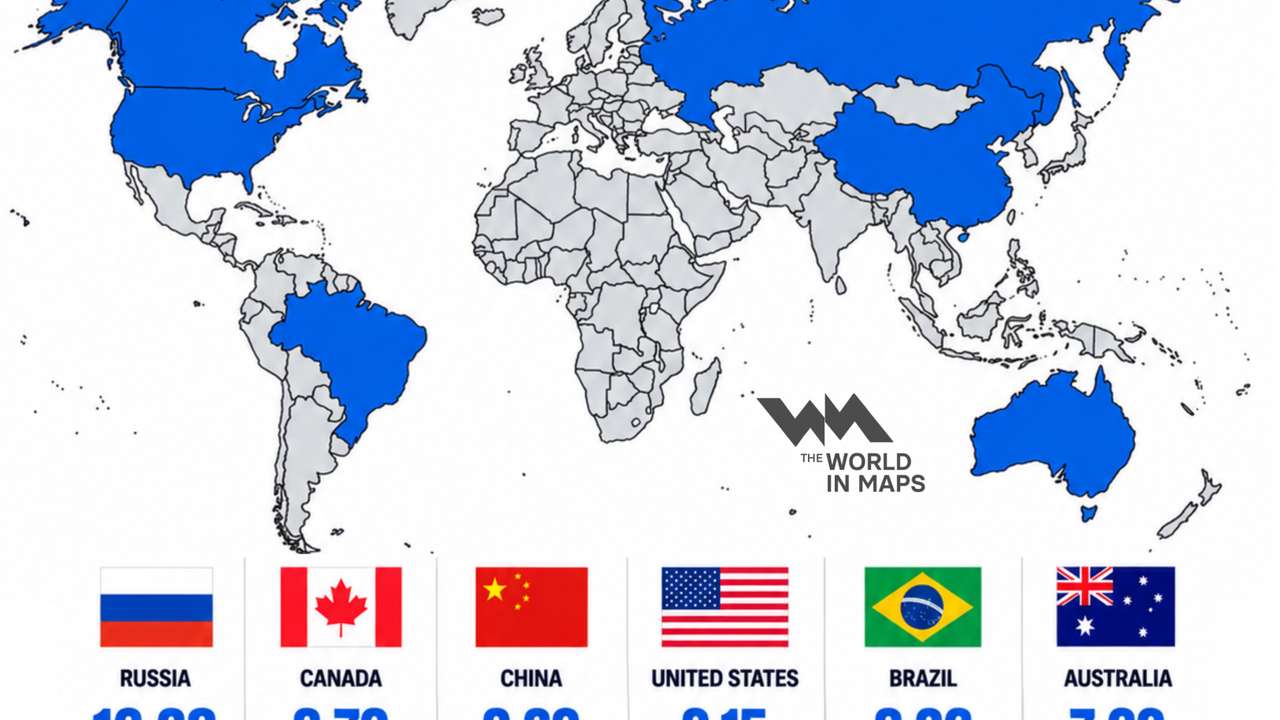
Key points
- Six countries cover about 40% of Earth's land.
- Russia leads with 16.38 million square kilometres.
- China ranks second, followed by the US and Canada.
Just six countries — Russia, China, the United States, Canada, Brazil and Australia — cover about 40% of the world's land area, highlighting how much of the planet is concentrated within a handful of national borders.
According to figures presented by The World in Maps, the six countries occupy a combined 59.75 million square kilometres, compared with an estimated 148.94 million square kilometres of land worldwide.
Russia leads with approximately 16.38 million square kilometres of land, making it the world's largest country by a considerable margin.
China follows with 9.39 million square kilometres, ahead of the United States at 9.15 million and Canada at 8.79 million. Brazil covers approximately 8.36 million square kilometres, while Australia accounts for 7.69 million.
RECOMMENDED FOR YOU
'We are not going anywhere' – Lisbon housing protesters defy police clearances with new encampment
Together, these countries stretch across five continents and include some of the world's largest forests, deserts, agricultural regions and mineral reserves.
The figures measure land area rather than total territory, meaning inland waters are excluded. This distinction helps explain why Canada, often ranked as the world's second-largest country by total area, falls behind China and the United States when only land is counted.
The six countries also account for a substantial share of the world's population, with China and the United States among the most populous.
The World Bank's 2024 land-area figures confirm the six-country ranking, showing that geographical size remains heavily concentrated even though the world's population is spread across many more countries.