Strait of Hormuz bottleneck raises alarms over global oil supply security
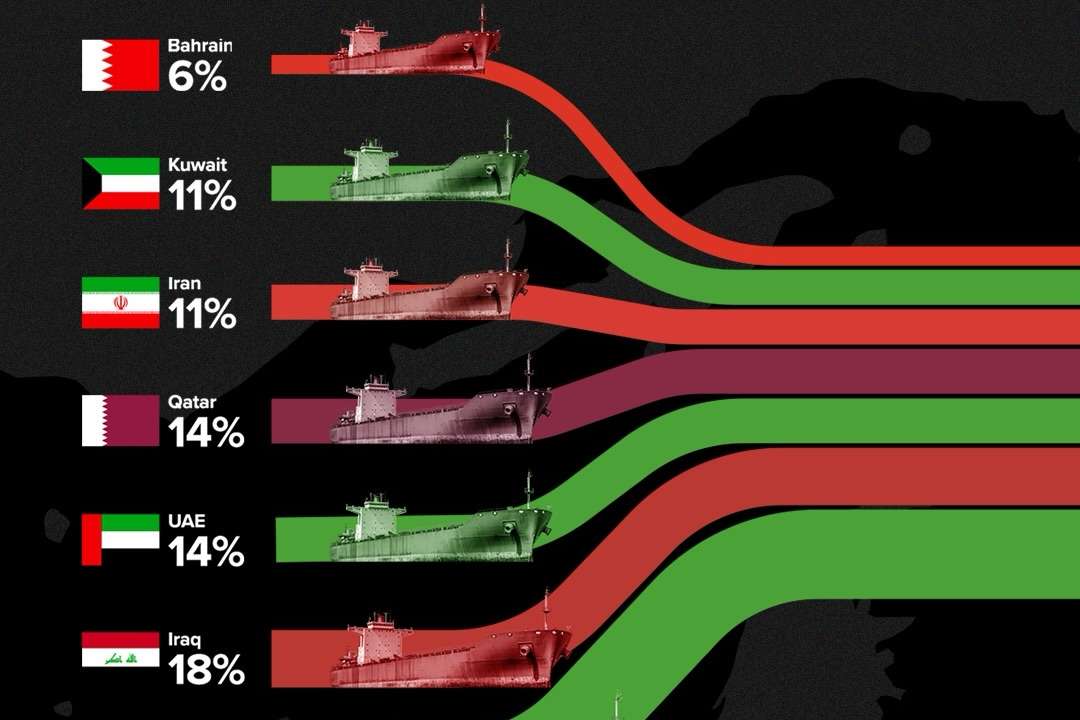
The Strait of Hormuz, one of the world’s most strategically vital oil shipping lanes, continues to dominate global energy security concerns, with the bulk of crude oil and liquefied natural gas flowing from a small group of Gulf producers, according to recent visual data and reporting by The New York Times.
The Strait of Hormuz, one of the world’s most strategically vital oil shipping lanes, continues to dominate global energy security concerns, with the bulk of crude oil and liquefied natural gas flowing from a small group of Gulf producers, according to recent visual data and reporting by The New York Times.
Roughly a fifth of the world’s oil consumption passes through the narrow waterway between Iran and Oman, making it a critical artery for global markets and a persistent geopolitical flashpoint.
Recent breakdowns of oil and gas shipments through the strait show Saudi Arabia accounting for the largest share at approximately 28%, followed by Iraq at 18%. The United Arab Emirates and Qatar each contribute about 14%, while Iran and Kuwait supply around 11% each. Bahrain accounts for a smaller share at roughly 6%.
The distribution reflects the concentration of hydrocarbon production in the Gulf region, where some of the world’s largest proven oil reserves are located.
RECOMMENDED FOR YOU
US state sponsors of terrorism list falls to three after Syria is removed
According to The New York Times, disruptions in the Strait of Hormuz have long been viewed as a worst-case scenario for energy markets, with even minor incidents capable of triggering price spikes and supply fears.
At its narrowest point, the strait is just 21 miles (34 km) wide, with shipping lanes only a few miles across in each direction. This physical constraint leaves little margin for error in the event of military escalation, accidents or blockades.
The waterway serves as the primary export route for oil producers in the Persian Gulf, particularly for countries whose infrastructure is heavily oriented towards maritime transport.
The New York Times has reported that tensions involving Iran, including threats to restrict passage, have repeatedly raised alarms among Western governments and energy traders.
Efforts to diversify export routes, including pipelines that bypass the strait, have expanded in recent years. However, The New York Times notes that these alternatives still account for only a fraction of total export capacity, leaving the majority of flows dependent on the chokepoint.
This story is written and edited by the Global South World team, you can contact us here.