Sudan tops global ranking of Islamic finance assets as industry expands across the Middle East and Africa
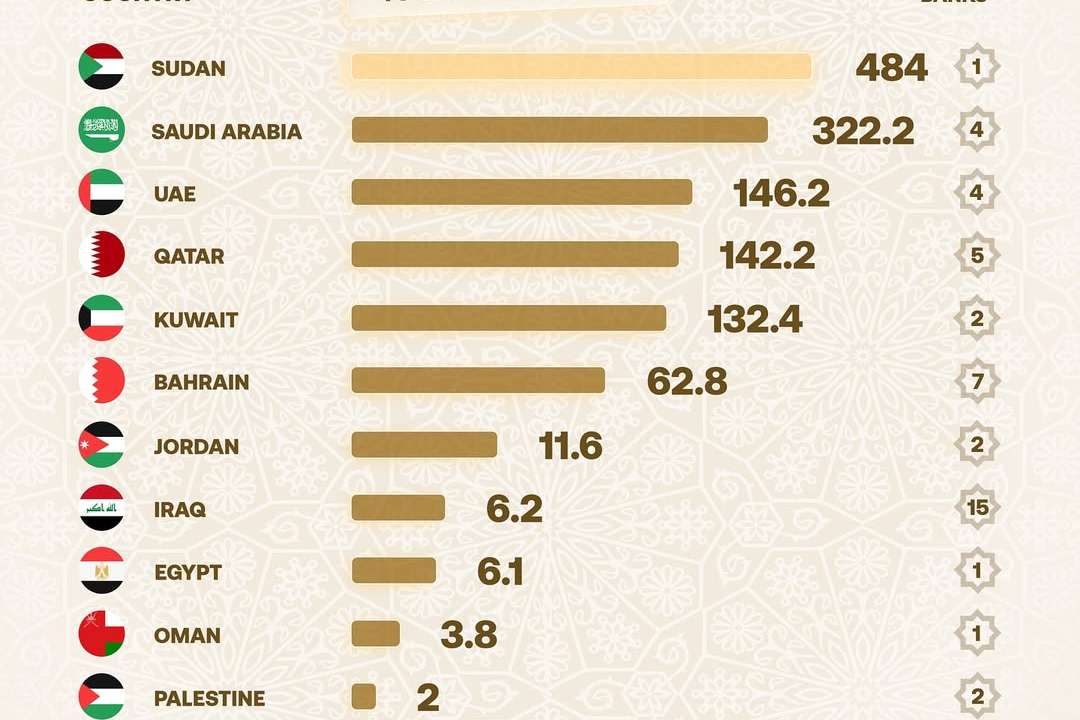
According to Global Finance Magazine, Sudan holds the largest volume of assets in Islamic banks worldwide, an estimated $484 billion, placing it ahead of Saudi Arabia, the UAE, Qatar and Kuwait.
Islamic finance is growing faster than ever, and new figures show a surprising leader at the top. According to Global Finance Magazine, Sudan holds the largest volume of assets in Islamic banks worldwide, an estimated $484 billion, placing it ahead of Saudi Arabia, the UAE, Qatar and Kuwait.
The latest numbers highlight a major shift in the global financial landscape. Countries across the Middle East and Africa continue to expand Islamic banking, which follows Sharia principles such as profit-and-loss sharing and the prohibition of interest-based lending.
Sudan ranks first with just one major Islamic bank, while Saudi Arabia follows with $322.2 billion, supported by four players in the sector. The UAE and Qatar hold $146.2 billion and $142.2 billion, respectively, reflecting the region’s status as a global hub for finance, trade and investment.
Global Finance Magazine reports that Islamic banking assets worldwide now exceed $3 trillion, with continued growth amid rising demand for ethical and asset-backed financial products.
RECOMMENDED FOR YOU

More than 6 billion people are now online as global internet access reaches new high
As Gulf economies push ahead with diversification away from oil, Islamic finance plays a bigger role in funding infrastructure, supporting SMEs and attracting foreign investment. Saudi Vision 2030, the UAE’s financial-services reforms, and Qatar’s expanding wealth-management sector all rely partly on Islamic banking to build more resilient economic systems.
Sudan’s position at the top of the ranking reflects decades of legislation that made Islamic banking the country’s default model. Countries like Egypt, Nigeria and South Africa have recently issued sukuk (Islamic bonds) to finance public projects, while the African Development Bank has boosted Sharia-compliant financing across the continent.
In places such as Jordan, Palestine and Tunisia, also listed in the ranking, Islamic banks often appeal to customers who prefer financial products tied to real assets and lower levels of speculation. In regions facing conflict or economic uncertainty, these models provide a sense of stability and community trust.
This story is written and edited by the Global South World team, you can contact us here.